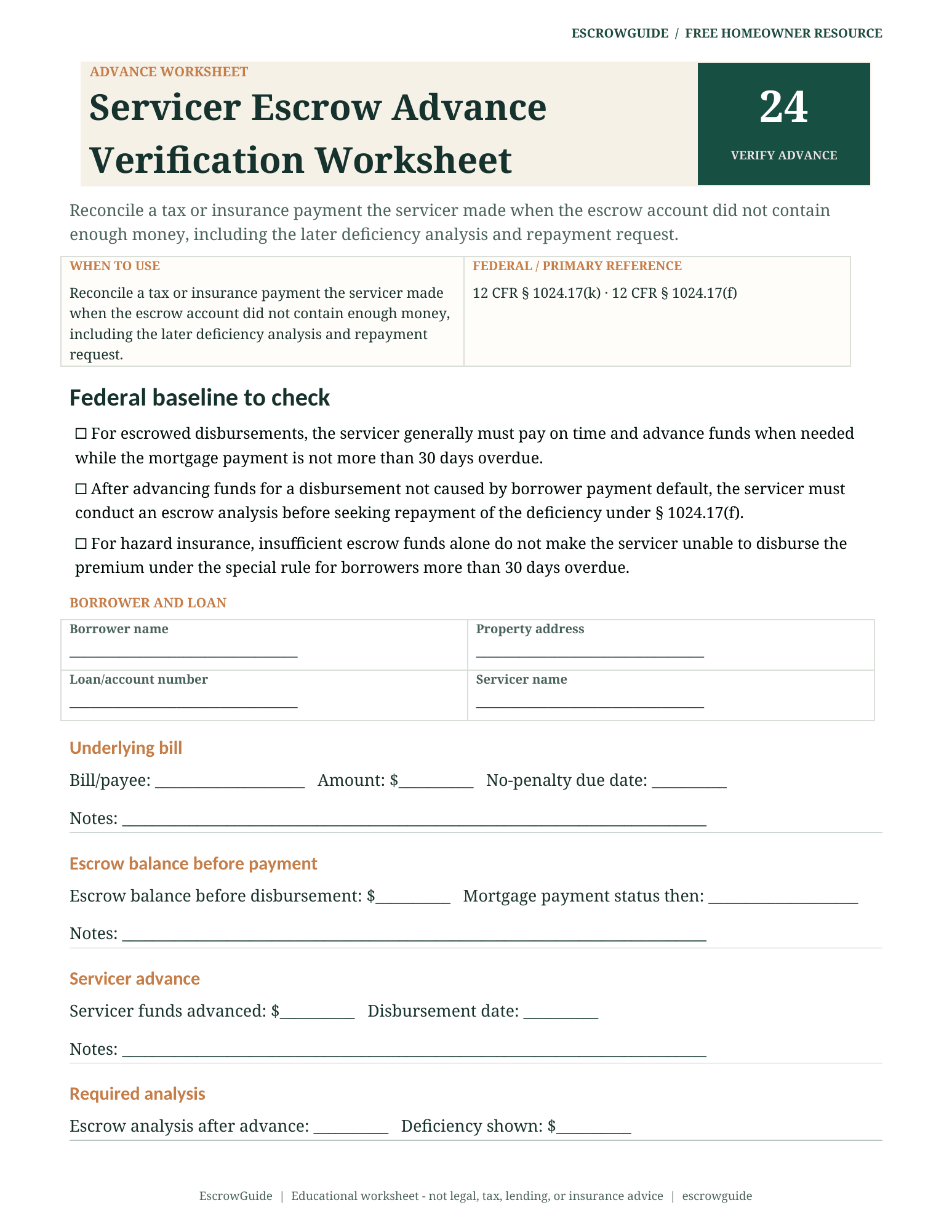
Freddie Mac Guide § 8201.1 says a servicer may restart previously waived escrow by written notice, and the waiver must reserve that right after nonpayment. When no escrow is being collected and the servicer discovers a covered charge was not paid, the guide requires contact with the borrower and a 30-day opportunity to provide proof of payment before the servicer advances the charge if proof is not provided. Future escrow collection may then begin when permitted by law and the guide.
The Freddie workflow makes documentary proof central. A servicer database saying “unpaid” should be tested against the taxing authority or insurer and the borrower’s receipt. The 30-day period is an opportunity to resolve that factual question before the servicer advances the charge.
Verify Freddie Mac ownership
The written waiver matters because Freddie requires the waiver to preserve the servicer’s right to resume escrow after nonpayment. A borrower should read the actual waiver rather than relying on a memory that the account was “permanently non-escrowed.”
Long-tail question: Freddie Mac escrow waiver restarted after unpaid taxes or insurance. Restarting escrow and advancing an unpaid charge are related but separate accounting events. The advance addresses the past-due property charge; the future escrow deposit prepares for upcoming charges. A payment bridge should show both.
The rule that controls read the written escrow-waiver terms
Freddie Mac’s rule is investor-specific. Section 8201.1 requires servicers that permit escrow waivers to maintain written policies and requires the waiver to grant the right to resume escrow after nonpayment. The same section describes the proof-of-payment workflow for a mortgage without escrow. Regulation X remains relevant to the administration and limits of an escrow account after it is established.
Freddie’s section also contains special rules for delinquent mortgages and manufactured homes. Do not import those special provisions into a current, site-built home loan unless the facts actually match.
Worked example: Confirm which tax insurance or other charge appears unpaid
A borrower with a Freddie Mac loan and a written waiver receives a notice that county taxes appear unpaid. The borrower has a canceled check and tax-authority receipt showing payment. The 30-day proof period matters because the correct response is to produce that evidence before an unnecessary advance and new escrow setup occur. If the borrower cannot prove payment and the tax is genuinely unpaid, the servicer’s advance and resumption of escrow follow a different path.
The phrase “may start collecting escrow” does not remove applicable law or the mortgage documents from the analysis. The guide itself conditions waiver administration on purchase documents and applicable law, so loan-level facts remain necessary.
Account audit from Verify Freddie Mac ownership to Save the effective Freddie Mac Guide version
Verify Freddie Mac ownership
The Freddie workflow makes documentary proof central. A servicer database saying “unpaid” should be tested against the taxing authority or insurer and the borrower’s receipt. The 30-day period is an opportunity to resolve that factual question before the servicer advances the charge. Evidence target: Verify Freddie Mac ownership. Next comparison: Read the written escrow-waiver terms. Error to avoid: applying the Freddie rule without investor verification.
Read the written escrow-waiver terms
The written waiver matters because Freddie requires the waiver to preserve the servicer’s right to resume escrow after nonpayment. A borrower should read the actual waiver rather than relying on a memory that the account was “permanently non-escrowed.” Evidence target: Read the written escrow-waiver terms. Next comparison: Confirm which tax insurance or other charge appears unpaid. Error to avoid: ignoring borrower proof that the charge was already paid.
Confirm which tax insurance or other charge appears unpaid
Restarting escrow and advancing an unpaid charge are related but separate accounting events. The advance addresses the past-due property charge; the future escrow deposit prepares for upcoming charges. A payment bridge should show both. Evidence target: Confirm which tax insurance or other charge appears unpaid. Next comparison: Record the date the servicer requested proof. Error to avoid: treating restart of future escrow as the same transaction as an advance.
Record the date the servicer requested proof
Freddie’s section also contains special rules for delinquent mortgages and manufactured homes. Do not import those special provisions into a current, site-built home loan unless the facts actually match. Evidence target: Record the date the servicer requested proof. Next comparison: Provide or request proof within the 30-day window when applicable. Error to avoid: confusing manufactured-home delinquency rules with every Freddie mortgage.
Provide or request proof within the 30-day window when applicable
The phrase “may start collecting escrow” does not remove applicable law or the mortgage documents from the analysis. The guide itself conditions waiver administration on purchase documents and applicable law, so loan-level facts remain necessary. Evidence target: Provide or request proof within the 30-day window when applicable. Next comparison: Trace any servicer advance to the outside charge. Error to avoid: assuming a waiver can never reserve a right to resume collection.
Trace any servicer advance to the outside charge
The effective date of the Freddie guide should be saved with the borrower’s file. Investor servicing rules change over time, and the date of the event matters when auditing what the servicer should have done. Evidence target: Trace any servicer advance to the outside charge. Next comparison: Separate future escrow collection from advance repayment. Error to avoid: applying the Freddie rule without investor verification.
Separate future escrow collection from advance repayment
The Freddie workflow makes documentary proof central. A servicer database saying “unpaid” should be tested against the taxing authority or insurer and the borrower’s receipt. The 30-day period is an opportunity to resolve that factual question before the servicer advances the charge. Evidence target: Separate future escrow collection from advance repayment. Next comparison: Save the effective Freddie Mac Guide version. Error to avoid: ignoring borrower proof that the charge was already paid.
Save the effective Freddie Mac Guide version
The written waiver matters because Freddie requires the waiver to preserve the servicer’s right to resume escrow after nonpayment. A borrower should read the actual waiver rather than relying on a memory that the account was “permanently non-escrowed.” Evidence target: Save the effective Freddie Mac Guide version. Next comparison: Verify Freddie Mac ownership. Error to avoid: treating restart of future escrow as the same transaction as an advance.
Evidence table for “Freddie Mac escrow waiver restarted after unpaid taxes or insurance”
| Step | What to verify | Failure mode |
|---|---|---|
| 1 | Verify Freddie Mac ownership | applying the Freddie rule without investor verification |
| 2 | Read the written escrow-waiver terms | ignoring borrower proof that the charge was already paid |
| 3 | Confirm which tax insurance or other charge appears unpaid | treating restart of future escrow as the same transaction as an advance |
| 4 | Record the date the servicer requested proof | confusing manufactured-home delinquency rules with every Freddie mortgage |
| 5 | Provide or request proof within the 30-day window when applicable | assuming a waiver can never reserve a right to resume collection |
| 6 | Trace any servicer advance to the outside charge | applying the Freddie rule without investor verification |
| 7 | Separate future escrow collection from advance repayment | ignoring borrower proof that the charge was already paid |
| 8 | Save the effective Freddie Mac Guide version | treating restart of future escrow as the same transaction as an advance |
What can change the answer
The effective date of the Freddie guide should be saved with the borrower’s file. Investor servicing rules change over time, and the date of the event matters when auditing what the servicer should have done.
- applying the Freddie rule without investor verification
- ignoring borrower proof that the charge was already paid
- treating restart of future escrow as the same transaction as an advance
- confusing manufactured-home delinquency rules with every Freddie mortgage
- assuming a waiver can never reserve a right to resume collection
Verify Freddie Mac ownership — reconciliation note Restarting escrow and advancing an unpaid charge are related but separate accounting events. The advance addresses the past-due property charge; the future escrow deposit prepares for upcoming charges. A payment bridge should show both. For this account, pair “Verify Freddie Mac ownership” with “Record the date the servicer requested proof” before carrying a dollar figure forward. If the documents do not agree, preserve the variance rather than resolving it by treating restart of future escrow as the same transaction as an advance.
Primary authority for this servicing question
- Freddie Mac Guide § 8201.1 ↗
Freddie Mac escrow waiver restarted after unpaid taxes or insurance — use Freddie Mac Guide § 8201.1 to verify the federal or investor rule described above; use the borrower’s own statements, bills and transaction history for loan-level facts.
- CFPB Regulation X — § 1024.17 ↗
Freddie Mac escrow waiver restarted after unpaid taxes or insurance — use CFPB Regulation X — § 1024.17 to verify the federal or investor rule described above; use the borrower’s own statements, bills and transaction history for loan-level facts.
Scope: this guide explains mortgage-servicing mechanics for Freddie Mac escrow waiver restarted after unpaid taxes or insurance. It does not provide personalized legal, tax, insurance-coverage or loan-choice advice. Where local law, mortgage documents or investor rules matter, verify those authorities separately.