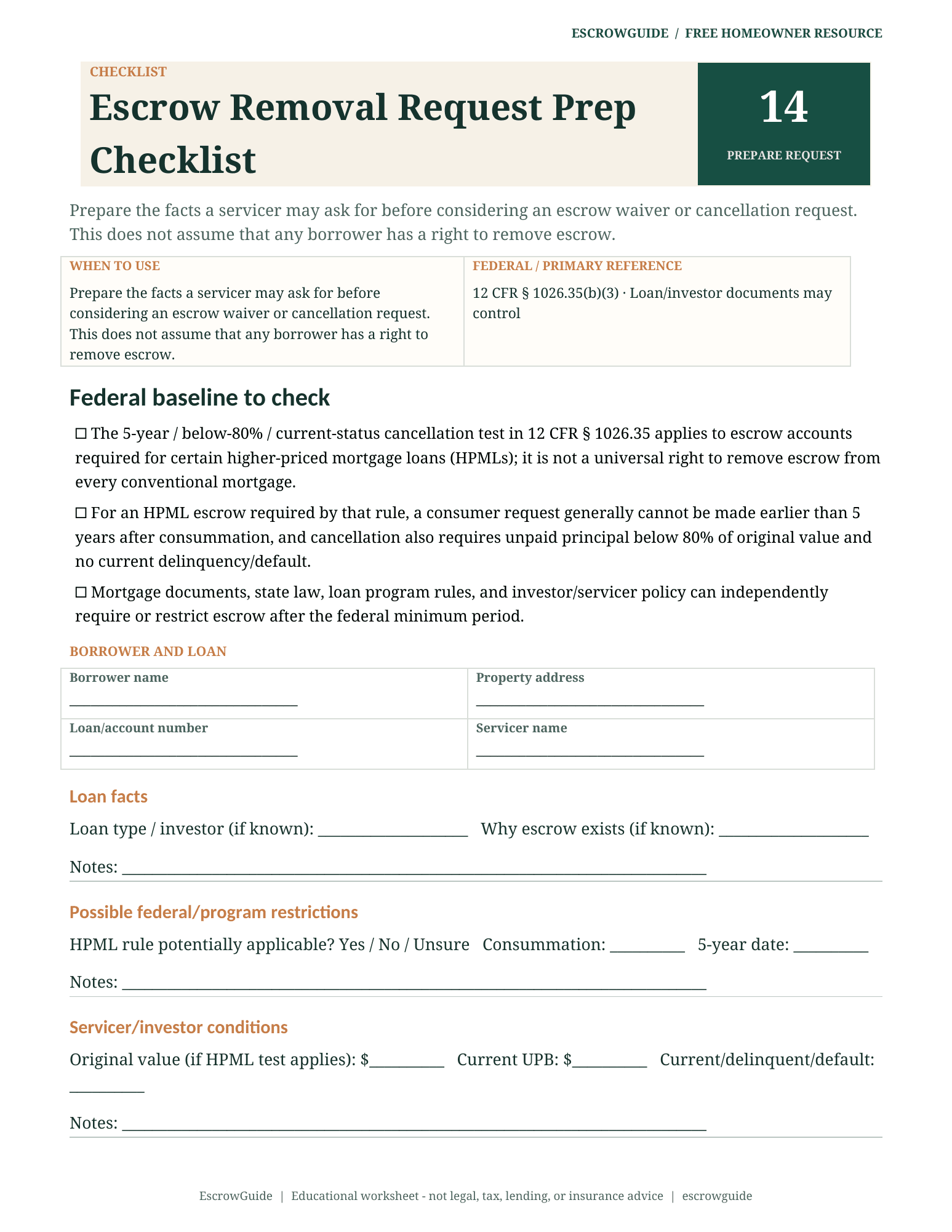
There is no universal federal rule saying every borrower can remove escrow once the loan reaches 80% loan-to-value. Whether an escrow account can be waived or discontinued depends on the mortgage documents, applicable law, loan program, investor or servicer requirements, and—in some cases—special federal rules such as the minimum escrow period for certain higher-priced mortgage loans.
Escrow waiver questions can turn on mortgage documents, loan-program rules, federal restrictions, state law and investor policy; no single equity percentage answers every loan. A component-level view also prevents a correct outside bill from hiding an unrelated posting problem.
Separate past catch-up from future cost
Find the earliest document that shows the change. It may be an annual escrow analysis, policy renewal, tax bill, transfer history or workout statement. That starting record usually reveals which payment component deserves attention. For what are the requirements to remove escrow from a mortgage, pair the disputed amount with the record that should control it. Dates matter as much as dollars. A transaction posted a few days before or after the analysis date can explain why a borrower and servicer appear to be starting from different balances.
The governing servicing framework
For higher-priced mortgage loans that were required to have escrow under Regulation Z §1026.35(b), cancellation on the consumer's request generally cannot occur earlier than five years after consummation and also requires the unpaid principal balance to be below 80% of the property's original value and the borrower not to be delinquent or in default. Those conditions are not a general escrow-removal entitlement for every mortgage.
The rulebook does not replace the account evidence. It tells you what should happen; dated statements and outside records show what did happen. A mismatch matters only after those two layers are compared on the same facts. If an outside authority controls the underlying charge, verify that record before asking the servicer to change its projection. A page-specific cross-check is to identify the loan type and, if possible, the investor or guarantor.
Escrow removal by loan type: the useful starting point
This matrix is a screening tool, not an approval chart. A loan program can set a federal or agency baseline, while the mortgage documents, investor, servicer, state law and special rules such as the higher-priced mortgage loan escrow rule can still control the actual request.
| Loan type | Can escrow ever be removed? | What the official baseline says | What to verify next |
|---|---|---|---|
| Conventional | Sometimes | No universal federal 80% rule grants removal. For an HPML escrow required by Regulation Z, a consumer request generally cannot cancel it before five years, and cancellation also requires balance below 80% of original value plus current status. | Mortgage/deed of trust, investor rules, servicer waiver policy, HPML status and any state-law restriction. |
| FHA | Generally no while FHA servicing requirements apply | HUD's FHA servicing policy requires the total mortgage payment to include escrow funds for property charges such as real estate taxes, required hazard/flood insurance and FHA MIP. | Confirm the mortgage is FHA-insured and whether a refinance, payoff or other event changes the governing program rather than treating equity alone as a waiver trigger. |
| VA | Potentially, but lender/loan rules matter | VA itself does not require a lender to establish tax-and-insurance escrow, but the lender remains responsible for ensuring those items are paid timely and may impose escrow under the loan documents or applicable law. | Promissory note/security instrument, lender or servicer policy, investor requirements and any HPML rule that independently requires escrow. |
| USDA guaranteed | Usually not a routine borrower waiver | USDA servicing rules say lenders with the capacity to escrow must establish escrow accounts for all guaranteed loans for taxes and insurance; limited procedures exist for lenders without escrow capacity. | Confirm whether the loan is USDA guaranteed versus USDA direct and ask the servicer which program rule governs the account. |
| Jumbo / portfolio | Case by case | "Jumbo" is a balance category, not a single servicing program. Federal HPML escrow rules can apply to certain higher-priced first-lien loans, while portfolio documents and creditor policy can add separate requirements. | Loan documents, creditor/investor policy, HPML status, property occupancy and any state-law rule. |
Why this differs from many online charts: PMI cancellation and escrow cancellation are separate questions, and VA is not accurately summarized by a universal “escrow required for life” or “waiver at 80% LTV” rule.
Dollar example
A conventional borrower may hear that reaching 79% LTV automatically permits escrow removal. That may be wrong. A Fannie Mae-serviced loan, for example, has investor-specific waiver conditions, while Freddie Mac has its own requirements and exceptions. The same borrower could therefore receive different answers depending on who owns or guarantees the loan and what the mortgage documents say.
Treat the sample as a unit test for the explanation. The real account passes only when its own bills, ledger entries and statement components produce the total the servicer is collecting. A page-specific cross-check is to read the mortgage or deed of trust provisions relating to escrow.
Documents that settle the question
Collect the smallest set of records that can prove or disprove the explanation: the relevant escrow analysis, nearby mortgage statements and the outside document tied to the change. Add transfer, payoff, hardship or correction records only when the timeline requires them. A page-specific cross-check is to ask the servicer for its written escrow-waiver criteria and any fee.
- Identify the loan type and, if possible, the investor or guarantor.
- Read the mortgage or deed of trust provisions relating to escrow.
- Ask the servicer for its written escrow-waiver criteria and any fee.
- Check whether an HPML escrow rule or another program-specific requirement applies.
- Before waiving escrow, budget for large annual or semiannual tax and insurance bills and set up a dedicated reserve.
Record both the finding and its source. A conclusion such as 'premium increased' is stronger when it sits beside the renewal amount, effective date and matching escrow disbursement. For this issue, also rule out treating PMI cancellation rules as escrow-waiver rules.
Separate what happened from what happens next
Look for effective dates, not just notice dates. Insurance renewals, tax assessments, transfers and workout changes can be communicated on one day but affect the ledger on another. Matching the correct effective date to the correct statement period avoids false discrepancies caused by timing alone. A page-specific cross-check is to check whether an HPML escrow rule or another program-specific requirement applies.
For educational estimates, label assumptions explicitly. If a simple annual amount divided by 12 is being used only as a cross-check, it should not be presented as the formal aggregate-accounting result. That distinction keeps a useful estimate from becoming false evidence of servicing error. For this issue, also rule out assuming 80% LTV is always sufficient.
Do not force every issue into an escrow remedy. Sometimes the escrow ledger accurately reflects an underlying bill that the homeowner disputes for a separate reason. In that case, the servicing audit can confirm the math while the underlying tax, insurance or program question continues through its own channel. A page-specific cross-check is to before waiving escrow, budget for large annual or semiannual tax and insurance bills and set up a dedicated reserve.
Where homeowners often misread the statement
- Treating PMI cancellation rules as escrow-waiver rules.
- Assuming 80% LTV is always sufficient.
- Ignoring prior delinquency or investor-specific restrictions.
- Removing escrow without a disciplined plan for tax and insurance due dates.
Do not let a surprising outcome substitute for evidence. A servicing error is easier to support when one dated entry is duplicated, missing, sent to the wrong payee or inconsistent with an official bill. A page-specific cross-check is to identify the loan type and, if possible, the investor or guarantor.
Turn the discrepancy into a testable question
A servicing request is most useful after the audit has reduced the problem to one or two disputed entries. Follow any designated address requirement and preserve the complete submission and proof that it was delivered. A page-specific cross-check is to read the mortgage or deed of trust provisions relating to escrow.
The existence of a dispute does not itself mean scheduled mortgage obligations stop. This page explains general servicing mechanics; loan documents, account status, state law and individual facts can affect a particular borrower's next step. For this issue, also rule out ignoring prior delinquency or investor-specific restrictions.
Recheck the account after the adjustment
Keep the next annual analysis in the same evidence file. Some corrections solve the current ledger but affect the following computation year as well. Comparing the new opening balance and projected bills with the resolved records can catch a stale input before it creates another unexplained shortage or surplus. A page-specific cross-check is to ask the servicer for its written escrow-waiver criteria and any fee.
If a third party corrects its own record, send the updated document to the current servicer and then verify that the servicing system uses the revised amount. An outside correction and a mortgage-account correction are separate events and may not happen automatically on the same day. For this issue, also rule out removing escrow without a disciplined plan for tax and insurance due dates.