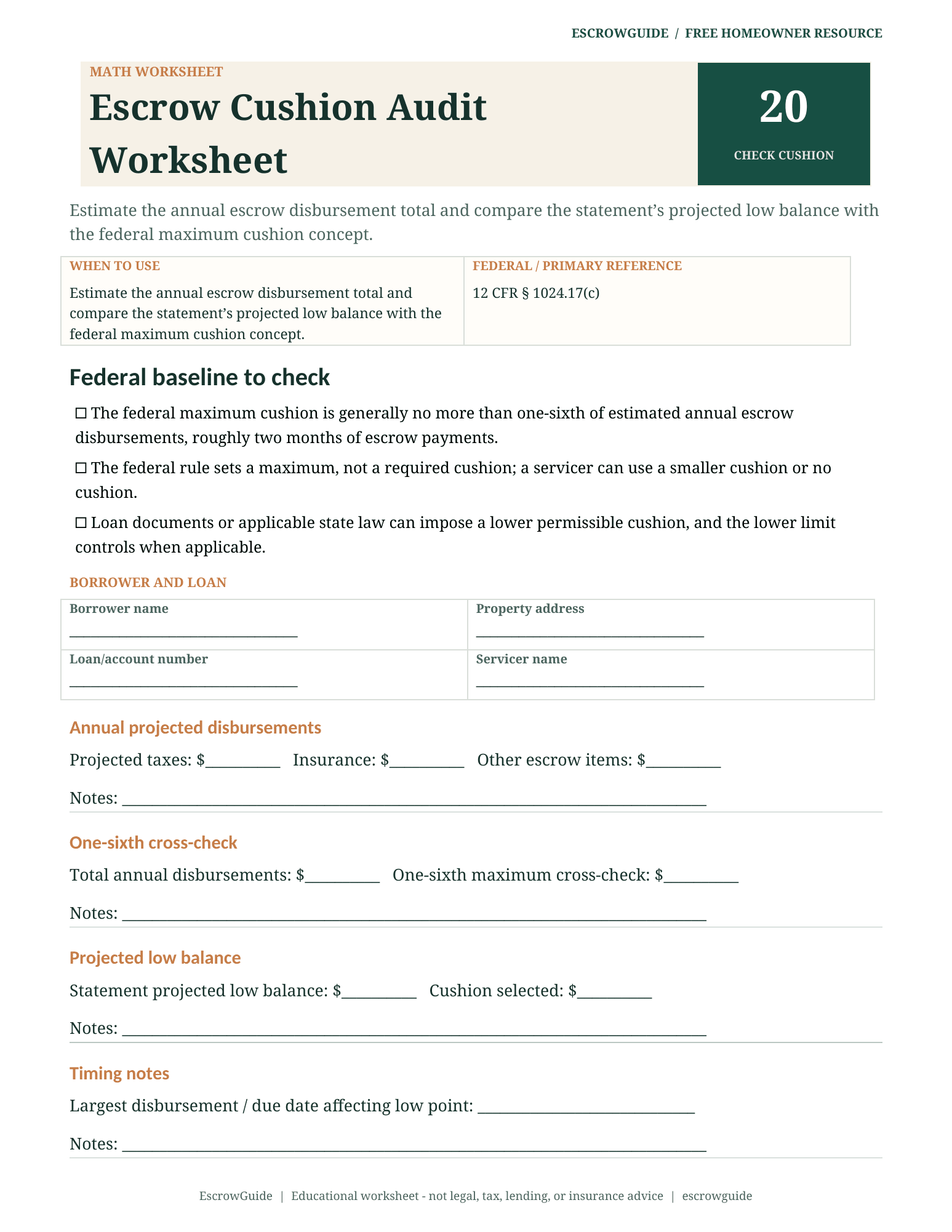
For a covered escrow account, Regulation X generally limits the cushion to no more than one-sixth of estimated annual escrow disbursements. That is commonly described as two months of escrow payments, but the actual analysis uses a trial running balance and the lowest projected month-end balance. The loan documents or state law can require a lower cushion, and a servicer may use less than the maximum or no cushion.
The formal escrow calculation is a running-balance problem. Annual bills divided by 12 is a useful cross-check, but timing and a permitted cushion can change the exact trial balance. Once the first mismatch is located, the rest of the analysis becomes a reconciliation rather than a guess.
Find the first number that changed
Begin with the event that changed the account, not with the new total. Put consecutive statements side by side and mark principal and interest, the periodic escrow deposit, temporary catch-up, mortgage insurance when relevant, and any other recurring line. For how does the two month mortgage escrow cushion work, pair the disputed amount with the record that should control it. Dates matter as much as dollars. A transaction posted a few days before or after the analysis date can explain why a borrower and servicer appear to be starting from different balances.
What Regulation X contributes
The rule requires aggregate analysis. The servicer projects monthly deposits and disbursements, identifies the lowest month-end balance, adjusts the trial balance so the low point reaches zero, and then may add the permitted cushion. The lowest target balance generally may not exceed one-sixth of estimated annual disbursements, subject to lower limits in law or the mortgage documents.
Regulation X can tell a servicer how to analyze or administer escrow without determining the underlying tax or insurance charge. Keep the rule question and the outside-bill question separate so a correct calculation does not validate a wrong input. Use adjacent statements first; comparing years that contain several intervening changes can merge unrelated causes. A page-specific cross-check is to find the annual projected disbursement total.
Test the explanation with a scenario
If projected annual taxes and insurance total $8,400, one-sixth is $1,400. That equals two months of a simple $700 monthly escrow deposit. But the cushion is not an extra $1,400 fee charged every year. It is a target reserve level within the running-balance calculation. As bills are paid and deposits arrive, the balance moves throughout the year.
The example is a reconciliation method, not a forecast. Substituting the reader's dated figures should either reproduce the statement or isolate a smaller residual that can be investigated directly. A page-specific cross-check is to calculate one-sixth as a maximum-reference point, not an automatic charge.
Verify the source documents
Gather records by function rather than by volume. One document should establish what the servicer used, another what the outside charge actually was, and a third should show how money moved through the account when timing is disputed. A page-specific cross-check is to read the mortgage documents and any applicable state rule for a lower limit.
- Find the annual projected disbursement total.
- Calculate one-sixth as a maximum-reference point, not an automatic charge.
- Read the mortgage documents and any applicable state rule for a lower limit.
- Look at the statement's projected month-by-month balance if provided.
- Do not confuse the cushion with a shortage created because the current balance is below target.
If a check fails, stop and define the failure before moving on. A duplicated payment, missing credit and wrong projection are different problems and should not be bundled into one allegation. For this issue, also rule out adding two months of escrow on top of every annual bill and calling that the required payment.
Resolve the remaining ambiguity
Keep the outside cost and the servicing treatment in separate columns. A tax increase may be valid while its projected amount is entered incorrectly, or a correct premium may be paid twice. Separating cause from administration allows both possibilities to be tested without assuming one proves the other. A page-specific cross-check is to look at the statement's projected month-by-month balance if provided.
Recheck the following statement after any correction or lump-sum transaction. A servicer may fix the ledger before the visible monthly amount changes, or may recalculate the payment on a later cycle. Verification should therefore include both the account entry and the payment that follows it. For this issue, also rule out treating the cushion as money the servicer permanently owns.
Keep estimates labeled as estimates. A simple monthly division is useful for checking direction and scale, but Regulation X aggregate accounting can depend on disbursement dates and the running balance. A rough check should narrow the investigation, not be treated as conclusive proof that formal escrow math is wrong. A page-specific cross-check is to do not confuse the cushion with a shortage created because the current balance is below target.
Avoid these shortcuts
- Adding two months of escrow on top of every annual bill and calling that the required payment.
- Treating the cushion as money the servicer permanently owns.
- Assuming every servicer must use the maximum cushion.
- Ignoring timing of large tax or insurance disbursements in the trial balance.
A broad claim that escrow is wrong is weak compared with a narrow mismatch. Isolate the exact line that fails to reconcile before deciding which formal servicing process is appropriate. A page-specific cross-check is to find the annual projected disbursement total.
Next step when the math is still off
When the remaining gap is specific, formal correspondence can be specific too. Quote the statement amount, quote the outside or prior-ledger amount, identify the date, and ask for the calculation or record that explains the difference. A page-specific cross-check is to calculate one-sixth as a maximum-reference point, not an automatic charge.
Servicing research is different from personalized advice. Use the evidence to ask a precise question, while treating payment, legal and tax decisions as fact-specific matters beyond this general explanation. For this issue, also rule out assuming every servicer must use the maximum cushion.
What the follow-up statement should show
If no correction is warranted, document that conclusion too. Note which outside bill or rule explained the payment and which calculation reproduced the result. Future escrow analyses are easier to review when the previous increase already has a traceable explanation. A page-specific cross-check is to read the mortgage documents and any applicable state rule for a lower limit.
For large changes, keep a simple spreadsheet with one row per material transaction and columns for source, expected amount, posted amount and date. The tool is not evidence by itself, but it makes missing or duplicate entries obvious and points back to the source documents that are evidence. For this issue, also rule out ignoring timing of large tax or insurance disbursements in the trial balance.