Read an annual escrow statement in this order: what actually happened last year, what the servicer projects for next year, the target/cushion calculation, the resulting shortage/surplus/deficiency, and finally the new payment. Starting with the new payment makes the document feel opaque; rebuilding the components turns it into an auditable worksheet.
An annual escrow statement combines history and forecast: past deposits and disbursements explain the current position, while projected bills explain the next periodic deposit. The point is not to reproduce proprietary servicing software; it is to make every material input traceable.
Break the all-in payment into parts
The fastest audit starts one level below the total payment. Compare the same line items on the statement before and after the change, then identify which component moved first and which document should support it. For how to read escrow analysis statement, pair the disputed amount with the record that should control it. The checklist is complete only when every major changed amount has a source. Anything left as 'unknown' should be requested specifically rather than filled in with an assumption.
Scope the rule carefully
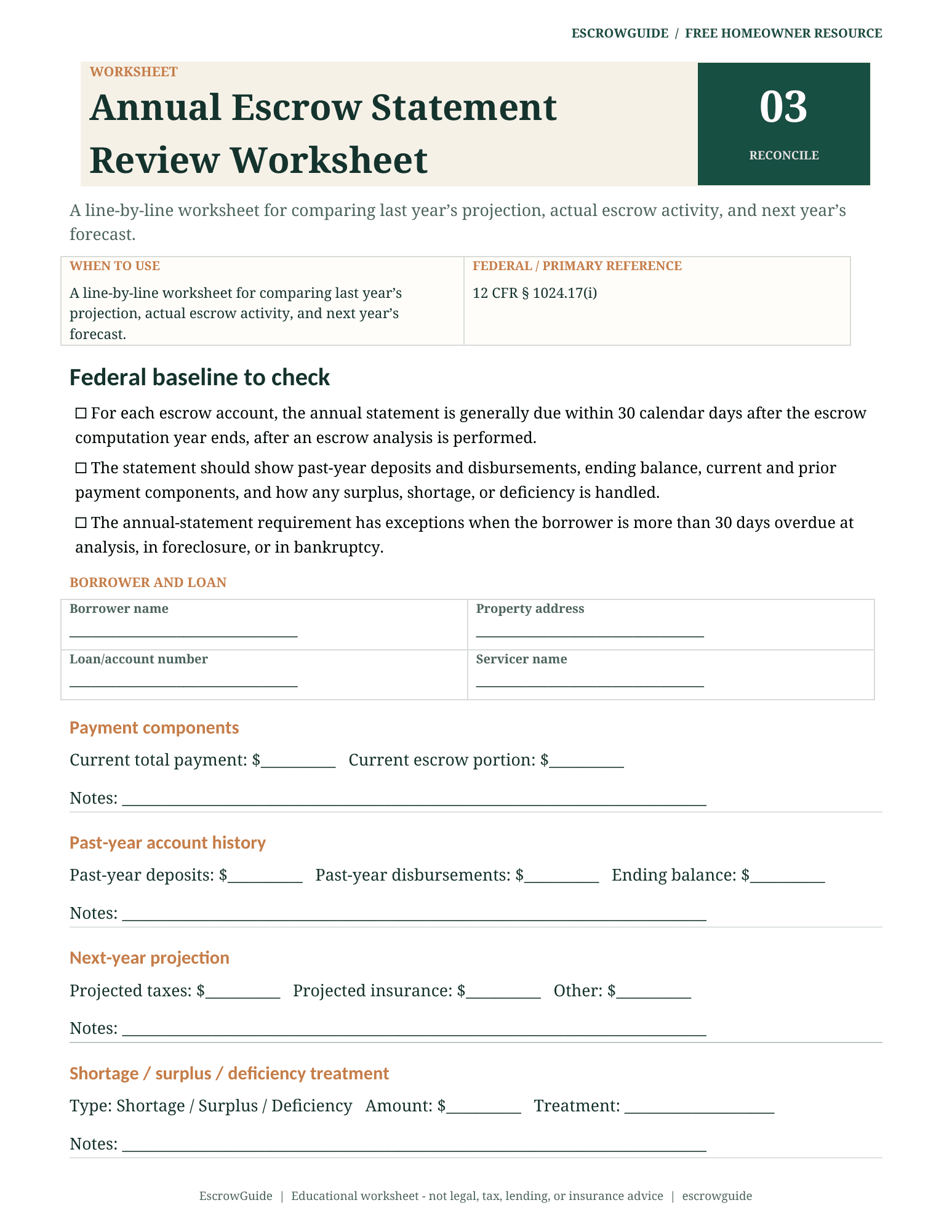
Regulation X requires an annual escrow account statement after the annual analysis, generally within 30 calendar days after the end of the escrow computation year. The statement includes the current and prior monthly payment information, total amounts paid into and out of escrow, ending balance, and explanations of any surplus, shortage, or deficiency and how it will be handled.
Federal servicing rules are the baseline, not the source of every dollar on the statement. Taxes, premiums and program-specific terms can originate elsewhere, so each input needs the authority that actually controls it. Write dates beside amounts because a bill paid near an analysis or transfer cutoff can make two accurate balances look inconsistent. A page-specific cross-check is to circle the prior monthly escrow deposit and new monthly escrow deposit.
Numerical walk-through
If the statement shows $7,800 paid into escrow and $8,650 paid out, that $850 difference is not automatically the shortage. The formal shortage depends on the current balance compared with the target balance after the trial running-balance analysis. That is why the statement's shortage line may differ from a simple deposits-minus-disbursements subtraction.
The numerical check should end with one of two results: either the statement can be reproduced from known inputs or a discrete gap remains. Only the second result calls for searching for a missing posting or unexplained assumption. A page-specific cross-check is to list every actual disbursement from the prior year with payee and amount.
Evidence checklist
Gather records by function rather than by volume. One document should establish what the servicer used, another what the outside charge actually was, and a third should show how money moved through the account when timing is disputed. A page-specific cross-check is to list every projected disbursement for the next year.
- Circle the prior monthly escrow deposit and new monthly escrow deposit.
- List every actual disbursement from the prior year with payee and amount.
- List every projected disbursement for the next year.
- Find the ending balance, target balance, and cushion.
- Find the exact treatment of any surplus, shortage, or deficiency and then rebuild the new total mortgage payment.
The checklist is complete only when every major changed amount has a source. Anything left as 'unknown' should be requested specifically rather than filled in with an assumption. For this issue, also rule out reading only the cover-page payment change.
A second-pass test for the account
Keep the outside cost and the servicing treatment in separate columns. A tax increase may be valid while its projected amount is entered incorrectly, or a correct premium may be paid twice. Separating cause from administration allows both possibilities to be tested without assuming one proves the other. A page-specific cross-check is to find the ending balance, target balance, and cushion.
The analysis is complete when another reader can reproduce it without relying on a phone conversation. Written statements, transaction histories and official bills should carry the argument. Notes from calls can add context, but the core explanation should survive even if those notes are removed. For this issue, also rule out using deposits minus withdrawals as the statutory shortage calculation.
The final account note should be concise enough to reuse later: what changed, which record explained it, whether a correction was needed, and what the next statement should show. That summary reduces repeated research when the following annual analysis arrives. A page-specific cross-check is to find the exact treatment of any surplus, shortage, or deficiency and then rebuild the new total mortgage payment.
Normal change or servicing problem?
- Reading only the cover-page payment change.
- Using deposits minus withdrawals as the statutory shortage calculation.
- Missing a changed disbursement date that affects the low point.
- Failing to compare projected bills with outside source documents.
A second common error is jumping across several years of statements. Reconcile one change at a time; otherwise a valid tax increase can mask an unrelated transfer or posting issue. A page-specific cross-check is to circle the prior monthly escrow deposit and new monthly escrow deposit.
Document the remaining gap
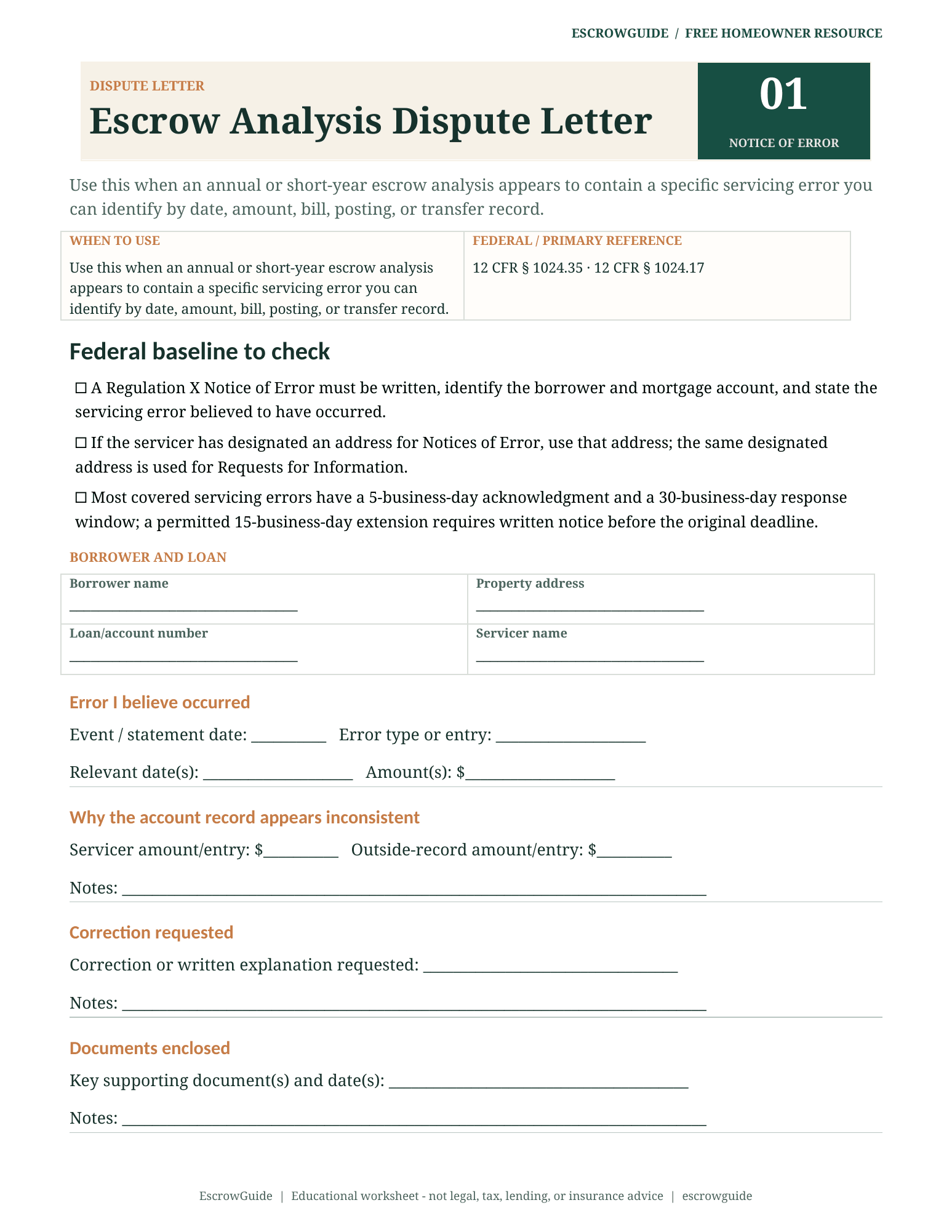
Escalate facts, not frustration. A written request should identify the loan, the transaction or projection at issue, the competing source record and the information or correction being sought. Keep copies and delivery evidence. A page-specific cross-check is to list every actual disbursement from the prior year with payee and amount.
Servicing research is different from personalized advice. Use the evidence to ask a precise question, while treating payment, legal and tax decisions as fact-specific matters beyond this general explanation. For this issue, also rule out missing a changed disbursement date that affects the low point.
Confirm the result instead of assuming it posted
If no correction is warranted, document that conclusion too. Note which outside bill or rule explained the payment and which calculation reproduced the result. Future escrow analyses are easier to review when the previous increase already has a traceable explanation. A page-specific cross-check is to list every projected disbursement for the next year.
For tax and insurance disputes, distinguish the billing address from the property and policy identifiers. A payment sent to the correct company can still be misapplied, so matching parcel number, policy number and covered period can matter as much as matching the dollar amount. For this issue, also rule out failing to compare projected bills with outside source documents.