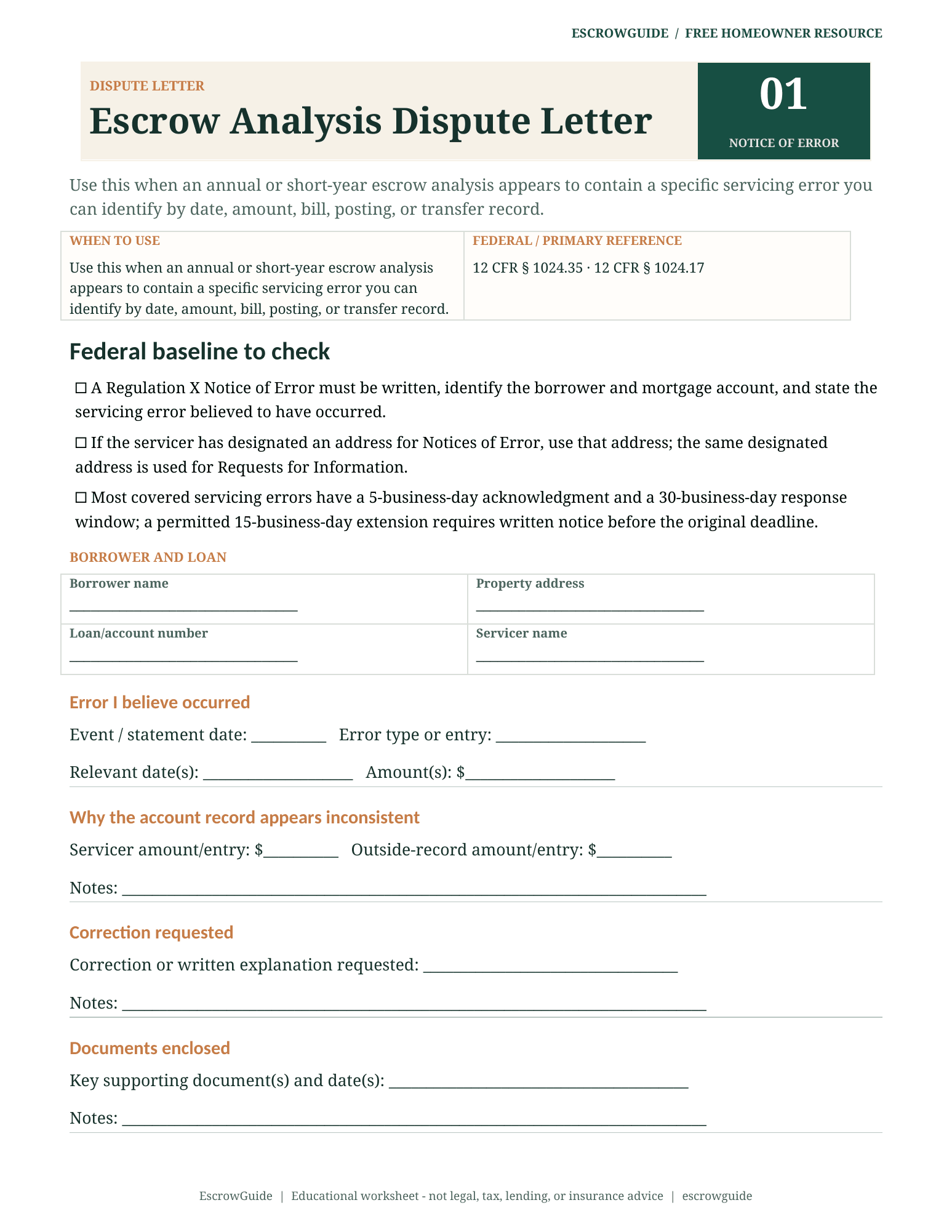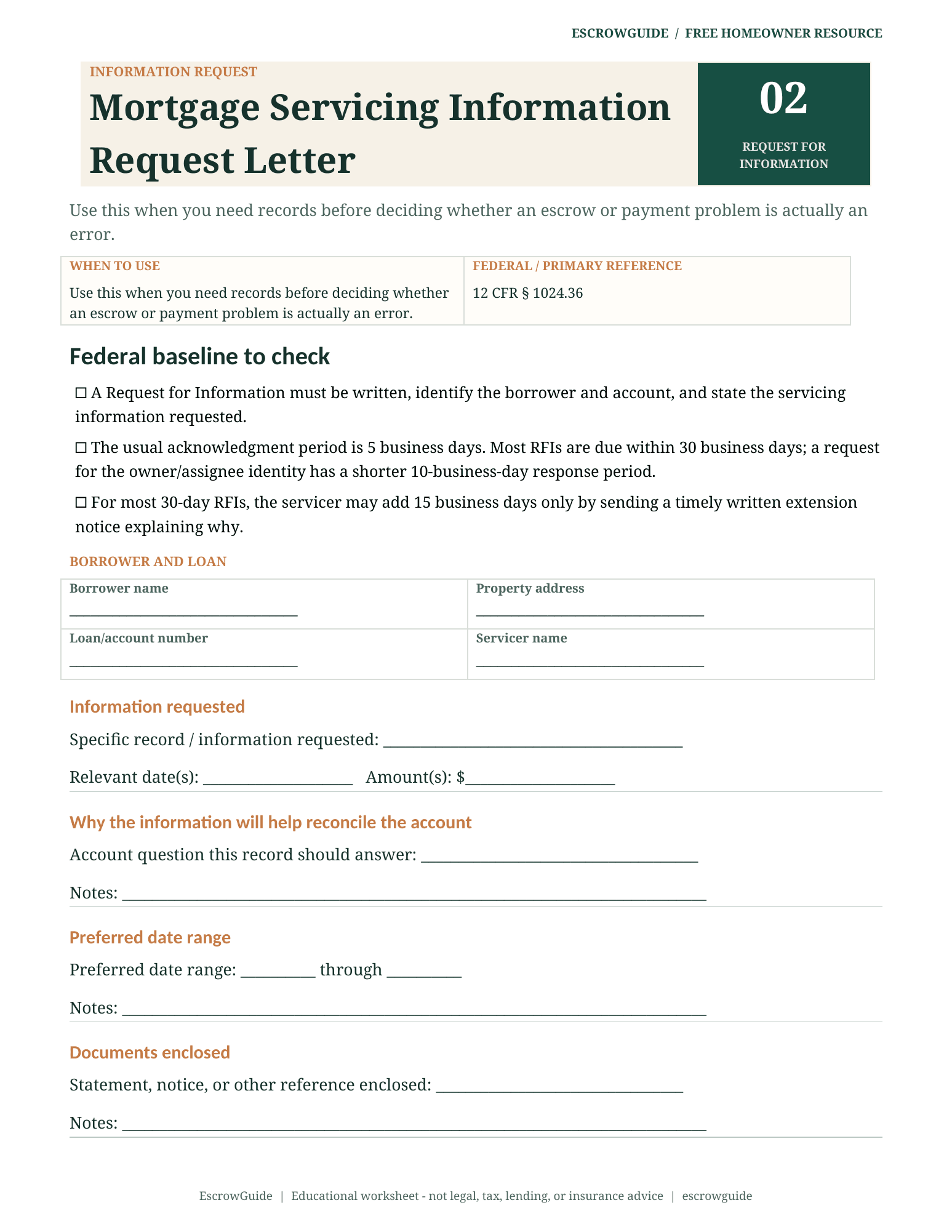
If you believe your mortgage servicer made an escrow servicing error, a written notice of error asks the servicer to investigate and correct a specific mistake. A written request for information asks for records or facts about the servicing of your loan. One letter can potentially function as both if it substantively does both, but send it to the servicer’s designated address and be specific.
Use the phone first for speed, writing for a documented federal process
Many escrow problems can be corrected through a phone call: an old insurance policy, a tax-bill update or a payment posted to the wrong bucket. The CFPB nevertheless notes that borrowers can receive stronger procedural protections by writing to the servicer.
A good sequence is to call, record the reference number and explanation, then write if the issue remains or if you need documents the representative cannot provide.
Notice of error versus request for information
Use a notice of error when you can identify a specific servicing mistake
Examples relevant to escrow include:
- the servicer failed to pay property taxes or insurance on time,
- a payment was applied incorrectly,
- the escrow balance after a servicing transfer is inaccurate,
- a tax or insurance disbursement was duplicated, or
- the servicer failed to return escrow funds after payoff within the applicable timeframe.
Use a request for information when you need the evidence
Examples include asking for:
- the full escrow transaction history,
- the annual escrow analysis and trial balance,
- the source and amount of projected tax or insurance disbursements,
- transfer accounting from the prior servicer, or
- payment-trace information for a tax or insurance disbursement.
The official commentary to Regulation X explains that a servicer must look at the substance of a borrower’s letter rather than rely only on the label the borrower gives it. A letter that asserts an error and asks for related information can potentially trigger both sets of obligations when it meets the substantive requirements.
The designated address matters
Mortgage servicers may designate a specific address for notices of error and information requests. The CFPB emphasizes that if the servicer has designated such an address, you must use it to receive the applicable protections. It may be different from the address where you send mortgage payments.
Look on the monthly statement, coupon book, servicer website or prior notices. Do not mail a dispute to a generic corporate address and assume it entered the federal error-resolution workflow.
What to include in the letter
The CFPB recommends identifying the borrower and loan and describing the error or information requested. For an escrow dispute, include:
- borrower name exactly as it appears on the mortgage,
- property address,
- loan or account number,
- the specific disputed transaction, date and amount,
- why you believe it is wrong,
- the correction you are requesting, and
- the specific records you want, if any.
Attach copies of the tax bill, insurance declaration, prior escrow analysis, transfer statement or payment proof that supports the issue. Keep the originals.
Example of a precise escrow error
Weak: “My escrow is wrong and my payment is too high.”
Strong: “The escrow history shows two county-tax disbursements of $3,420 for tax year 2026, dated November 3 and November 10. The county account history shows only one $3,420 obligation and one payment. Please investigate the second disbursement, correct the escrow balance and provide the payment trace for both entries.”
The second version gives the servicer a transaction to investigate and a document to produce.
General response timeline
The CFPB explains that a servicer generally must acknowledge a qualifying written notice of error or information request within five days, excluding weekends and legal public holidays. It generally must respond within 30 days, also excluding weekends and legal public holidays. The rules contain exceptions, specialized timelines and circumstances in which the servicer can extend the investigation, so use those figures as the general framework rather than a universal deadline for every possible request.
For many requests, the servicer can notify you of an additional 15-day period as permitted by the applicable regulation. Keep the acknowledgement letter because it proves the servicer received the request and identifies the response schedule.
Keep paying while the dispute is pending
The CFPB specifically advises borrowers to continue making scheduled mortgage payments while waiting for a response. A notice of error is not a payment holiday. If the amount due itself is disputed, preserve the dispute but avoid creating a separate delinquency problem through unilateral underpayment.
Build an evidence packet before you write
- Current monthly statement.
- Annual escrow analysis.
- Escrow transaction history.
- Official tax bill or tax-account history.
- Insurance declaration and payment history.
- Proof of any lump-sum shortage payment.
- Servicing-transfer notices if the servicer changed.
- Notes from prior calls, including dates and reference numbers.
You may discover the answer while assembling the packet. If not, the packet lets you write a focused dispute instead of a vague complaint.
What the servicer can do after investigating
For a notice of error, the CFPB says the servicer can correct the error and confirm the correction, investigate and explain why it believes no error occurred, request additional information in certain circumstances, or use an allowed extension. For an information request, it can provide the information or explain after a search that the requested information is not available and give contact information for further assistance.
If the written response does not reconcile the account, compare it line by line with your evidence. A denial that identifies the documents and transactions used can still help you isolate the remaining disagreement.
When to escalate beyond the servicer
If the servicer does not respond within the applicable federal timeframe, or if a serious error remains unresolved, the CFPB accepts consumer complaints. If unpaid taxes, insurance cancellation, foreclosure or legal papers create immediate risk, consider a HUD-approved housing counselor or qualified attorney. The right response depends on the severity and local legal consequences.