A servicing transfer changes the company that collects and administers your mortgage; it does not by itself change the underlying loan terms. Your old and new servicers generally must send transfer notices around the effective date, and a 60-day federal protection applies to on-time payments accidentally sent to the old servicer. Escrow balances and servicing records should be transferred and reconciled, but you should verify the first statements carefully.
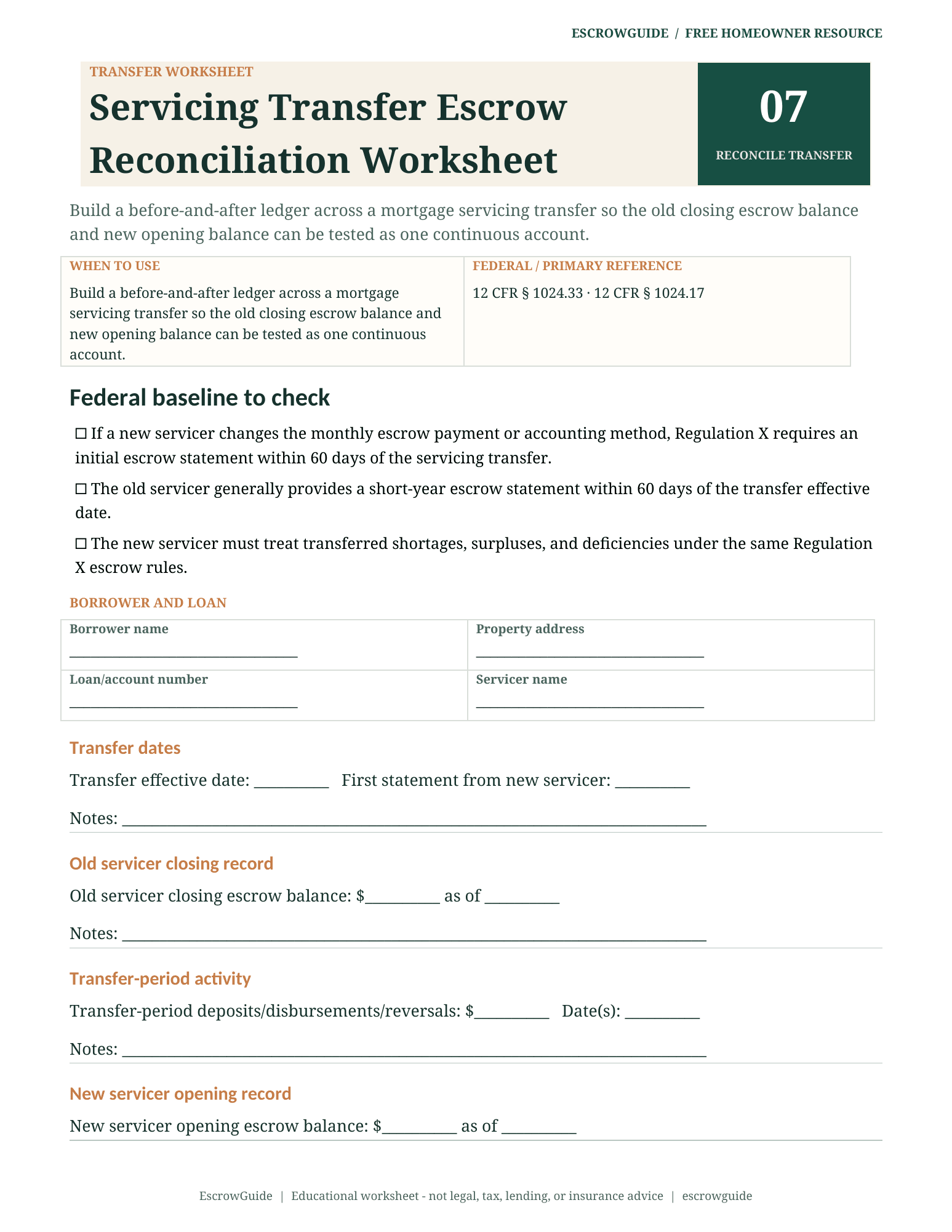
A servicing handoff is best audited like a reconciliation: the old closing ledger, transfer-period transactions and new opening ledger should form one continuous account history. A component-level view also prevents a correct outside bill from hiding an unrelated posting problem.
Reconstruct the timeline before judging the total
Build a before-and-after ledger before deciding why the payment changed. A note rate can remain untouched while an escrow deposit, insurance charge or temporary repayment changes the amount drafted each month. For what happens to my escrow account when mortgage servicing transfers, pair the disputed amount with the record that should control it. Write the supporting date and amount beside every completed check. That chronology can show whether an apparent balance gap is actually a bill paid near an analysis, transfer or reinstatement cutoff.
Rule first, statement second
Regulation X §1024.33 governs transfer notices and payment treatment. §1024.17(e) addresses transferred escrow accounts: if the new servicer changes the monthly payment or accounting method, it must provide an initial escrow statement within 60 days of the transfer; if it retains the prior payment and method, it may continue the prior computation year or use a short year.
Regulation X can tell a servicer how to analyze or administer escrow without determining the underlying tax or insurance charge. Keep the rule question and the outside-bill question separate so a correct calculation does not validate a wrong input. The strongest follow-up names the disputed transaction instead of asserting that the entire escrow account is incorrect. A page-specific cross-check is to save both transfer notices and note the effective date.
Put actual numbers beside the rule
Your transfer date is September 1. You mailed the September payment to the old servicer on time because an automatic bill-pay instruction had not yet been changed. During the 60-day period beginning on the transfer date, that on-time payment cannot be treated as late merely because it reached the old servicer. Still, you should update payment instructions and confirm the payment appears on the new servicer's statement.
Treat the sample as a unit test for the explanation. The real account passes only when its own bills, ledger entries and statement components produce the total the servicer is collecting. A page-specific cross-check is to record the escrow balance on the final old-servicer statement.
Audit the account
Prepare the file before contacting the servicer. Start with the current and prior analysis, recent statements and the tax or insurance evidence. A dated source beside each disputed amount is more useful than a thick folder of unrelated paperwork. A page-specific cross-check is to compare it with the opening balance or transaction history from the new servicer.
- Save both transfer notices and note the effective date.
- Record the escrow balance on the final old-servicer statement.
- Compare it with the opening balance or transaction history from the new servicer.
- Confirm tax and insurance payee information did not disappear in the transfer.
- Review the first annual or short-year escrow analysis for duplicate disbursements or missing history.
Keep the sequence visible instead of reducing it to one ending balance. Escrow is a running ledger, and timing can make two snapshots misleading even when all transactions eventually reconcile. For this issue, also rule out assuming the servicing transfer changed the mortgage interest rate.
One more reconciliation before you decide
Look for effective dates, not just notice dates. Insurance renewals, tax assessments, transfers and workout changes can be communicated on one day but affect the ledger on another. Matching the correct effective date to the correct statement period avoids false discrepancies caused by timing alone. A page-specific cross-check is to confirm tax and insurance payee information did not disappear in the transfer.
Preserve the original document set even after the problem appears resolved. Escrow changes can affect later analyses, and a future shortage or transfer question is easier to diagnose when the prior correction, refund or recalculation can be traced to its source. For this issue, also rule out ignoring autopay or bank bill-pay instructions.
A good worksheet also records what the article cannot determine from the statement alone. Loan-program eligibility, local tax liability, insurance coverage disputes and individualized legal consequences may require a different source. Marking that boundary keeps the escrow audit focused on facts the servicing records can actually prove. A page-specific cross-check is to review the first annual or short-year escrow analysis for duplicate disbursements or missing history.
Mistakes that distort the diagnosis
- Assuming the servicing transfer changed the mortgage interest rate.
- Ignoring autopay or bank bill-pay instructions.
- Discarding the final old-servicer statement before the escrow balance is reconciled.
- Treating a new escrow analysis as automatically wrong just because it followed a transfer.
Do not merge cause and remedy. First establish what changed and whether it is correct; only then evaluate how a shortage, deficiency, refund or other servicing treatment should be handled. A page-specific cross-check is to save both transfer notices and note the effective date.
When a written servicing request makes sense
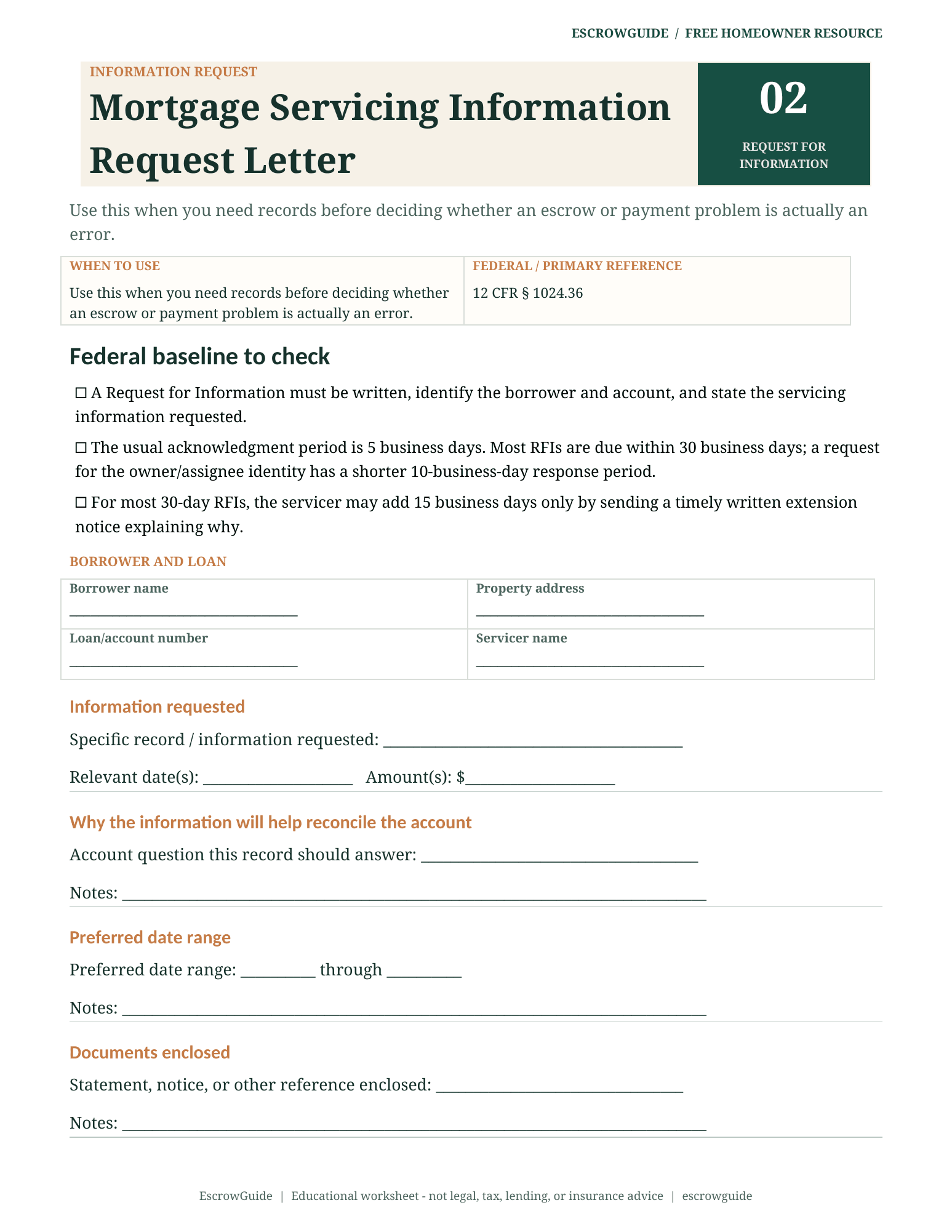
When the remaining gap is specific, formal correspondence can be specific too. Quote the statement amount, quote the outside or prior-ledger amount, identify the date, and ask for the calculation or record that explains the difference. A page-specific cross-check is to record the escrow balance on the final old-servicer statement.
A written inquiry creates a record; it does not automatically freeze the loan. Borrowers with consequences beyond account reconciliation may need loan-specific guidance from the appropriate professional or agency. For this issue, also rule out discarding the final old-servicer statement before the escrow balance is reconciled.
What to save after the issue is explained
If the explanation is timing, test it against the following cycle rather than accepting the word 'timing' by itself. The expected transaction should appear on a predictable date and amount. When it does not, the prior explanation has not actually reconciled the account. A page-specific cross-check is to compare it with the opening balance or transaction history from the new servicer.
Treat a revised payment notice and an escrow transaction history as complementary records. The notice explains what the servicer plans to collect; the history shows what money actually moved. Both are needed when the question concerns whether a projection and an account balance tell the same story. For this issue, also rule out treating a new escrow analysis as automatically wrong just because it followed a transfer.