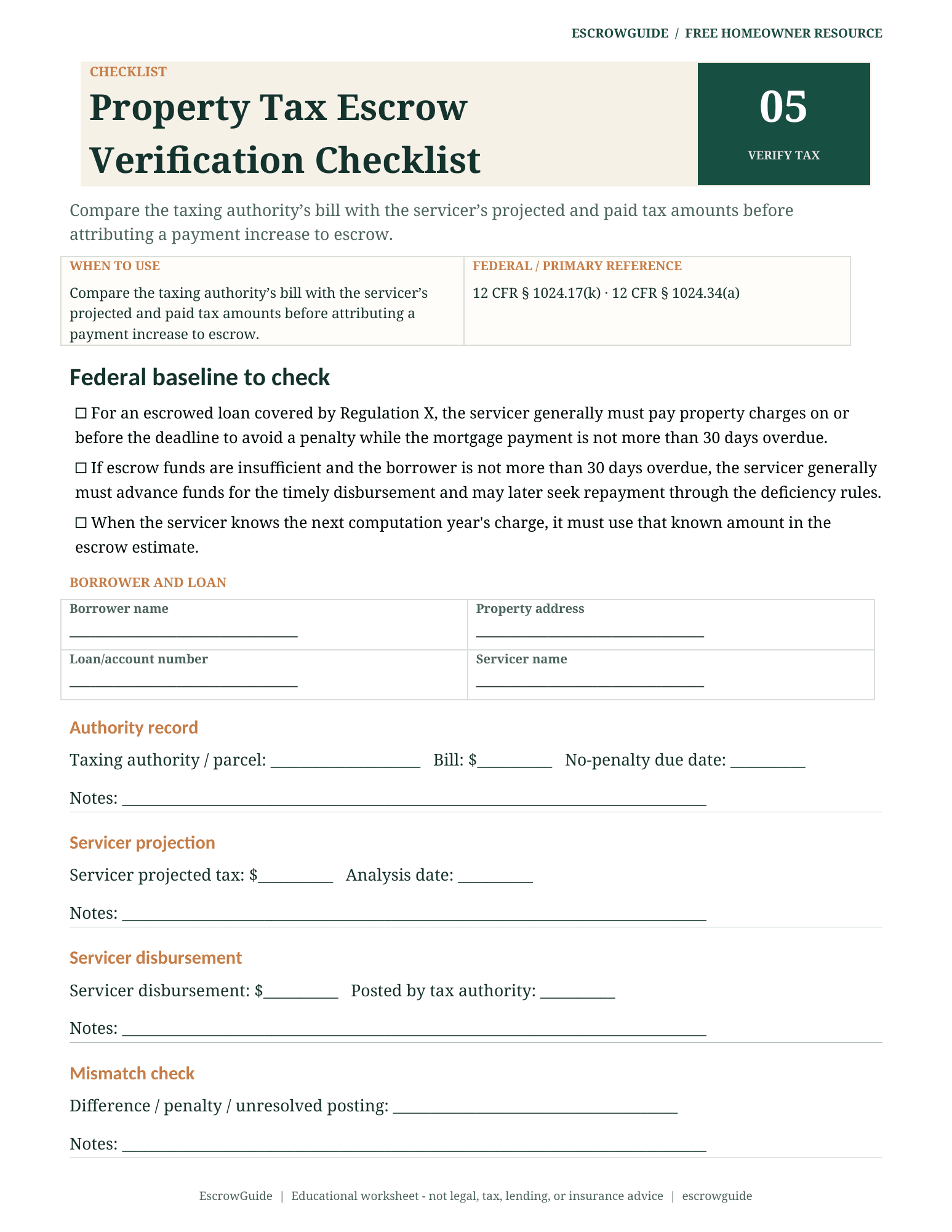
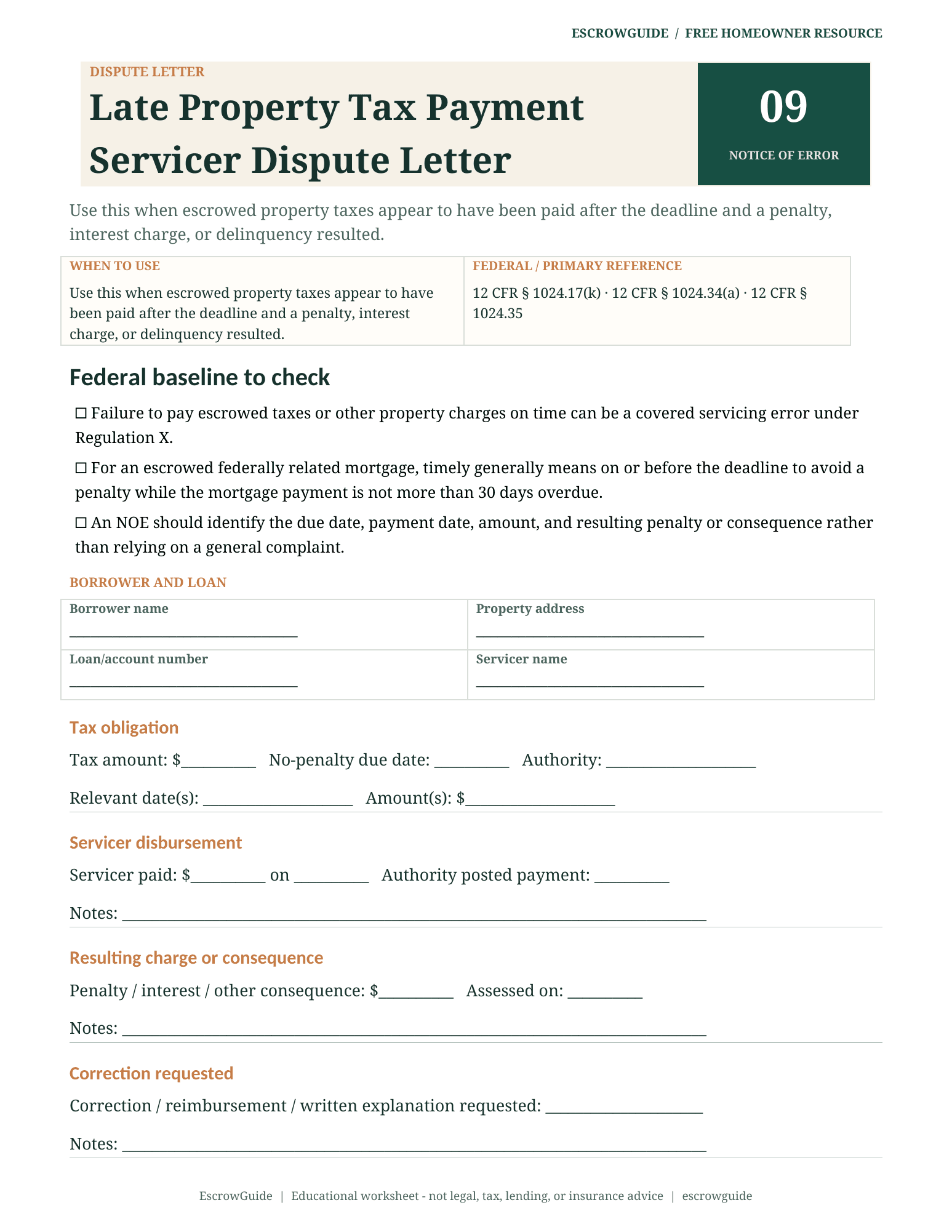
If your mortgage requires an escrow account for property taxes, Regulation X requires the servicer to make escrow disbursements on or before the deadline to avoid a penalty, as long as the rule's conditions are met. If a late tax payment creates a penalty or other harm, document the tax bill, payment history, and escrow statement and use the servicer's written error-resolution process when necessary.
A servicing complaint becomes testable when it identifies a date, amount, transaction and supporting record instead of relying on a broad conclusion that the account looks wrong. Keeping the records separate also makes a later dispute much easier to describe precisely.
Break the all-in payment into parts
Start with two adjacent billing periods and circle every line that differs. This keeps a real tax, insurance or servicing change from being hidden inside a single all-in number. For mortgage servicer paid property taxes late escrow, pair the disputed amount with the record that should control it. Record both the finding and its source. A conclusion such as 'premium increased' is stronger when it sits beside the renewal amount, effective date and matching escrow disbursement.
Scope the rule carefully
§1024.34 requires timely escrow disbursements, and §1024.17(k) states that the servicer must make payments in a timely manner. The rule also addresses advancing funds when the escrow account is short, rather than simply allowing a covered tax or insurance payment to become late because the escrow balance is insufficient.
The federal rule supplies the servicing framework, but it does not set a county assessment or write an insurance premium. Verify the rule's scope first, then compare the outside bill or loan record that supplies the number used in the account. Keep copies rather than originals when sending records and retain proof of delivery for formal servicing correspondence. A page-specific cross-check is to download the official tax bill showing due date, amount, and penalty.
Numerical walk-through
Your county tax installment of $3,200 is due November 30 to avoid a penalty. The escrow account has only $2,700 because of an unexpected premium increase. If the loan meets the rule's conditions, the servicer cannot solve the problem by waiting until your future deposits fill the gap and allowing the tax payment to incur a penalty; the servicing rules address timely payment and advances.
The example is a reconciliation method, not a forecast. Substituting the reader's dated figures should either reproduce the statement or isolate a smaller residual that can be investigated directly. A page-specific cross-check is to ask the tax authority when payment was received and whether a penalty was assessed.
Evidence checklist
Collect the smallest set of records that can prove or disprove the explanation: the relevant escrow analysis, nearby mortgage statements and the outside document tied to the change. Add transfer, payoff, hardship or correction records only when the timeline requires them. A page-specific cross-check is to pull the escrow transaction history showing when funds left the account.
- Download the official tax bill showing due date, amount, and penalty.
- Ask the tax authority when payment was received and whether a penalty was assessed.
- Pull the escrow transaction history showing when funds left the account.
- Send the servicer a concise written notice identifying the specific error and evidence.
- Keep proof of delivery and all responses; ask for correction of the account and any consequences caused by the servicing error.
Write the supporting date and amount beside every completed check. That chronology can show whether an apparent balance gap is actually a bill paid near an analysis, transfer or reinstatement cutoff. For this issue, also rule out calling the tax authority first but never creating a written servicer record.
A second-pass test for the account
Separate the answer into a historical question and a forward-looking question. The historical side asks whether prior collections and disbursements produced the displayed balance; the forward side asks whether the next projected bills justify the new periodic amount. A page can reconcile on one side and still contain a problem on the other. A page-specific cross-check is to send the servicer a concise written notice identifying the specific error and evidence.
The analysis is complete when another reader can reproduce it without relying on a phone conversation. Written statements, transaction histories and official bills should carry the argument. Notes from calls can add context, but the core explanation should survive even if those notes are removed. For this issue, also rule out assuming the tax authority will automatically waive a penalty because a mortgage company was involved.
A good worksheet also records what the article cannot determine from the statement alone. Loan-program eligibility, local tax liability, insurance coverage disputes and individualized legal consequences may require a different source. Marking that boundary keeps the escrow audit focused on facts the servicing records can actually prove. A page-specific cross-check is to keep proof of delivery and all responses; ask for correction of the account and any consequences caused by the servicing error.
Normal change or servicing problem?
- Calling the tax authority first but never creating a written servicer record.
- Assuming the tax authority will automatically waive a penalty because a mortgage company was involved.
- Sending a vague complaint without loan identification and the specific error.
- Stopping mortgage payments while the dispute is pending.
Watch for compounded explanations. Several legitimate changes can occur together, so the total may look dramatic even though no single component is unusually large. Test components before testing the emotion of the total. A page-specific cross-check is to download the official tax bill showing due date, amount, and penalty.
Document the remaining gap
Before using a formal error process, make sure the allegation is operational: wrong amount, wrong date, missing transfer, duplicate disbursement, or unavailable calculation. That gives the servicer something testable to investigate. A page-specific cross-check is to ask the tax authority when payment was received and whether a penalty was assessed.
Account documentation can establish whether a servicing number is supported without answering every legal or financial question that may follow. Those later questions can depend on facts not visible in an escrow statement. For this issue, also rule out sending a vague complaint without loan identification and the specific error.
Confirm the result instead of assuming it posted
Save any corrected analysis as a new version instead of replacing the original. Differences between the two documents can show exactly which input or balance changed and can be important if a later statement appears to revert to the earlier, incorrect figure. A page-specific cross-check is to pull the escrow transaction history showing when funds left the account.
For tax and insurance disputes, distinguish the billing address from the property and policy identifiers. A payment sent to the correct company can still be misapplied, so matching parcel number, policy number and covered period can matter as much as matching the dollar amount. For this issue, also rule out stopping mortgage payments while the dispute is pending.