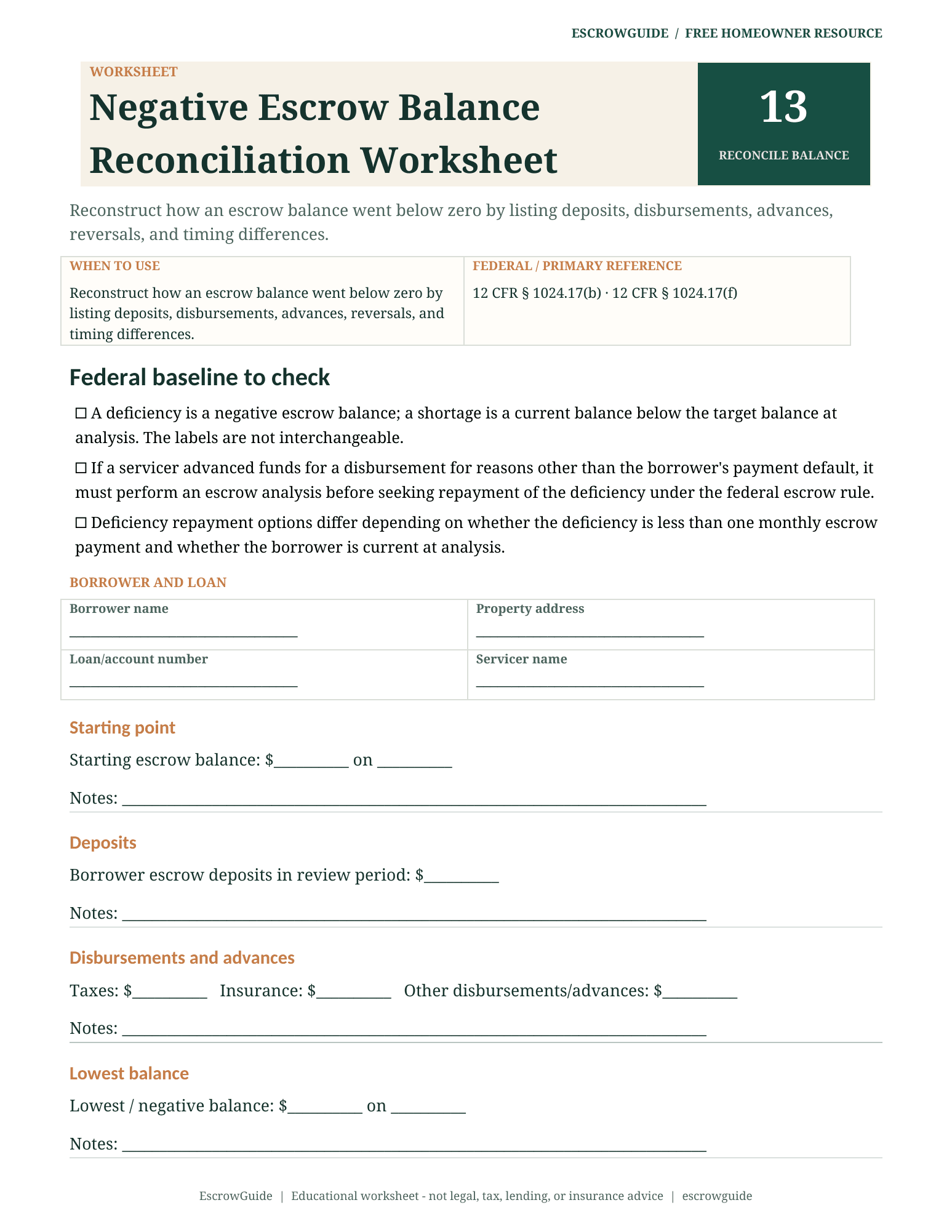
A negative escrow balance is a deficiency under Regulation X. It means the account balance itself went below zero, usually because a servicer advanced funds to pay a tax, insurance, or other escrow item when the account lacked enough money. Before seeking repayment of an advance not caused by payment default, the servicer must conduct an escrow analysis to determine the deficiency.
A dated transaction timeline usually reveals more than a single ending balance because it shows whether the problem began with forecasting, a disbursement, a transfer or a posting correction. The same approach works even when several changes take effect in one billing cycle.
Separate past catch-up from future cost
Start with two adjacent billing periods and circle every line that differs. This keeps a real tax, insurance or servicing change from being hidden inside a single all-in number. For what does a negative escrow balance mean on a mortgage, pair the disputed amount with the record that should control it. If a check fails, stop and define the failure before moving on. A duplicated payment, missing credit and wrong projection are different problems and should not be bundled into one allegation.
The governing servicing framework
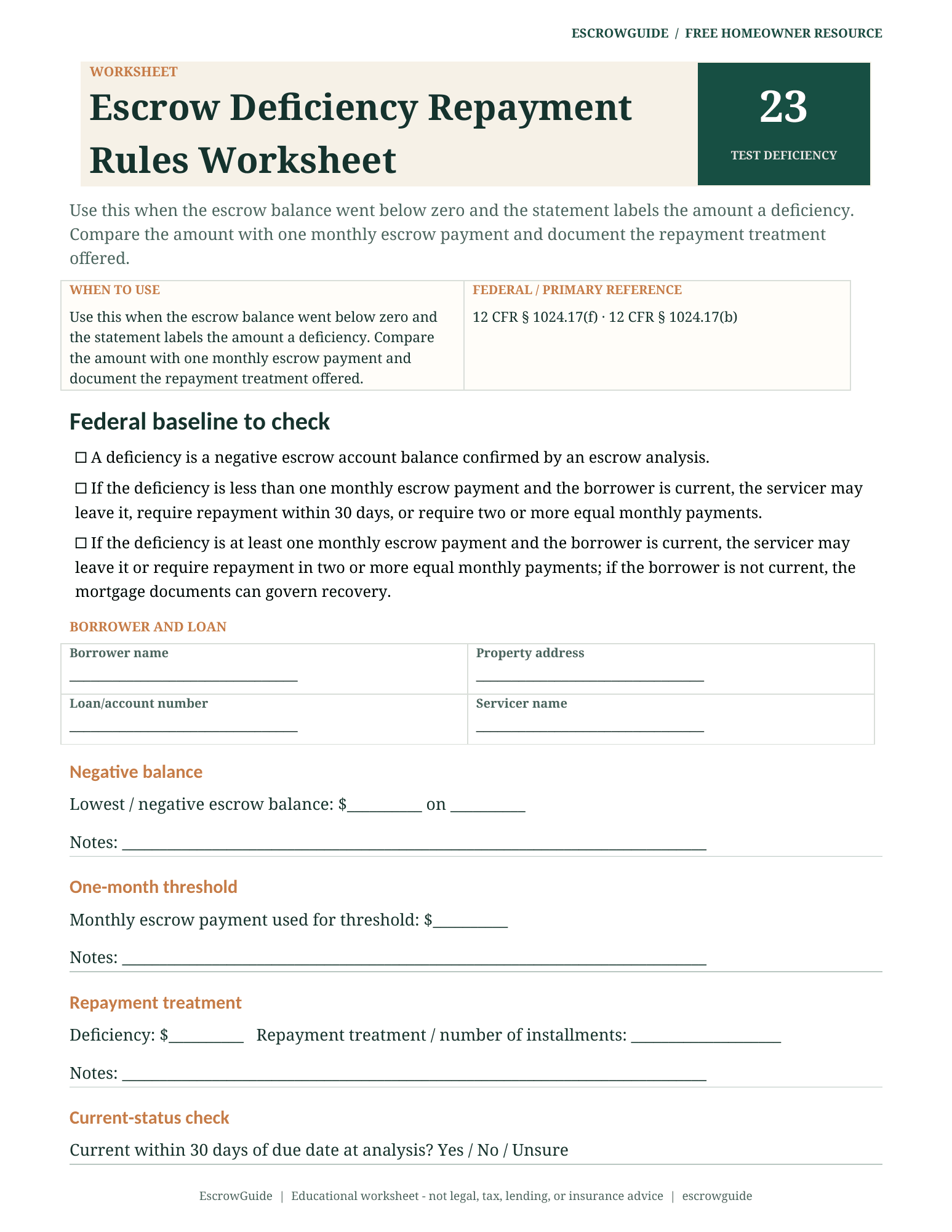
Regulation X defines deficiency as the amount of a negative balance and separately defines shortage as the amount a current balance falls below target. The repayment rules for deficiencies differ from shortage rules. For current borrowers, a deficiency may generally be left in place or collected through the options described in §1024.17(f)(4), depending on whether it is smaller than one month's escrow payment.
A regulation and a mortgage statement answer different questions. The rule defines servicing duties; the statement shows what the servicer actually posted or projected. The tax authority, insurer or investor record may still control the underlying input. The strongest follow-up names the disputed transaction instead of asserting that the entire escrow account is incorrect. A page-specific cross-check is to identify which disbursement pushed the account below zero.
Dollar example
If the escrow balance is $300 and a $1,100 insurance premium is due, the servicer may need to advance $800 to pay the policy on time. The account then shows negative $800. That is a deficiency. If the account instead remained positive but below the target cushion, it could be a shortage without being negative.
Replace the example numbers with the amounts on the actual loan documents. If the rebuilt total matches, test whether the inputs were correct; if it does not, the remaining difference points to an omitted component, posting or arithmetic issue. A page-specific cross-check is to verify the tax or insurance amount and payment date.
Documents that settle the question
The best call preparation is a one-page timeline backed by source documents. Attach the annual analysis, the relevant monthly statements and the bill, policy or transfer ledger that corresponds to each important date. A page-specific cross-check is to check whether your mortgage payment was more than 30 days overdue at the relevant time, because the rule's treatment can differ.
- Identify which disbursement pushed the account below zero.
- Verify the tax or insurance amount and payment date.
- Check whether your mortgage payment was more than 30 days overdue at the relevant time, because the rule's treatment can differ.
- Look for the escrow analysis performed before repayment was requested when required.
- Separate the deficiency amount from the new monthly deposit needed for future bills.
Turn the checklist into a short timeline. The order of collection, disbursement, analysis and notice dates often explains a balance that looks wrong when only month-end totals are compared. For this issue, also rule out treating a negative balance as a penalty.
Separate what happened from what happens next
Ask whether the disputed number is an input, a calculation or an output. A tax bill and insurance premium are inputs; an escrow trial balance is a calculation; the new monthly draft is an output. The evidence needed to challenge each one is different, so locating the level of the problem saves time. A page-specific cross-check is to look for the escrow analysis performed before repayment was requested when required.
If several explanations remain possible, list them rather than choosing the most alarming one. A projection update, posting lag, transfer cutoff and true outside-cost increase can produce similar symptoms. The next document request should be aimed at eliminating possibilities one at a time. For this issue, also rule out assuming the servicer should let insurance lapse rather than advance funds.
A clean reconciliation distinguishes what is known from what is inferred. Known facts come from dated bills, statements and rules; inferred facts are hypotheses about why a number moved. Keep those labels visible until another document converts the hypothesis into a supported explanation. A page-specific cross-check is to separate the deficiency amount from the new monthly deposit needed for future bills.
Where homeowners often misread the statement
- Treating a negative balance as a penalty.
- Assuming the servicer should let insurance lapse rather than advance funds.
- Confusing a deficiency with the maximum cushion.
- Paying an unexplained negative balance without tracing the underlying disbursement.
A second common error is jumping across several years of statements. Reconcile one change at a time; otherwise a valid tax increase can mask an unrelated transfer or posting issue. A page-specific cross-check is to identify which disbursement pushed the account below zero.
Turn the discrepancy into a testable question
A useful written follow-up sounds like a reconciliation exception: 'the analysis uses X on date A, while source B shows Y.' That is more actionable than asking the servicer to recheck the entire mortgage without identifying the discrepancy. A page-specific cross-check is to verify the tax or insurance amount and payment date.
A written inquiry creates a record; it does not automatically freeze the loan. Borrowers with consequences beyond account reconciliation may need loan-specific guidance from the appropriate professional or agency. For this issue, also rule out confusing a deficiency with the maximum cushion.
Recheck the account after the adjustment
If the explanation is timing, test it against the following cycle rather than accepting the word 'timing' by itself. The expected transaction should appear on a predictable date and amount. When it does not, the prior explanation has not actually reconciled the account. A page-specific cross-check is to check whether your mortgage payment was more than 30 days overdue at the relevant time, because the rule's treatment can differ.
When contacting a tax authority, insurer or prior servicer, ask for a record that includes the property or loan reference, amount, effective date and payment status. Those fields are more useful for reconciliation than a generic confirmation that the account is 'fine.' For this issue, also rule out paying an unexplained negative balance without tracing the underlying disbursement.