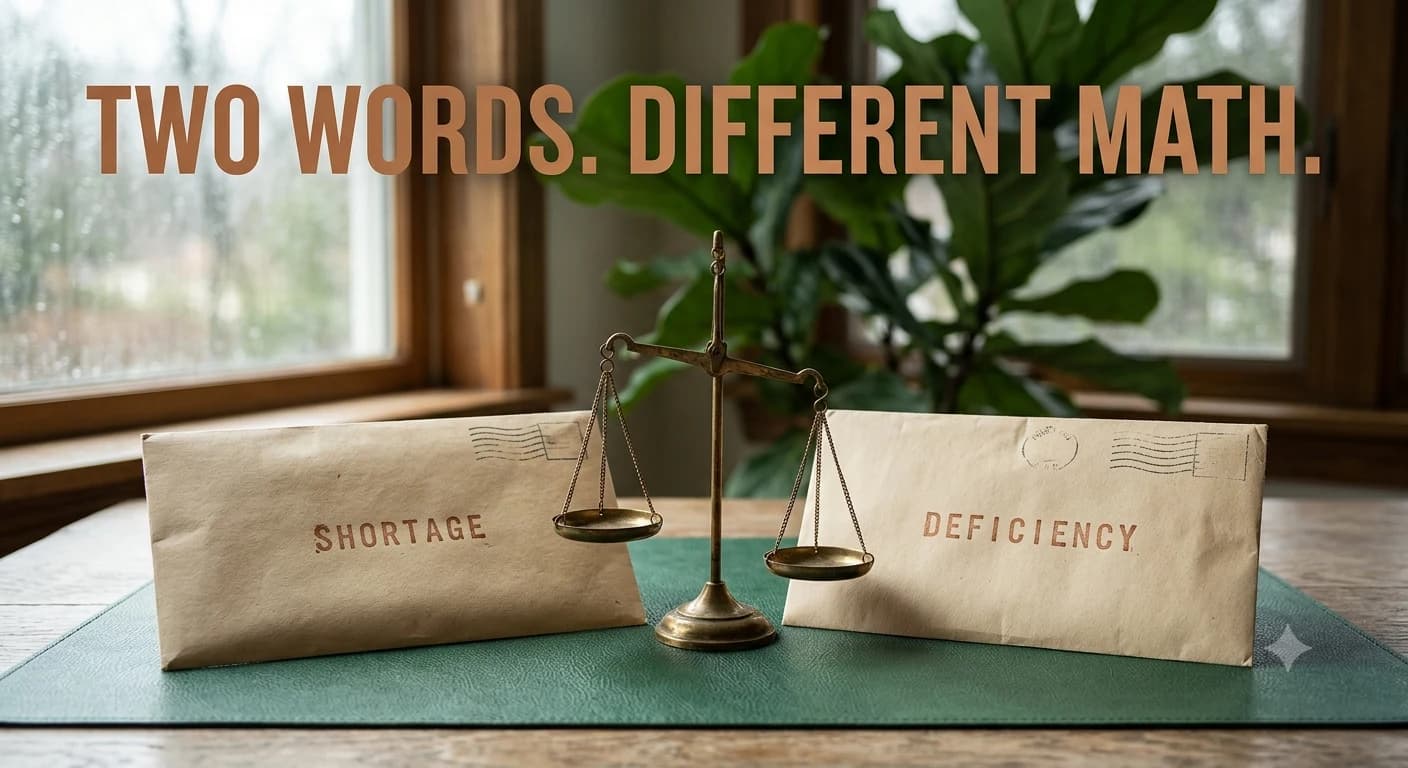
Under Regulation X, a shortage is the amount by which the current escrow balance falls below the target balance at the time of analysis. A deficiency is a negative escrow balance. The terms are not interchangeable. A shortage can exist while the account still has money in it; a deficiency means the balance itself went below zero.
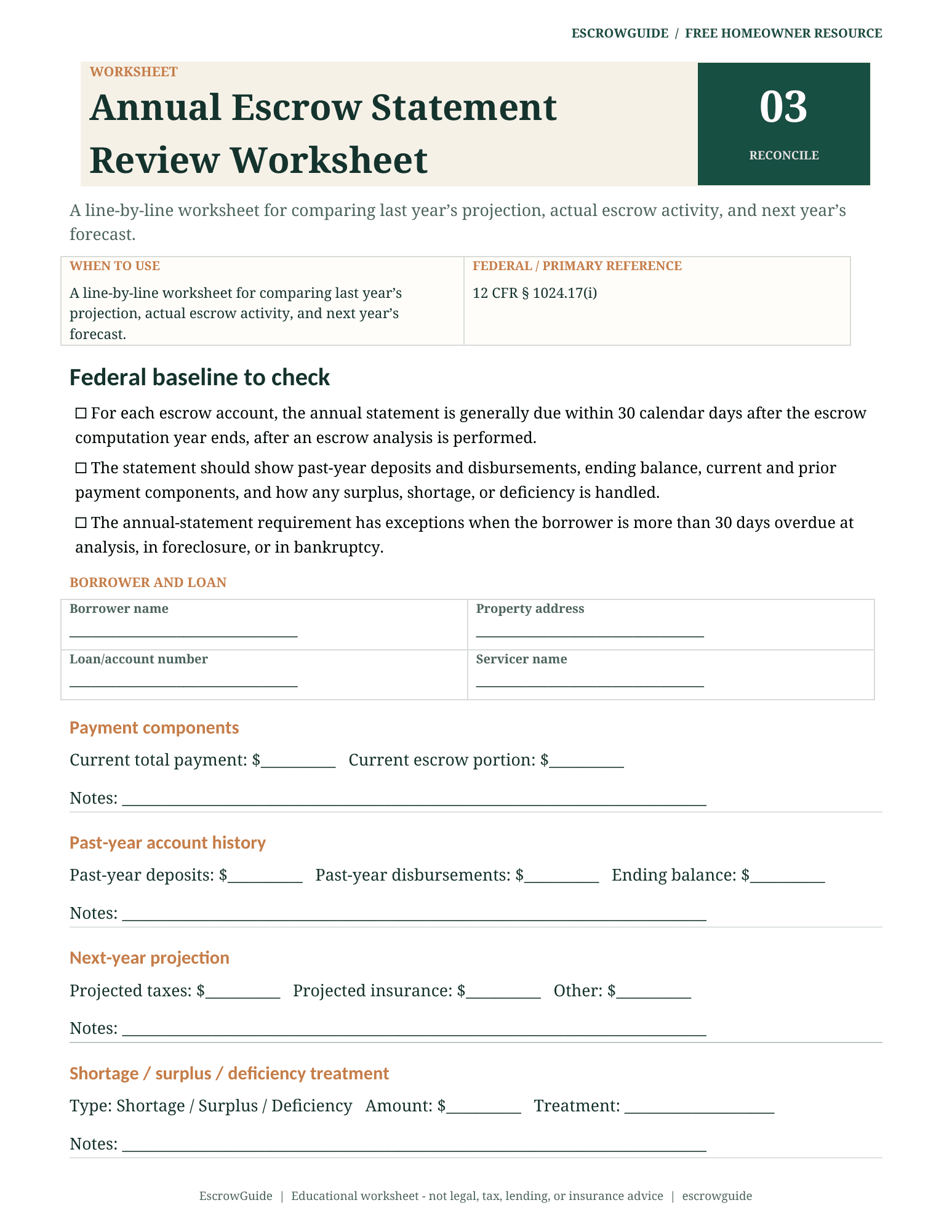
Regulation X terminology is operational rather than decorative; shortage, deficiency, surplus and cushion describe different account conditions and can lead to different treatment. The useful result is an evidence trail, not merely a second estimate of the monthly total.
Break the all-in payment into parts
Build a before-and-after ledger before deciding why the payment changed. A note rate can remain untouched while an escrow deposit, insurance charge or temporary repayment changes the amount drafted each month. For what is the difference between an escrow shortage and deficiency, pair the disputed amount with the record that should control it. If a check fails, stop and define the failure before moving on. A duplicated payment, missing credit and wrong projection are different problems and should not be bundled into one allegation.
Scope the rule carefully
The distinction matters because Regulation X gives servicers different repayment options. For a shortage smaller than one month's escrow payment, the servicer may do nothing, collect it within 30 days, or spread it over at least 12 months. For a shortage at least one month's escrow payment, the servicer may leave it or spread repayment over at least 12 months. Deficiencies have a separate rule and may be collected in two or more equal monthly payments depending on size.
Use the primary rule as a boundary rather than a universal answer. Once the federal servicing obligation is clear, verify the bill, policy, transfer record or investor rule that creates the amount entering the escrow calculation. A calculator can test magnitude, but the statement and primary records remain the evidence for the actual loan. A page-specific cross-check is to find the actual escrow balance shown at the analysis date.
Numerical walk-through
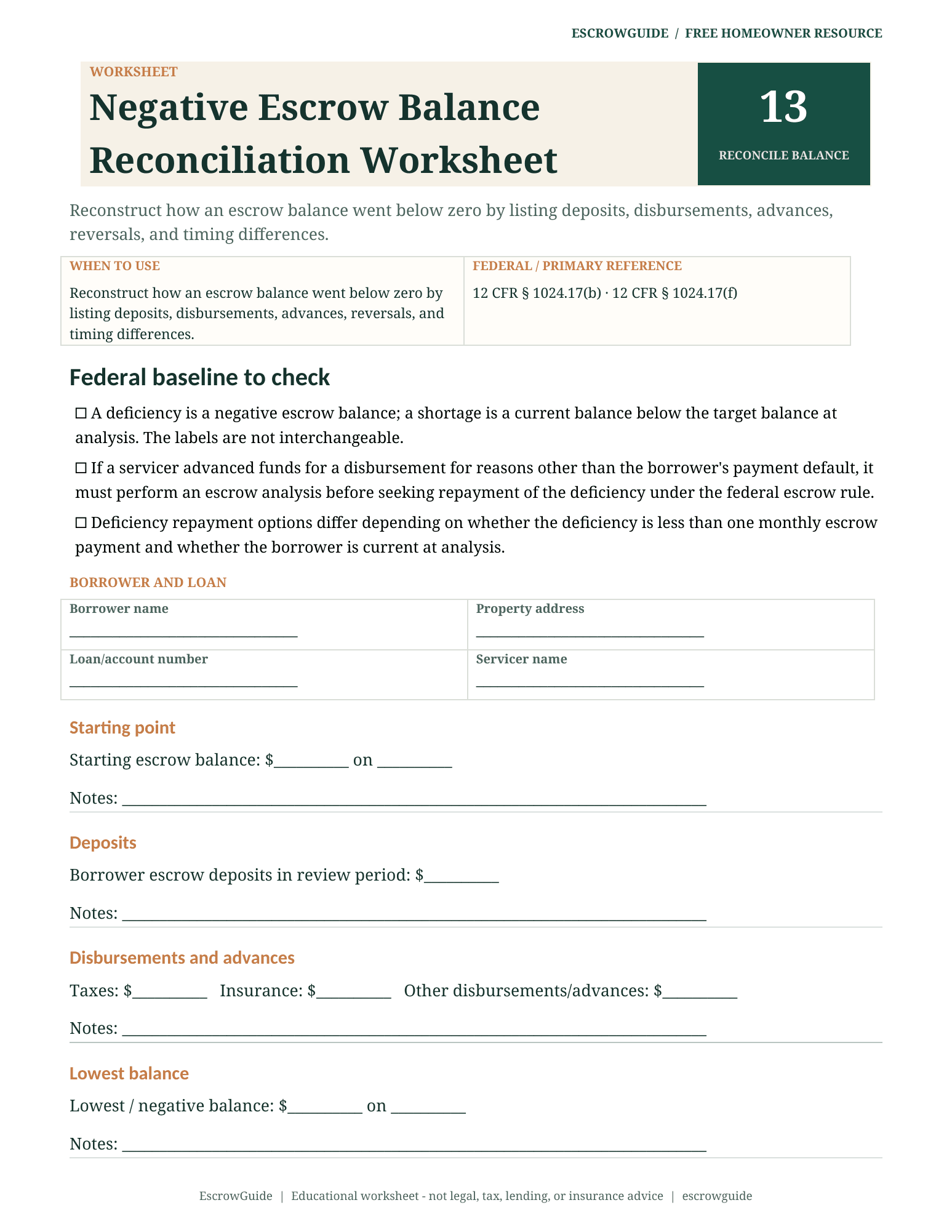
Imagine the account's target low point is $900 but the actual balance at analysis is $500. The shortage is $400 even though the balance is positive. Now imagine the actual balance is negative $400. That $400 is a deficiency. Both can raise future payments, but the regulatory labels and repayment choices are different.
Do not copy the sample outcome onto another loan. Copy only the process: identify the inputs, show the calculation, and compare the reconstructed result with the servicer's figure. A page-specific cross-check is to find the target balance or lowest projected balance used by the servicer.
Evidence checklist
Prepare the file before contacting the servicer. Start with the current and prior analysis, recent statements and the tax or insurance evidence. A dated source beside each disputed amount is more useful than a thick folder of unrelated paperwork. A page-specific cross-check is to determine whether the actual balance is positive or negative.
- Find the actual escrow balance shown at the analysis date.
- Find the target balance or lowest projected balance used by the servicer.
- Determine whether the actual balance is positive or negative.
- Read the statement's explanation of how the amount will be repaid.
- Check the monthly escrow deposit separately from the repayment amount.
Keep the sequence visible instead of reducing it to one ending balance. Escrow is a running ledger, and timing can make two snapshots misleading even when all transactions eventually reconcile. For this issue, also rule out calling every escrow problem a 'negative escrow'.
A second-pass test for the account
Ask whether the disputed number is an input, a calculation or an output. A tax bill and insurance premium are inputs; an escrow trial balance is a calculation; the new monthly draft is an output. The evidence needed to challenge each one is different, so locating the level of the problem saves time. A page-specific cross-check is to read the statement's explanation of how the amount will be repaid.
For educational estimates, label assumptions explicitly. If a simple annual amount divided by 12 is being used only as a cross-check, it should not be presented as the formal aggregate-accounting result. That distinction keeps a useful estimate from becoming false evidence of servicing error. For this issue, also rule out using the shortage amount alone to estimate next year's payment.
A clean reconciliation distinguishes what is known from what is inferred. Known facts come from dated bills, statements and rules; inferred facts are hypotheses about why a number moved. Keep those labels visible until another document converts the hypothesis into a supported explanation. A page-specific cross-check is to check the monthly escrow deposit separately from the repayment amount.
Normal change or servicing problem?
- Calling every escrow problem a 'negative escrow'.
- Using the shortage amount alone to estimate next year's payment.
- Ignoring the difference between an ongoing deposit increase and a catch-up amount.
- Assuming the servicer must collect every shortage immediately.
Avoid treating a calculator disagreement as the error itself. Simplified estimates do not capture every running-balance timing rule, while an identified wrong bill or posting is a concrete fact the servicer can investigate. A page-specific cross-check is to find the actual escrow balance shown at the analysis date.
Document the remaining gap
Before using a formal error process, make sure the allegation is operational: wrong amount, wrong date, missing transfer, duplicate disbursement, or unavailable calculation. That gives the servicer something testable to investigate. A page-specific cross-check is to find the target balance or lowest projected balance used by the servicer.
This reconciliation framework is educational. Mortgage terms, investor rules and account status may change the operational next step, so the article stops at explaining and documenting the servicing issue. For this issue, also rule out ignoring the difference between an ongoing deposit increase and a catch-up amount.
Confirm the result instead of assuming it posted
Keep the next annual analysis in the same evidence file. Some corrections solve the current ledger but affect the following computation year as well. Comparing the new opening balance and projected bills with the resolved records can catch a stale input before it creates another unexplained shortage or surplus. A page-specific cross-check is to determine whether the actual balance is positive or negative.
For large changes, keep a simple spreadsheet with one row per material transaction and columns for source, expected amount, posted amount and date. The tool is not evidence by itself, but it makes missing or duplicate entries obvious and points back to the source documents that are evidence. For this issue, also rule out assuming the servicer must collect every shortage immediately.