Worksheet · Free download
Annual Escrow Statement Review Worksheet
A line-by-line worksheet for comparing last year’s projection, actual escrow activity, and next year’s forecast.
2 pagesNo email requiredEditable + printable
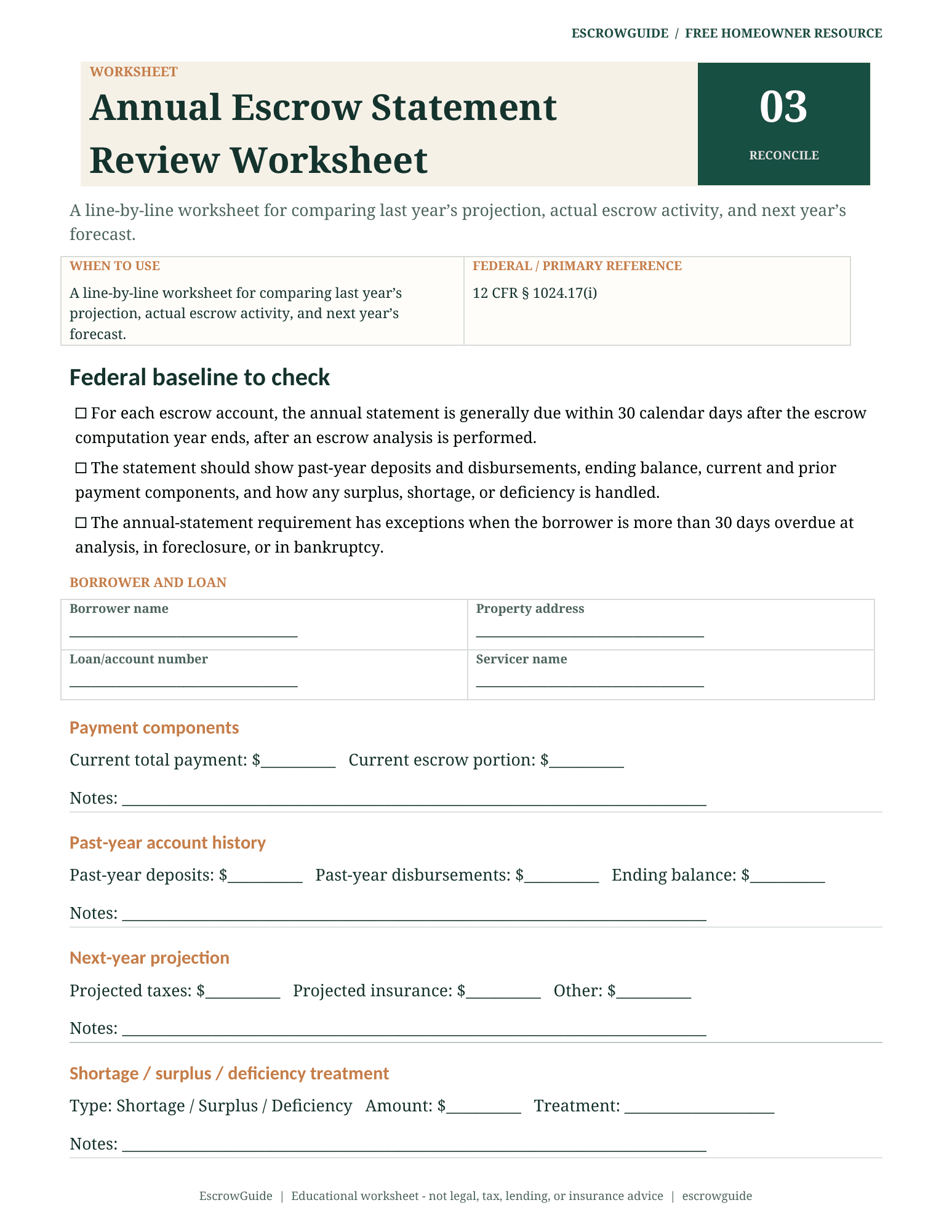
Actual first-page previewAnnual Escrow Statement Review Worksheet
Before you fill it out
What this resource helps you document
A line-by-line worksheet for comparing last year’s projection, actual escrow activity, and next year’s forecast.
01Payment components
02Past-year account history
03Next-year projection
04Shortage / surplus / deficiency treatment
05Questions to resolve
Federal baseline to check
Use the form with the rule, not instead of the rule.
These templates organize facts and records. They do not create a borrower right that the underlying regulation, loan terms, investor rules, or state law does not provide.
- For each escrow account, the annual statement is generally due within 30 calendar days after the escrow computation year ends, after an escrow analysis is performed.
- The statement should show past-year deposits and disbursements, ending balance, current and prior payment components, and how any surplus, shortage, or deficiency is handled.
- The annual-statement requirement has exceptions when the borrower is more than 30 days overdue at analysis, in foreclosure, or in bankruptcy.
Use this resource carefully
- Reconcile the historical ledger separately from the next-year projection. A correct prior-year history can still be paired with a wrong future estimate, and vice versa.
- For every projected tax or insurance item, compare the amount and due date with an outside source such as the taxing authority or insurer.
- Do not treat a shortage as proof of error by itself; first identify whether the driver is a higher bill, timing change, lower starting balance, or posting problem.