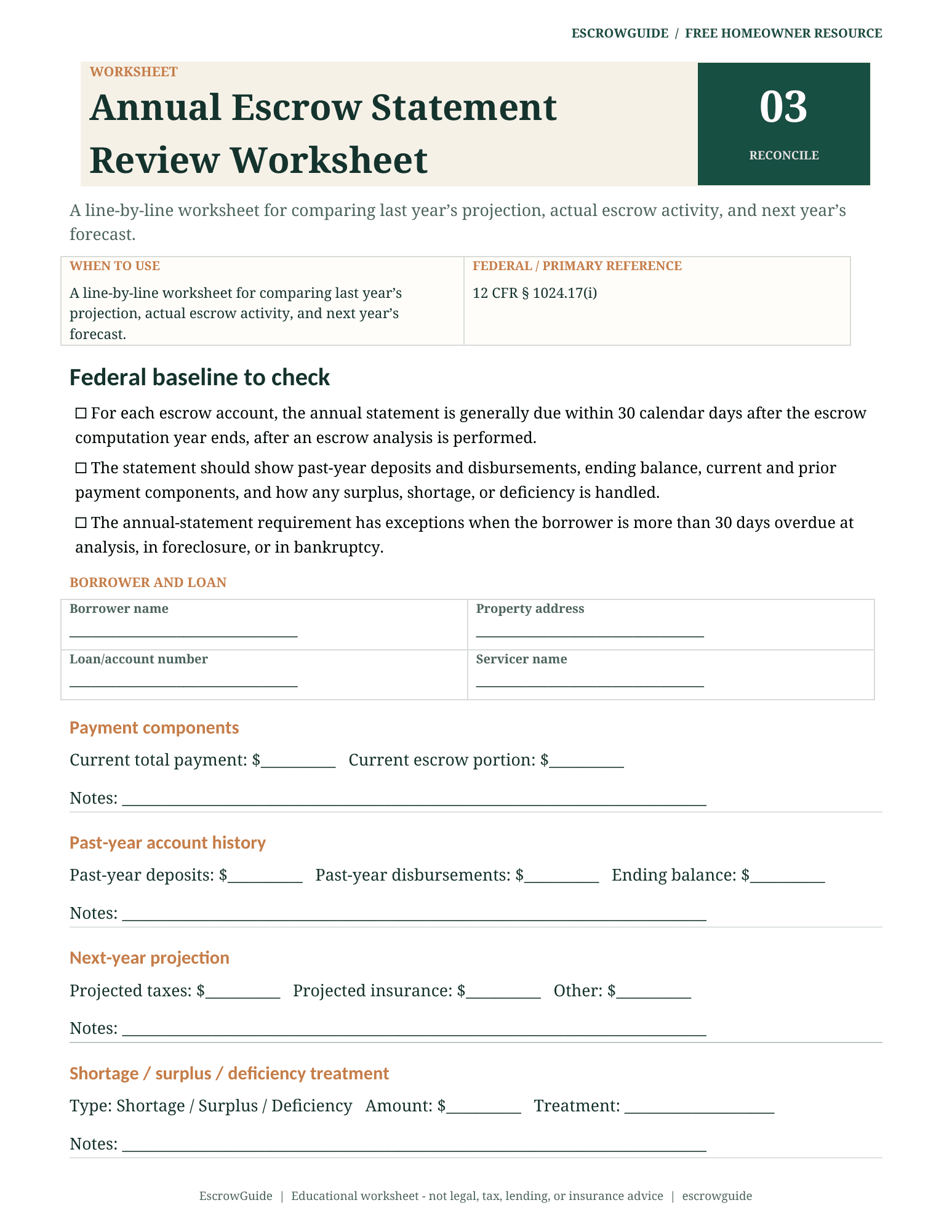
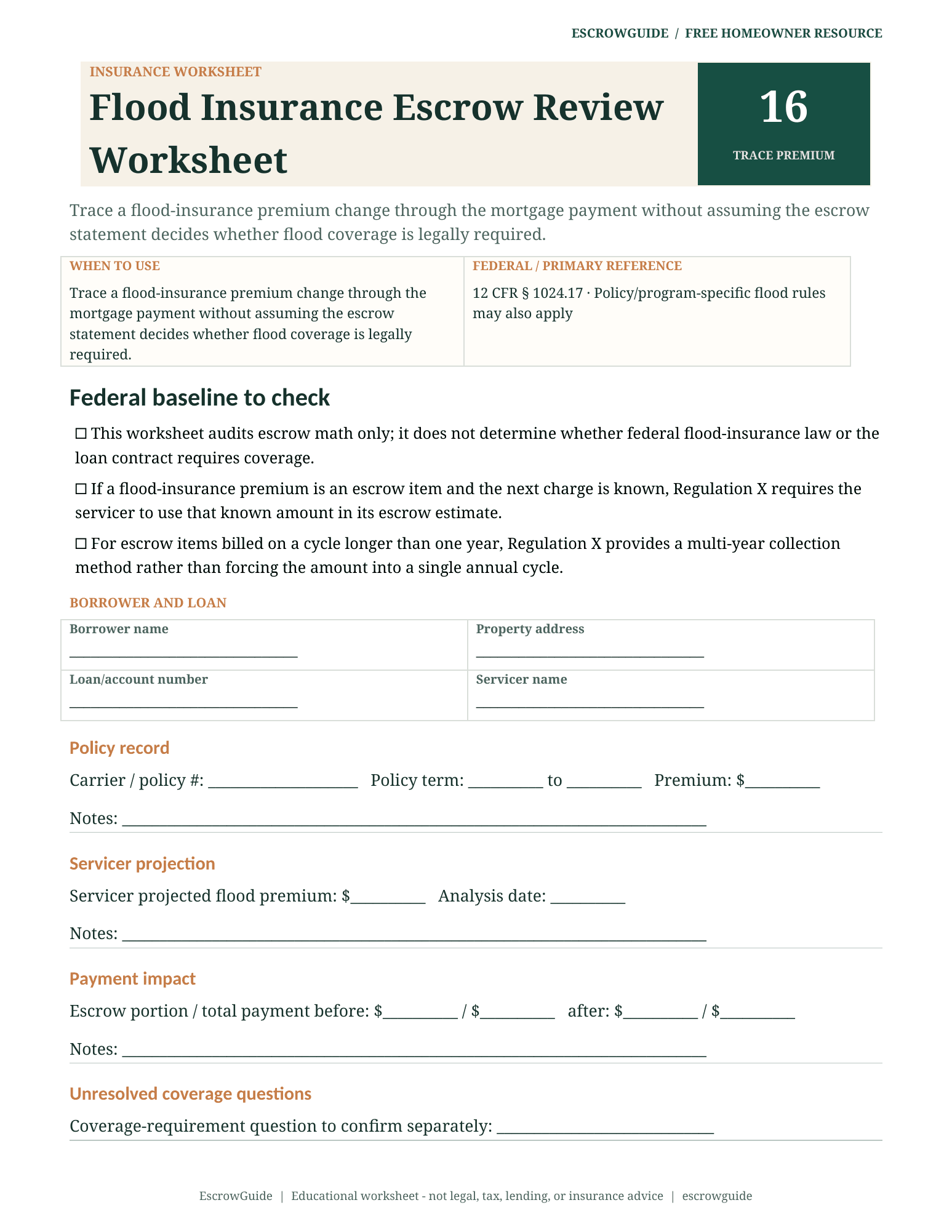
For an escrow item billed on a multi-year cycle, § 1024.17(c)(9) says the servicer estimates payments for the full cycle. The regulation gives a three-year flood-insurance premium as an example and says the servicer would collect 36 equal monthly amounts. In two of the three years, the account may not reach the low balance seen in the disbursement year, and the annual statement should explain that situation.
This issue is a useful example of why the current escrow balance is not the same thing as an excess cushion. A balance that looks high in a year with no multi-year disbursement may be necessary to fund the known bill in a later year.
Confirm the flood premium billing period is longer than one year
The source document should establish both the premium amount and the coverage/billing period. A standard one-year declarations page does not prove a three-year billing cycle. Confirm the carrier or program document that actually sets the due date and period.
Long-tail question: how does escrow work for flood insurance paid every three years. The annual escrow statement still arrives on its normal cycle. What changes is the explanation of the low-balance behavior. The regulation specifically anticipates that the low point for a multi-year item may occur only once in the full cycle rather than once every twelve months.
The rule that controls verify the actual multi-year premium amount and due date
The normal escrow computation year is twelve months, but some escrow items have billing periods longer than one year. Section 1024.17(c)(9) prevents the servicer from pretending a three-year obligation is a one-year bill. The collection is spread over the full cycle, while the annual statement explains why the projected low point may not occur in each individual year.
When taxes, homeowners insurance and multi-year flood insurance share one aggregate escrow account, the trial balance reflects all of the disbursements together. A borrower should therefore isolate the flood line without assuming the total account should equal the simple flood reserve.
Worked example: Map the full 36-month cycle rather than one annual statement
Assume a flood-insurance premium of $3,600 is payable once every three years and the amount is known for illustration. Ignoring other escrow items, a full-cycle collection model would allocate $100 per month over 36 months. During years one and two, the balance builds because no flood premium is disbursed. In year three, the disbursement consumes the accumulated amount. An annual statement showing a relatively high year-end balance in year two is not automatically an improper cushion; the multi-year bill must be analyzed over its full cycle.
A premium change mid-cycle can alter the remaining collection requirement. The audit should identify whether the new amount applies to the existing three-year obligation, a renewal, or a replacement policy; those are different events in the ledger.
Account audit from Confirm the flood premium billing period is longer than one year to Keep coverage requirements separate from escrow accounting
Confirm the flood premium billing period is longer than one year
This issue is a useful example of why the current escrow balance is not the same thing as an excess cushion. A balance that looks high in a year with no multi-year disbursement may be necessary to fund the known bill in a later year. Evidence target: Confirm the flood premium billing period is longer than one year. Next comparison: Verify the actual multi-year premium amount and due date. Error to avoid: calling a multi-year reserve an excessive annual cushion.
Verify the actual multi-year premium amount and due date
The source document should establish both the premium amount and the coverage/billing period. A standard one-year declarations page does not prove a three-year billing cycle. Confirm the carrier or program document that actually sets the due date and period. Evidence target: Verify the actual multi-year premium amount and due date. Next comparison: Map the full 36-month cycle rather than one annual statement. Error to avoid: dividing the premium by twelve instead of the full billing cycle.
Map the full 36-month cycle rather than one annual statement
The annual escrow statement still arrives on its normal cycle. What changes is the explanation of the low-balance behavior. The regulation specifically anticipates that the low point for a multi-year item may occur only once in the full cycle rather than once every twelve months. Evidence target: Map the full 36-month cycle rather than one annual statement. Next comparison: Separate the flood reserve from other aggregate escrow items. Error to avoid: assuming every annual statement must reach the same low balance.
Separate the flood reserve from other aggregate escrow items
When taxes, homeowners insurance and multi-year flood insurance share one aggregate escrow account, the trial balance reflects all of the disbursements together. A borrower should therefore isolate the flood line without assuming the total account should equal the simple flood reserve. Evidence target: Separate the flood reserve from other aggregate escrow items. Next comparison: Locate the year in which the actual flood disbursement occurs. Error to avoid: using a one-year policy document to prove a multi-year bill.
Locate the year in which the actual flood disbursement occurs
A premium change mid-cycle can alter the remaining collection requirement. The audit should identify whether the new amount applies to the existing three-year obligation, a renewal, or a replacement policy; those are different events in the ledger. Evidence target: Locate the year in which the actual flood disbursement occurs. Next comparison: Check the annual statement explanation for the unusual low balance. Error to avoid: mixing coverage eligibility questions with escrow arithmetic.
Check the annual statement explanation for the unusual low balance
This federal example explains escrow accounting, not whether a particular property is required to carry flood insurance or what coverage amount is sufficient. Those coverage questions belong to separate flood-insurance rules and policy documents. Evidence target: Check the annual statement explanation for the unusual low balance. Next comparison: Recalculate remaining deposits after any premium change. Error to avoid: calling a multi-year reserve an excessive annual cushion.
Recalculate remaining deposits after any premium change
This issue is a useful example of why the current escrow balance is not the same thing as an excess cushion. A balance that looks high in a year with no multi-year disbursement may be necessary to fund the known bill in a later year. Evidence target: Recalculate remaining deposits after any premium change. Next comparison: Keep coverage requirements separate from escrow accounting. Error to avoid: dividing the premium by twelve instead of the full billing cycle.
Keep coverage requirements separate from escrow accounting
The source document should establish both the premium amount and the coverage/billing period. A standard one-year declarations page does not prove a three-year billing cycle. Confirm the carrier or program document that actually sets the due date and period. Evidence target: Keep coverage requirements separate from escrow accounting. Next comparison: Confirm the flood premium billing period is longer than one year. Error to avoid: assuming every annual statement must reach the same low balance.
Evidence table for “how does escrow work for flood insurance paid every three years”
| Step | What to verify | Failure mode |
|---|---|---|
| 1 | Confirm the flood premium billing period is longer than one year | calling a multi-year reserve an excessive annual cushion |
| 2 | Verify the actual multi-year premium amount and due date | dividing the premium by twelve instead of the full billing cycle |
| 3 | Map the full 36-month cycle rather than one annual statement | assuming every annual statement must reach the same low balance |
| 4 | Separate the flood reserve from other aggregate escrow items | using a one-year policy document to prove a multi-year bill |
| 5 | Locate the year in which the actual flood disbursement occurs | mixing coverage eligibility questions with escrow arithmetic |
| 6 | Check the annual statement explanation for the unusual low balance | calling a multi-year reserve an excessive annual cushion |
| 7 | Recalculate remaining deposits after any premium change | dividing the premium by twelve instead of the full billing cycle |
| 8 | Keep coverage requirements separate from escrow accounting | assuming every annual statement must reach the same low balance |
What can change the answer
This federal example explains escrow accounting, not whether a particular property is required to carry flood insurance or what coverage amount is sufficient. Those coverage questions belong to separate flood-insurance rules and policy documents.
- calling a multi-year reserve an excessive annual cushion
- dividing the premium by twelve instead of the full billing cycle
- assuming every annual statement must reach the same low balance
- using a one-year policy document to prove a multi-year bill
- mixing coverage eligibility questions with escrow arithmetic
Primary authority for this servicing question
- CFPB Regulation X — § 1024.17(c)(9) ↗
how does escrow work for flood insurance paid every three years — use CFPB Regulation X — § 1024.17(c)(9) to verify the federal or investor rule described above; use the borrower’s own statements, bills and transaction history for loan-level facts.
- eCFR — 12 CFR § 1024.17(c)(9) ↗
how does escrow work for flood insurance paid every three years — use eCFR — 12 CFR § 1024.17(c)(9) to verify the federal or investor rule described above; use the borrower’s own statements, bills and transaction history for loan-level facts.
Scope: this guide explains mortgage-servicing mechanics for how does escrow work for flood insurance paid every three years. It does not provide personalized legal, tax, insurance-coverage or loan-choice advice. Where local law, mortgage documents or investor rules matter, verify those authorities separately.