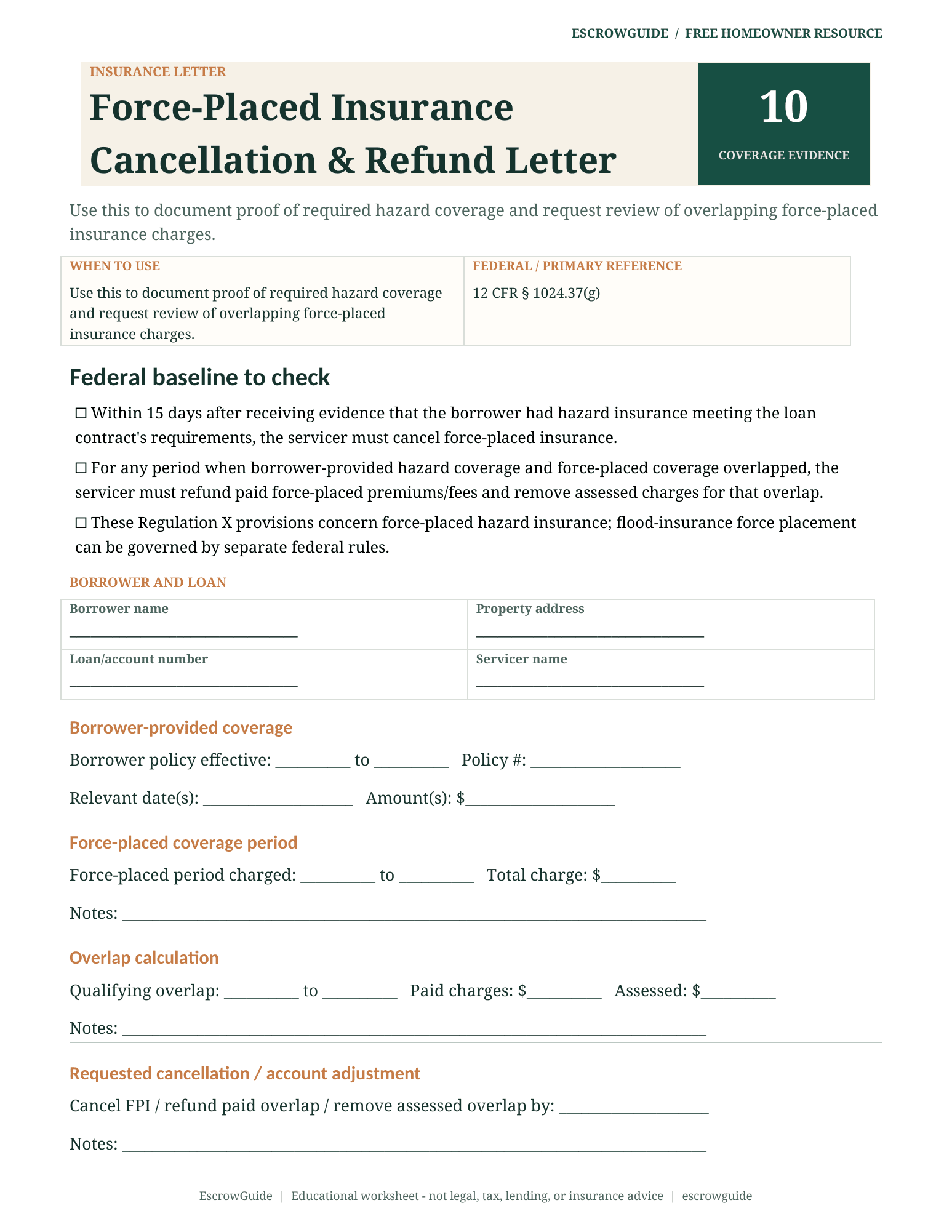
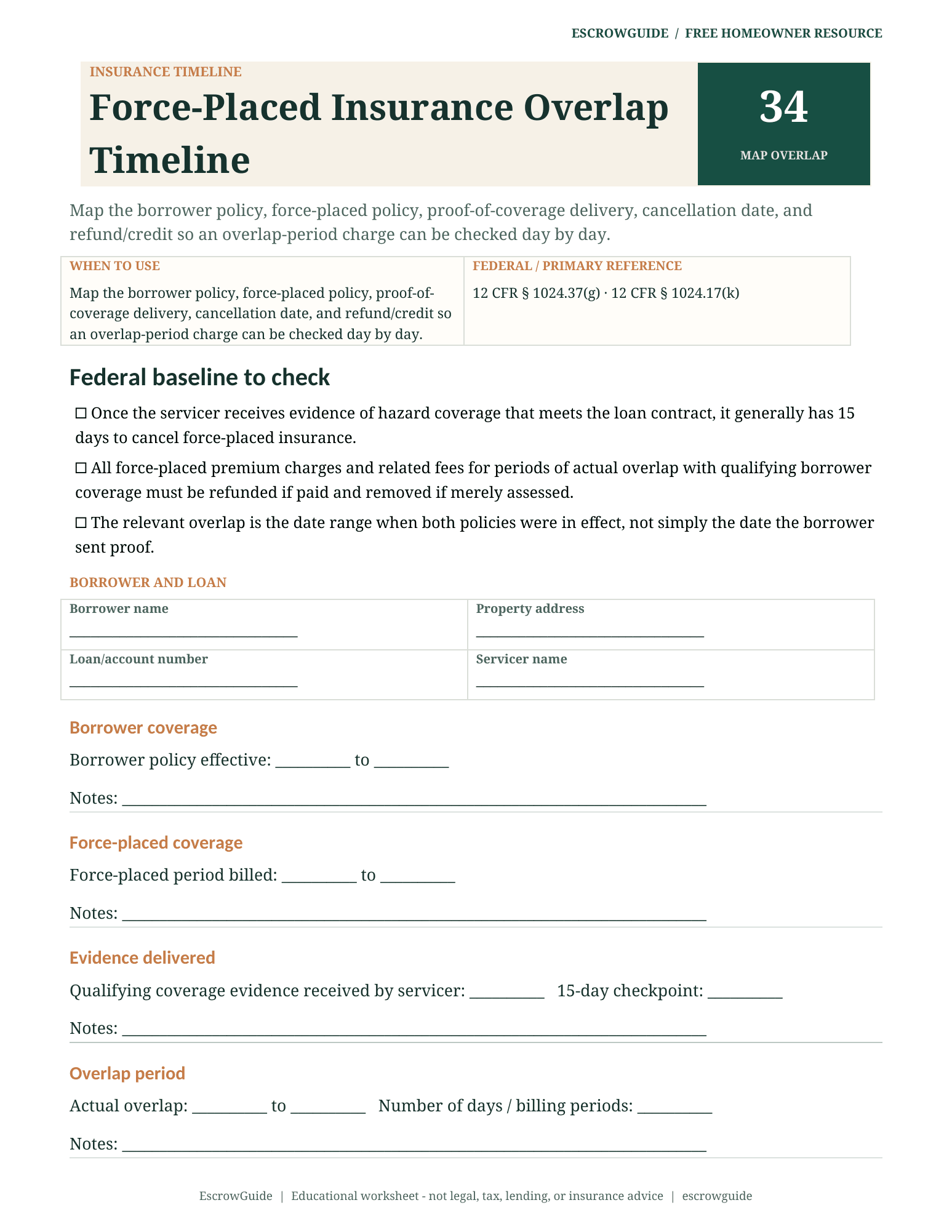
Force-placed insurance is coverage a servicer obtains when it reasonably believes the borrower has failed to maintain required hazard insurance. It can be substantially more expensive than borrower-purchased coverage. If the premium is charged through the mortgage account or escrow ledger, it can create both a historical shortfall and a higher payment until the charge is corrected, cancelled or absorbed through the next escrow analysis.
Insurance is an outside bill administered through the escrow account, so the policy record and the servicing ledger have to agree before the payment change is explained. That distinction prevents an old balance problem from being mistaken for a new recurring cost.
Read the account in the right order
There are two audits here: insurance coverage and escrow math. First establish whether a coverage gap actually existed and which days, if any, were legitimately force placed. Only then recalculate the escrow effect. That order prevents a correct escrow calculation from distracting from an incorrect insurance charge, or vice versa.
Where federal servicing rules fit
Regulation X § 1024.37 generally requires a servicer to have a reasonable basis to believe required hazard coverage lapsed and to provide notices before charging for force-placed insurance. The rule generally uses a 45-day first-notice timeline before a charge may be imposed. If the borrower later provides evidence of overlapping coverage, the regulation contains cancellation and refund requirements for the overlapping period.
Regulation X can tell a servicer how to analyze or administer escrow without determining the underlying tax or insurance charge. Keep the rule question and the outside-bill question separate so a correct calculation does not validate a wrong input. A calculator can test magnitude, but the statement and primary records remain the evidence for the actual loan. A page-specific cross-check is to find the date your original coverage allegedly ended and compare it with the declarations page, renewal receipt and insurer payment history.
A concrete scenario
Assume the prior homeowners policy cost $1,900 a year, or about $158 per month when annualized. A force-placed policy is charged at $4,300. The $2,400 difference is $200 a month on a simple annual basis before any shortage treatment. If the servicer already paid or charged the higher premium and the account falls $1,800 below target, a separate $150 monthly shortage repayment over 12 months could temporarily sit on top of the higher projected insurance amount.
Use the arithmetic to narrow the question. A match shifts attention to the validity of the tax, insurance or balance inputs; a mismatch shifts attention to posting, timing or a component that has not yet been accounted for. A page-specific cross-check is to save both force-placed notices and note when each was sent.
Reconcile the evidence
Prepare the file before contacting the servicer. Start with the current and prior analysis, recent statements and the tax or insurance evidence. A dated source beside each disputed amount is more useful than a thick folder of unrelated paperwork. A page-specific cross-check is to send proof of continuous or replacement coverage to the address or channel the servicer specifies for insurance evidence.
- Find the date your original coverage allegedly ended and compare it with the declarations page, renewal receipt and insurer payment history.
- Save both force-placed notices and note when each was sent.
- Send proof of continuous or replacement coverage to the address or channel the servicer specifies for insurance evidence.
- After cancellation, verify the effective date and any premium refund or account credit for overlapping coverage.
- Check the next escrow analysis to make sure the projected premium no longer includes a cancelled force-placed amount.
Dates matter as much as dollars. A transaction posted a few days before or after the analysis date can explain why a borrower and servicer appear to be starting from different balances. For this issue, also rule out ignoring a force-placed notice because a policy exists without confirming the servicer received evidence.
Finish with a timeline check
Use a control total. Add only the components that should be active for the month being reviewed and compare that sum with the statement total. If the control total matches, investigate the components themselves. If it does not, identify the missing or extra line before debating whether an outside bill is correct. A page-specific cross-check is to after cancellation, verify the effective date and any premium refund or account credit for overlapping coverage.
Do not erase uncertainty with a confident label. If the evidence shows only that two records differ, say that. The next step is to identify which record should control and whether a correction, credit, recalculation or simply a clearer explanation is warranted under the applicable rule. For this issue, also rule out assuming the entire payment increase will disappear the day evidence is sent.
Keep estimates labeled as estimates. A simple monthly division is useful for checking direction and scale, but Regulation X aggregate accounting can depend on disbursement dates and the running balance. A rough check should narrow the investigation, not be treated as conclusive proof that formal escrow math is wrong. A page-specific cross-check is to check the next escrow analysis to make sure the projected premium no longer includes a cancelled force-placed amount.
Common false signals
- Ignoring a force-placed notice because a policy exists without confirming the servicer received evidence.
- Assuming the entire payment increase will disappear the day evidence is sent.
- Failing to verify the refund period when borrower coverage overlapped the force-placed policy.
- Treating flood-insurance placement as identical to every hazard-insurance rule without checking the applicable provision.
Avoid treating a calculator disagreement as the error itself. Simplified estimates do not capture every running-balance timing rule, while an identified wrong bill or posting is a concrete fact the servicer can investigate. A page-specific cross-check is to find the date your original coverage allegedly ended and compare it with the declarations page, renewal receipt and insurer payment history.
If the ledger still does not tie
A servicing request is most useful after the audit has reduced the problem to one or two disputed entries. Follow any designated address requirement and preserve the complete submission and proof that it was delivered. A page-specific cross-check is to save both force-placed notices and note when each was sent.
A written inquiry creates a record; it does not automatically freeze the loan. Borrowers with consequences beyond account reconciliation may need loan-specific guidance from the appropriate professional or agency. For this issue, also rule out failing to verify the refund period when borrower coverage overlapped the force-placed policy.
Close the loop on the following statement
Save any corrected analysis as a new version instead of replacing the original. Differences between the two documents can show exactly which input or balance changed and can be important if a later statement appears to revert to the earlier, incorrect figure. A page-specific cross-check is to send proof of continuous or replacement coverage to the address or channel the servicer specifies for insurance evidence.
For tax and insurance disputes, distinguish the billing address from the property and policy identifiers. A payment sent to the correct company can still be misapplied, so matching parcel number, policy number and covered period can matter as much as matching the dollar amount. For this issue, also rule out treating flood-insurance placement as identical to every hazard-insurance rule without checking the applicable provision.