A large homeowners-insurance renewal can create a 'double hit': the escrow account may have paid a premium higher than the prior estimate, creating a shortage, and the next analysis may also raise the ongoing monthly deposit to prepare for the next premium. Treat those as separate layers so you can see which part is temporary and which part is likely to persist.
Insurance is an outside bill administered through the escrow account, so the policy record and the servicing ledger have to agree before the payment change is explained. This turns a surprising payment into a set of smaller questions that can each be verified.
The payment question to isolate first
The fastest audit starts one level below the total payment. Compare the same line items on the statement before and after the change, then identify which component moved first and which document should support it. For escrow shortage after homeowners insurance increase, pair the disputed amount with the record that should control it. Keep the sequence visible instead of reducing it to one ending balance. Escrow is a running ledger, and timing can make two snapshots misleading even when all transactions eventually reconcile.
The rule boundary
When the next charge is known, Regulation X directs the servicer to use the known amount in its escrow estimate. If the charge is not known, the rule allows specified estimation methods. The account is then analyzed as a whole, and any shortage is handled under the shortage rules.
Federal servicing rules are the baseline, not the source of every dollar on the statement. Taxes, premiums and program-specific terms can originate elsewhere, so each input needs the authority that actually controls it. A calculator can test magnitude, but the statement and primary records remain the evidence for the actual loan. A page-specific cross-check is to get the renewal declarations page showing premium, effective dates, and coverages.
Run the numbers
Suppose insurance was projected at $1,800 but renewed at $2,700. If the servicer paid the $900 difference from escrow, the account may finish below its target. At the same time, the next year's estimate may use the $2,700 known premium, increasing the monthly base by about $75 compared with the old premium. A shortage repayment can add another temporary amount on top.
Use the arithmetic to narrow the question. A match shifts attention to the validity of the tax, insurance or balance inputs; a mismatch shifts attention to posting, timing or a component that has not yet been accounted for. A page-specific cross-check is to check whether the servicer paid the correct insurer and policy amount.
Build the document trail
Collect the smallest set of records that can prove or disprove the explanation: the relevant escrow analysis, nearby mortgage statements and the outside document tied to the change. Add transfer, payoff, hardship or correction records only when the timeline requires them. A page-specific cross-check is to compare the insurance amount on the escrow analysis with the renewal premium.
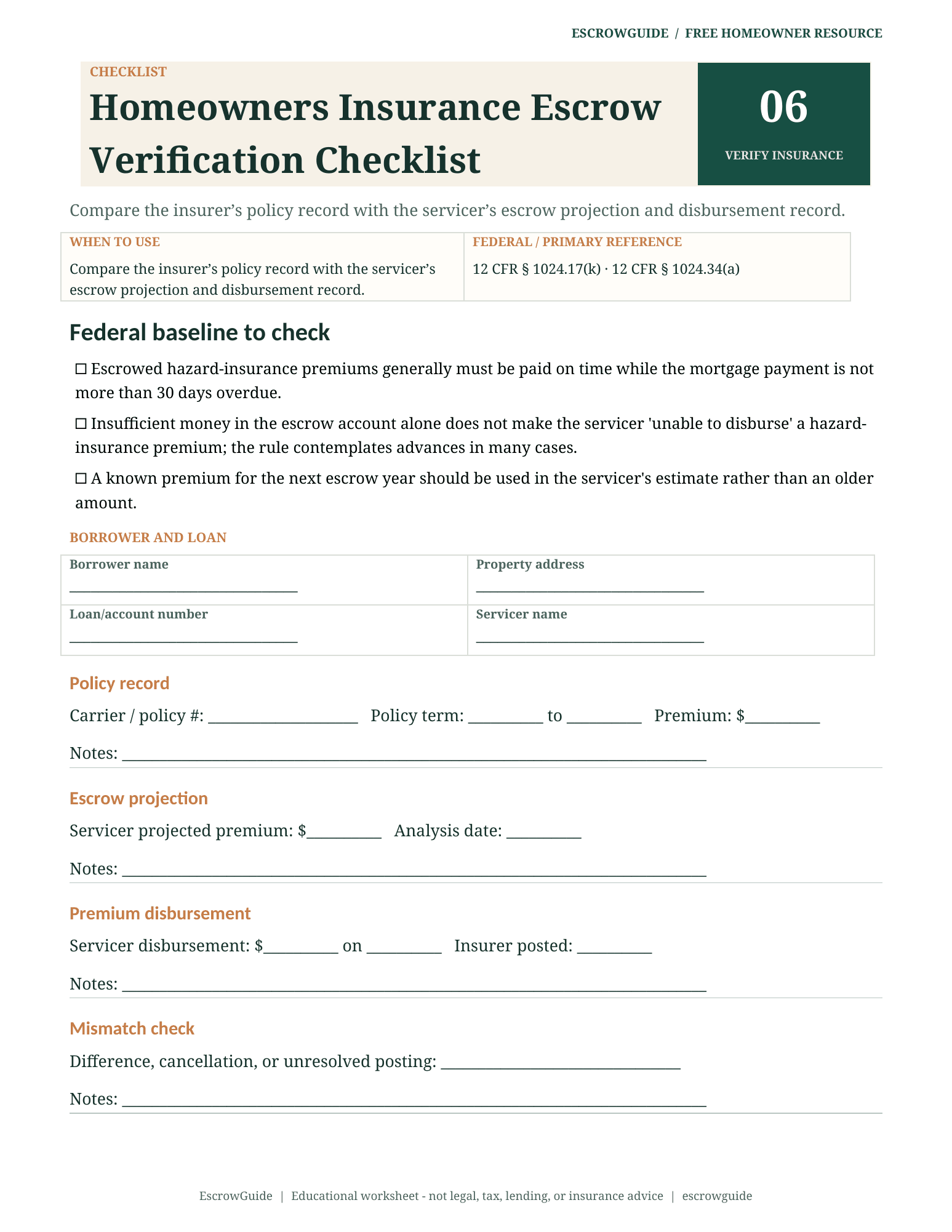
- Get the renewal declarations page showing premium, effective dates, and coverages.
- Check whether the servicer paid the correct insurer and policy amount.
- Compare the insurance amount on the escrow analysis with the renewal premium.
- If you change insurers, send the new declarations page and cancellation information promptly so the servicer does not project or pay two policies.
- Confirm any refund from the old insurer was credited appropriately.
Dates matter as much as dollars. A transaction posted a few days before or after the analysis date can explain why a borrower and servicer appear to be starting from different balances. For this issue, also rule out shopping insurance only after the escrow analysis without sending updated proof to the servicer.
Before treating the result as an error
Test causation in chronological order. First identify the outside event or account entry, then the servicer's response, then the monthly-payment effect. Reversing that order—starting from the payment and guessing backward—makes unrelated events look connected and encourages conclusions the records may not support. A page-specific cross-check is to if you change insurers, send the new declarations page and cancellation information promptly so the servicer does not project or pay two policies.
For educational estimates, label assumptions explicitly. If a simple annual amount divided by 12 is being used only as a cross-check, it should not be presented as the formal aggregate-accounting result. That distinction keeps a useful estimate from becoming false evidence of servicing error. For this issue, also rule out assuming every increase is a servicer error when the underlying premium really changed.
When the evidence points outside the servicer, follow it. A tax assessment question belongs with the taxing authority, a policy-premium question with the insurer, and an investor-specific eligibility question with the applicable program material. The servicer can explain how it used those inputs without necessarily controlling them. A page-specific cross-check is to confirm any refund from the old insurer was credited appropriately.
What would count as a real mismatch
- Shopping insurance only after the escrow analysis without sending updated proof to the servicer.
- Assuming every increase is a servicer error when the underlying premium really changed.
- Ignoring duplicate-policy or force-placed-insurance issues.
- Focusing on the shortage while leaving the higher renewal premium unexplained.
The strongest red flags are transactional: an amount cannot be tied to a source, a transfer loses a balance, a disbursement appears twice, or an outside bill and the servicer's projection disagree on the same date. A page-specific cross-check is to get the renewal declarations page showing premium, effective dates, and coverages.
Questions worth putting in writing
If the call center cannot reconcile the account, convert the timeline into a written question. Regulation X has procedures for certain servicing errors and information requests, but the submission should still be anchored to concrete account facts. A page-specific cross-check is to check whether the servicer paid the correct insurer and policy amount.
Servicing research is different from personalized advice. Use the evidence to ask a precise question, while treating payment, legal and tax decisions as fact-specific matters beyond this general explanation. For this issue, also rule out ignoring duplicate-policy or force-placed-insurance issues.
One final transaction-history check
For a payment change with both temporary and recurring layers, calendar when the temporary layer is expected to end. The payment after that date should still reflect whatever ongoing escrow, insurance or other recurring amounts remain. This makes the later statement a useful confirmation of the original analysis. A page-specific cross-check is to compare the insurance amount on the escrow analysis with the renewal premium.
For tax and insurance disputes, distinguish the billing address from the property and policy identifiers. A payment sent to the correct company can still be misapplied, so matching parcel number, policy number and covered period can matter as much as matching the dollar amount. For this issue, also rule out focusing on the shortage while leaving the higher renewal premium unexplained.