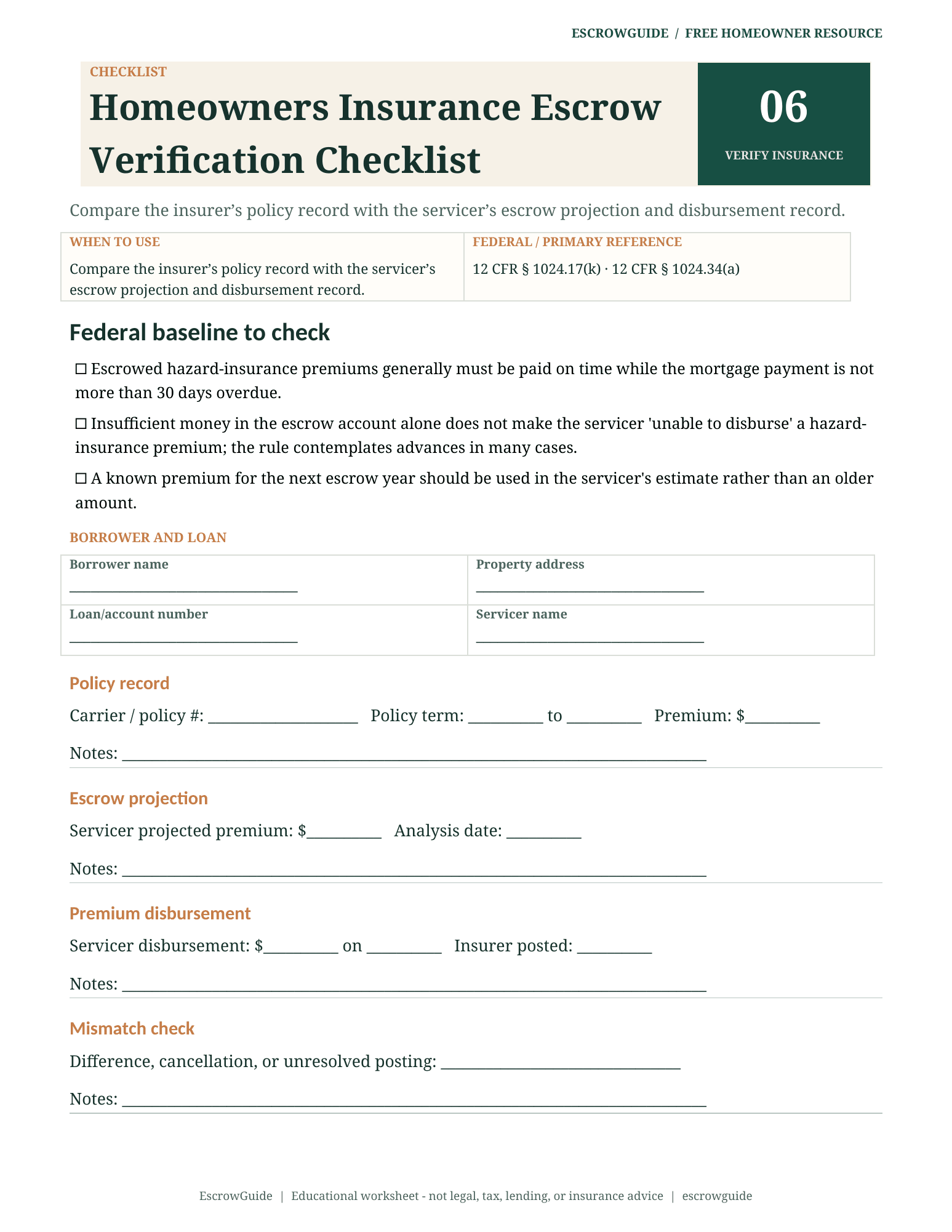
A lower homeowners-insurance premium can reduce future escrow needs, but the mortgage payment may not fall immediately. The servicer needs the new premium information, the old policy may generate a refund, and the account may still contain a prior shortage. Timing depends on when the servicer learns the new charge and when it performs or updates its escrow analysis.
Insurance is an outside bill administered through the escrow account, so the policy record and the servicing ledger have to agree before the payment change is explained. The same approach works even when several changes take effect in one billing cycle.
Start with the component that moved
Treat the monthly total as the result, not the evidence. Reconstruct it from P&I, escrow, shortage or deficiency treatment, mortgage insurance and any other listed charge so the first unexplained movement is visible. For homeowners insurance decreased will mortgage payment go down, pair the disputed amount with the record that should control it. Each checked item should end with a citation to a statement page, bill or transaction. If one step has no source record, that unsupported step becomes the next research target.
What the regulation controls — and what it does not
Regulation X says that when the next escrow charge is known, the servicer uses the known amount in estimating disbursements for the analysis. The rule permits analyses at times other than the annual endpoint, but it does not require an instant payment recalculation every time a policy premium changes.
The rulebook does not replace the account evidence. It tells you what should happen; dated statements and outside records show what did happen. A mismatch matters only after those two layers are compared on the same facts. Investor-specific guidance should be labeled as such rather than presented as a universal borrower right. A page-specific cross-check is to obtain the new declarations page and invoice showing premium and effective date.
Worked case
Your insurance renewal drops from $3,000 to $2,160, an $840 annual decrease or $70 a month in simple annualized terms. If the current payment also includes a $120 monthly shortage repayment from the prior year, the total payment may not fall by the full $70 immediately—or the servicer may wait for the scheduled analysis before adjusting.
The example is a reconciliation method, not a forecast. Substituting the reader's dated figures should either reproduce the statement or isolate a smaller residual that can be investigated directly. A page-specific cross-check is to send it through the servicer's insurance or escrow channel and keep confirmation.
Create a before-and-after record
Build a compact evidence packet that a second reader could follow without explanation. Include the statement that introduced the change, the prior comparison point, and the official record that should support the changed amount. A page-specific cross-check is to if you switched carriers midterm, track any refund from the old carrier and where it was sent.
- Obtain the new declarations page and invoice showing premium and effective date.
- Send it through the servicer's insurance or escrow channel and keep confirmation.
- If you switched carriers midterm, track any refund from the old carrier and where it was sent.
- Ask whether the servicer will run an off-cycle analysis or wait until the annual analysis.
- After the new statement arrives, compare the projected premium with the new known charge.
Dates matter as much as dollars. A transaction posted a few days before or after the analysis date can explain why a borrower and servicer appear to be starting from different balances. For this issue, also rule out assuming an insurance quote is enough before the policy is actually bound.
Make the conclusion reproducible
Look for effective dates, not just notice dates. Insurance renewals, tax assessments, transfers and workout changes can be communicated on one day but affect the ledger on another. Matching the correct effective date to the correct statement period avoids false discrepancies caused by timing alone. A page-specific cross-check is to ask whether the servicer will run an off-cycle analysis or wait until the annual analysis.
Do not erase uncertainty with a confident label. If the evidence shows only that two records differ, say that. The next step is to identify which record should control and whether a correction, credit, recalculation or simply a clearer explanation is warranted under the applicable rule. For this issue, also rule out failing to cancel the old policy correctly.
Keep estimates labeled as estimates. A simple monthly division is useful for checking direction and scale, but Regulation X aggregate accounting can depend on disbursement dates and the running balance. A rough check should narrow the investigation, not be treated as conclusive proof that formal escrow math is wrong. A page-specific cross-check is to after the new statement arrives, compare the projected premium with the new known charge.
Red flags versus normal changes
- Assuming an insurance quote is enough before the policy is actually bound.
- Failing to cancel the old policy correctly.
- Expecting the principal-and-interest portion of the payment to change.
- Ignoring a shortage repayment that can temporarily mask the insurance savings.
Watch for compounded explanations. Several legitimate changes can occur together, so the total may look dramatic even though no single component is unusually large. Test components before testing the emotion of the total. A page-specific cross-check is to obtain the new declarations page and invoice showing premium and effective date.
Escalation with specific facts
A servicing request is most useful after the audit has reduced the problem to one or two disputed entries. Follow any designated address requirement and preserve the complete submission and proof that it was delivered. A page-specific cross-check is to send it through the servicer's insurance or escrow channel and keep confirmation.
This reconciliation framework is educational. Mortgage terms, investor rules and account status may change the operational next step, so the article stops at explaining and documenting the servicing issue. For this issue, also rule out expecting the principal-and-interest portion of the payment to change.
Verify the next visible account change
If no correction is warranted, document that conclusion too. Note which outside bill or rule explained the payment and which calculation reproduced the result. Future escrow analyses are easier to review when the previous increase already has a traceable explanation. A page-specific cross-check is to if you switched carriers midterm, track any refund from the old carrier and where it was sent.
When contacting a tax authority, insurer or prior servicer, ask for a record that includes the property or loan reference, amount, effective date and payment status. Those fields are more useful for reconciliation than a generic confirmation that the account is 'fine.' For this issue, also rule out ignoring a shortage repayment that can temporarily mask the insurance savings.