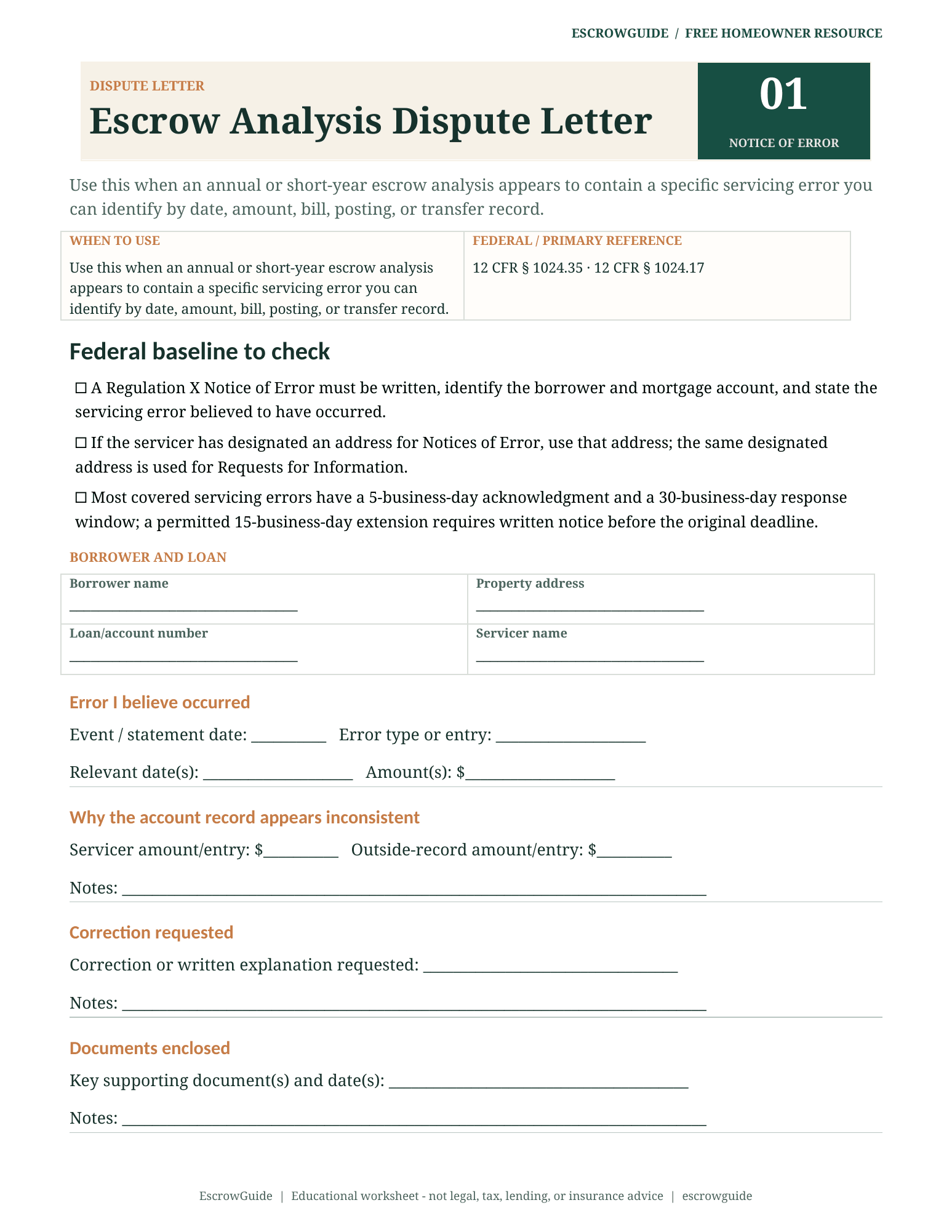
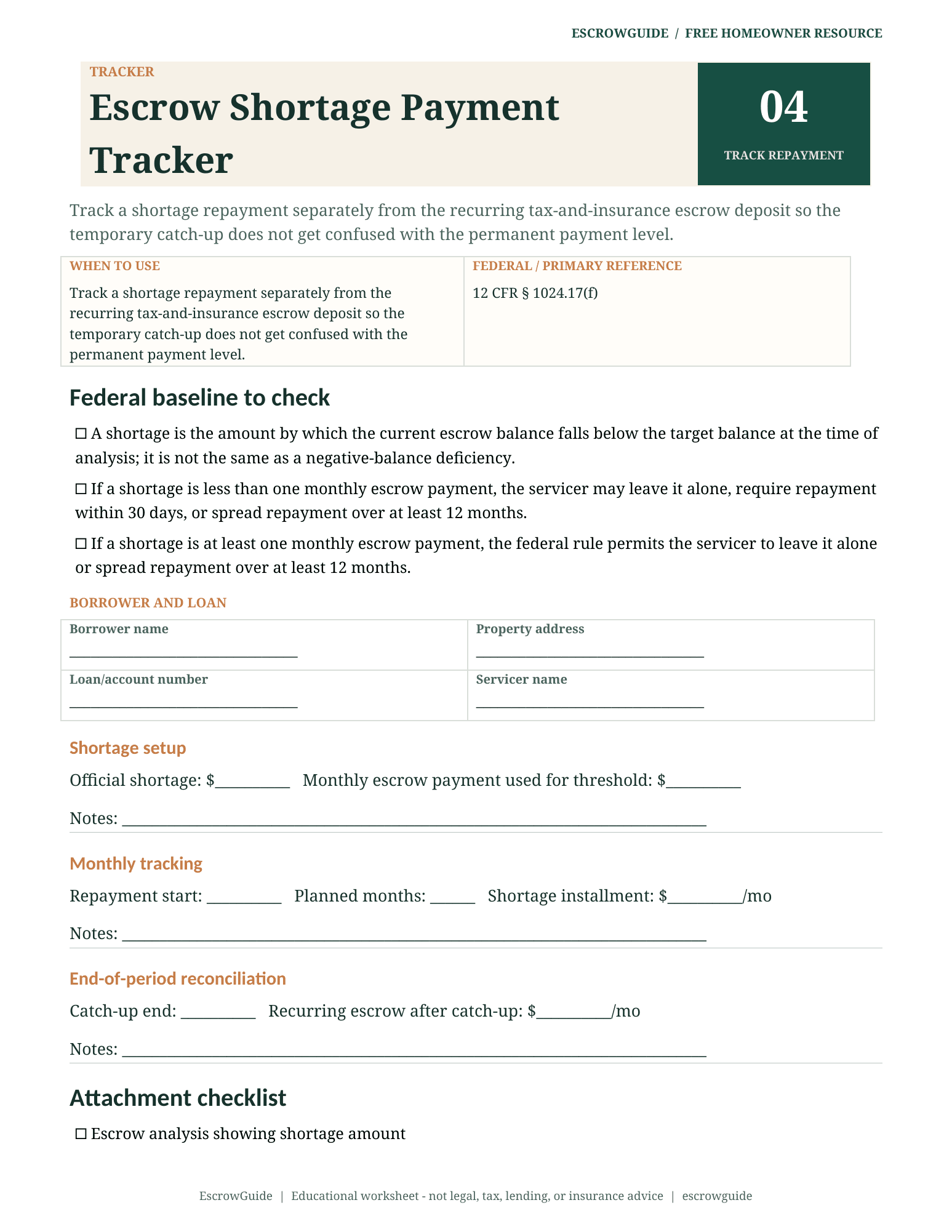
To estimate the new mortgage payment from an escrow analysis, separate the stable loan payment from the escrow reset: principal and interest + new ongoing monthly escrow + temporary shortage or deficiency repayment + other recurring loan charges. Do not simply add the shortage divided by 12 to your old payment.
The formula that prevents the most common mistake
Homeowners often calculate a shortage payment correctly but forget that the ongoing escrow amount also changes. Use this simplified structure:
For a typical fixed-rate mortgage, principal and interest are the stable base. Ongoing escrow is rebuilt from the next-year tax, insurance and other projected escrow items through the servicer’s aggregate analysis. The shortage installment is a separate temporary layer.
Step 1: find principal and interest
Use the principal-and-interest amount from the monthly statement, not the total mortgage payment. If the loan is a standard fixed-rate amortizing mortgage and there has been no modification or other contractual change, this amount is usually unchanged by an escrow analysis.
Example:
Step 2: add the next-year projected escrow items
From the annual escrow statement, list the projected annual disbursements. For example:
- Property taxes: $5,400
- Homeowners insurance: $2,640
- Mortgage insurance paid through escrow: $480
Total projected annual escrow disbursements are $8,520. A simple annualized monthly amount is:
This is a useful cross-check, not a replacement for the servicer’s aggregate analysis. Regulation X requires aggregate accounting and permits a cushion within defined limits, so the analysis schedule can affect the exact deposit.
Step 3: isolate the shortage repayment
Suppose the annual statement shows a $1,800 shortage and the servicer is collecting it in equal installments over 12 months.
If you plan to pay the shortage in full and the servicer confirms it will remove the installment, use $0 for this layer after the payoff is applied. Do not set ongoing escrow to the old amount; the tax and insurance projection still changed.
Step 4: rebuild the total payment
Using the example:
- P&I: $1,850
- Ongoing escrow cross-check: $710
- Shortage installment: $150
If the servicer’s statement says $2,724, the $14 difference is not automatically an error. Look for another escrow item, mortgage insurance, a different aggregate-analysis deposit, or another recurring charge. The point of the reconstruction is to get close enough to identify the unexplained remainder.
Step 5: calculate how much of the increase is temporary
Assume your old payment was $2,470. The new estimated payment is $2,710, an increase of $240. Of that:
- $150 is temporary shortage repayment.
- About $90 is the increase in ongoing escrow compared with the old $620 escrow amount.
That decomposition tells you what happens if you pay the shortage in full. The payment might fall from roughly $2,710 to $2,560, not back to $2,470.
Step 6: verify the projected bills before trusting the answer
The formula is only as good as the inputs. Compare the projected annual tax with the official tax bill and the projected insurance premium with the insurer’s declaration. Regulation X says a known charge for the next computation year must be used in the estimate. If the analysis uses a stale amount, the calculated payment can be wrong even when the arithmetic itself is flawless.
How the cushion fits the calculation
Regulation X generally limits the cushion to one-sixth of estimated annual escrow disbursements, equivalent to two months of the regular annualized escrow amount, with lower limits possible under state law or the mortgage documents. The servicer projects a trial running balance across the year and uses aggregate accounting.
That means you should not simply add “two months of escrow ÷ 12” to every monthly payment. The cushion is incorporated into the target-balance analysis. Use the annual statement’s calculated monthly escrow amount as the authoritative account figure and the annual-total ÷ 12 calculation as your reasonableness check.
How to calculate a partial shortage payment
If the servicer accepts a partial lump-sum payment toward a $1,800 shortage, ask it to quote the new installment. A simple estimate for a $600 upfront payment is:
But the servicer may rerun the analysis or use a different effective date. Do not send a partial payment based only on this formula and assume the billing system will produce exactly the same result.
How to reverse-engineer a payment increase when the statement is confusing
If you know only the old and new total payments, work backward:
- Subtract unchanged P&I from both totals.
- Identify any separately disclosed shortage installment.
- Subtract that installment from the new non-P&I amount.
- What remains is the ongoing escrow and other recurring-charge layer.
- Compare that layer with annual projected tax and insurance divided by 12.
This isolates the unexplained difference and gives you a precise question for the servicer.
A calculator is a cross-check, not the account of record
Online calculators can help you understand the components and test scenarios. They cannot see your servicer’s actual trial balance, mortgage documents, state-law cushion limit, exact disbursement dates or posting history. Use a calculator to prepare for the conversation, then verify against the annual escrow statement.
Use the statement's effective date before changing autopay
An escrow analysis usually shows both the newly calculated amount and the date that amount becomes due. Your arithmetic can be perfectly correct and still produce an accidental underpayment if you update automatic payments for the wrong month. After calculating the new total, identify the first payment date on which the new amount applies and compare it with your bank's scheduled payment.
If the servicer offers more than one shortage option, save both versions of the calculation. One number should represent the payment with the shortage spread over the permitted installment period; the other should represent the ongoing payment after a timely lump-sum shortage payment, if that option is available on your statement. Keeping both prevents you from confusing a temporary repayment layer with the permanent change in taxes or insurance.
A quick reasonableness test
Convert every known annual change into a monthly equivalent before reading the servicer's result. A $1,200 annual insurance increase is roughly $100 per month; a $600 tax increase is roughly $50 per month. If the new escrow payment rises by $400 per month, those two changes explain only $150. The remaining $250 should be traceable to shortage repayment, a cushion adjustment, another escrow item or an error. This back-of-the-envelope test does not replace the full aggregate analysis, but it tells you where to investigate.