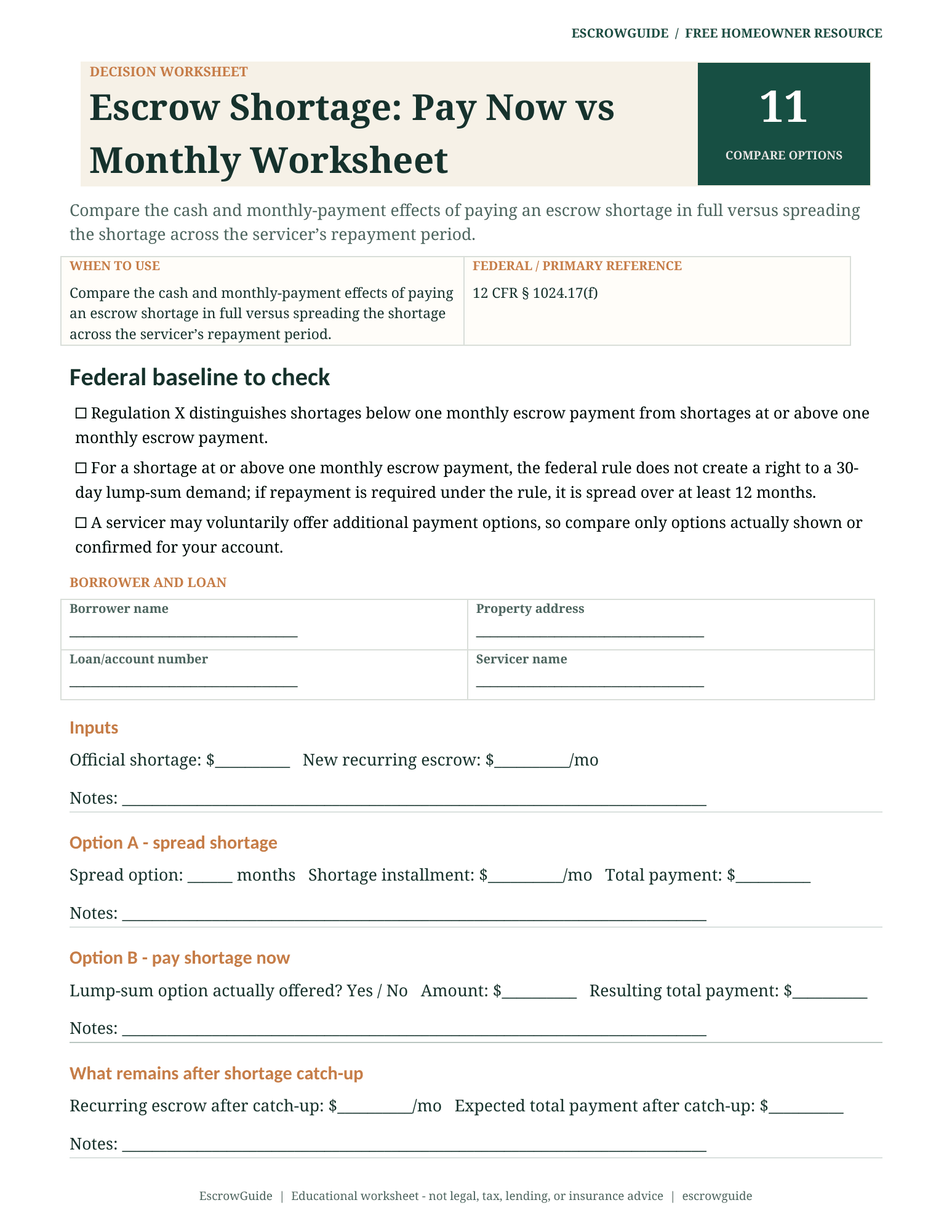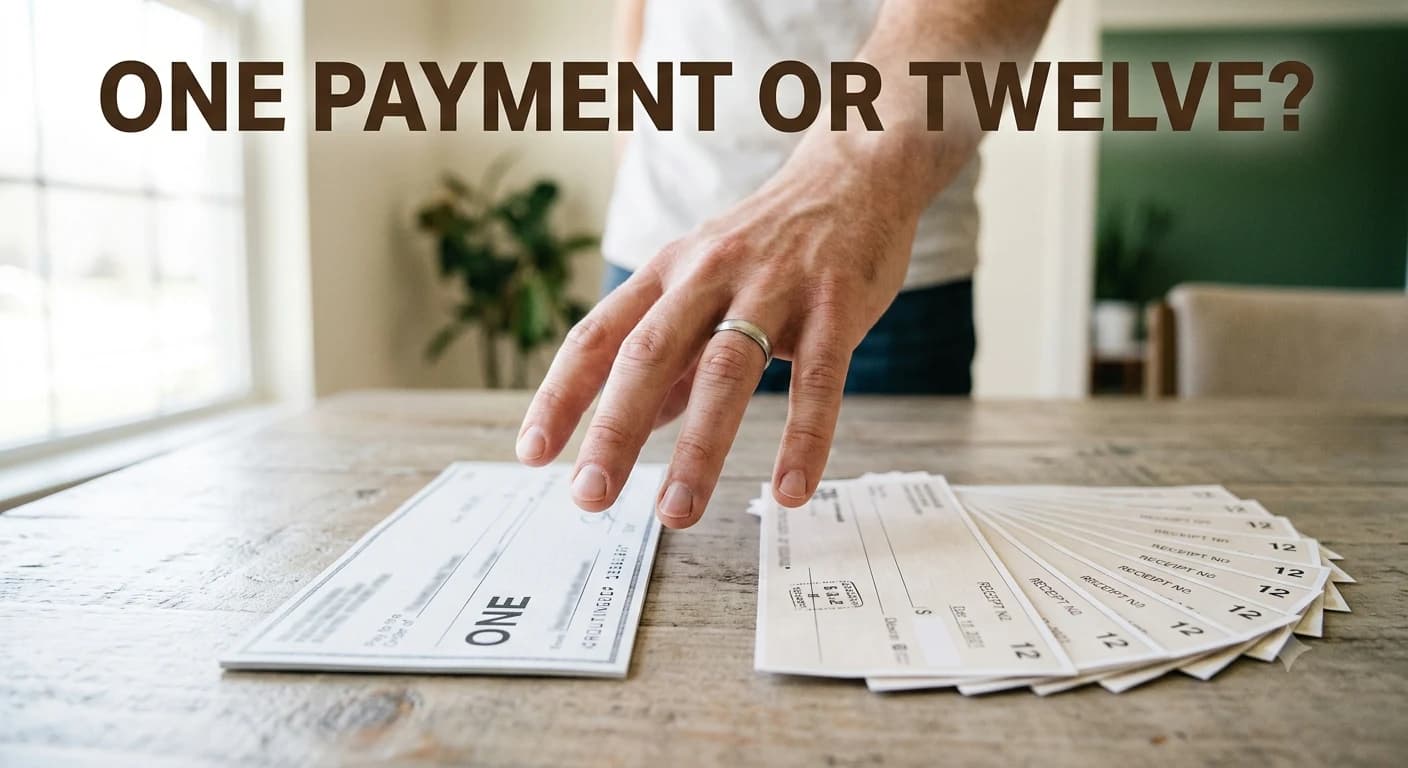
Paying an escrow shortage in full can remove or reduce the temporary shortage-repayment portion of a future payment, but it does not erase the new ongoing escrow amount needed for higher taxes or insurance. Before choosing a lump sum, compare two numbers: the payment if the shortage is spread over the permitted period and the payment after the shortage is paid but the new base escrow remains.
A payment choice should separate recurring housing cost from temporary catch-up and should not be judged only by the smallest next-month draft. Once the first mismatch is located, the rest of the analysis becomes a reconciliation rather than a guess.
Identify the ledger event
The fastest audit starts one level below the total payment. Compare the same line items on the statement before and after the change, then identify which component moved first and which document should support it. For pay escrow shortage in full or monthly, pair the disputed amount with the record that should control it. The checklist is complete only when every major changed amount has a source. Anything left as 'unknown' should be requested specifically rather than filled in with an assumption.
The federal baseline
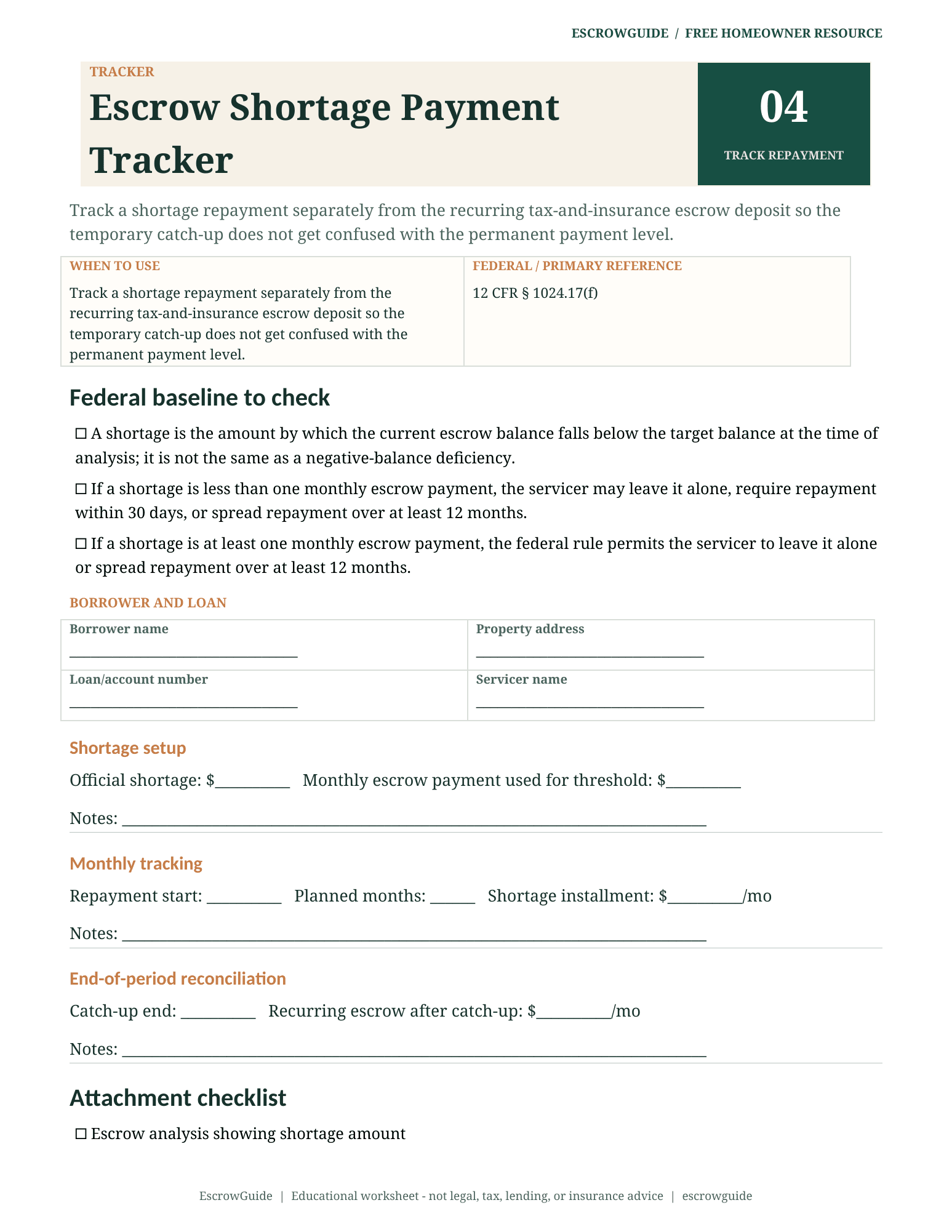
Regulation X permits different shortage treatments depending on the shortage size. A shortage equal to or greater than one month's escrow payment generally may be left in place or repaid in equal monthly payments over at least 12 months. A smaller shortage may also be collected within 30 days. Your statement should explain the treatment actually selected by the servicer.
The federal rule supplies the servicing framework, but it does not set a county assessment or write an insurance premium. Verify the rule's scope first, then compare the outside bill or loan record that supplies the number used in the account. If the servicer uses a designated address for written notices, ordinary customer-service chat may not substitute for that process. A page-specific cross-check is to identify the exact shortage amount on the analysis.
Example with dates and dollars
If principal and interest are $1,900, the new base escrow is $700, and the shortage is $2,400, spreading it over 12 months adds $200. That produces a $2,800 payment. Paying the $2,400 shortage now can remove that $200 layer, but the payment would still be $2,600, not the old payment if last year's base escrow was lower.
The numerical check should end with one of two results: either the statement can be reproduced from known inputs or a discrete gap remains. Only the second result calls for searching for a missing posting or unexplained assumption. A page-specific cross-check is to find the new monthly escrow deposit before shortage repayment.
Cross-check three records
Gather records by function rather than by volume. One document should establish what the servicer used, another what the outside charge actually was, and a third should show how money moved through the account when timing is disputed. A page-specific cross-check is to ask the servicer how a lump-sum payment will be applied and when the payment will be recalculated.
- Identify the exact shortage amount on the analysis.
- Find the new monthly escrow deposit before shortage repayment.
- Ask the servicer how a lump-sum payment will be applied and when the payment will be recalculated.
- Keep enough cash for taxes, insurance deductibles, repairs, and emergency reserves before using savings to eliminate a temporary payment layer.
- Recheck the next statement after any lump-sum payment.
If a check fails, stop and define the failure before moving on. A duplicated payment, missing credit and wrong projection are different problems and should not be bundled into one allegation. For this issue, also rule out choosing the lump sum only because the monthly payment looks lower.
Check the direction of the evidence
Ask whether the disputed number is an input, a calculation or an output. A tax bill and insurance premium are inputs; an escrow trial balance is a calculation; the new monthly draft is an output. The evidence needed to challenge each one is different, so locating the level of the problem saves time. A page-specific cross-check is to keep enough cash for taxes, insurance deductibles, repairs, and emergency reserves before using savings to eliminate a temporary payment layer.
Recheck the following statement after any correction or lump-sum transaction. A servicer may fix the ledger before the visible monthly amount changes, or may recalculate the payment on a later cycle. Verification should therefore include both the account entry and the payment that follows it. For this issue, also rule out assuming a shortage payment is the same as an extra principal payment.
A good worksheet also records what the article cannot determine from the statement alone. Loan-program eligibility, local tax liability, insurance coverage disputes and individualized legal consequences may require a different source. Marking that boundary keeps the escrow audit focused on facts the servicing records can actually prove. A page-specific cross-check is to recheck the next statement after any lump-sum payment.
What not to infer
- Choosing the lump sum only because the monthly payment looks lower.
- Assuming a shortage payment is the same as an extra principal payment.
- Draining emergency savings to solve a temporary cash-flow problem.
- Sending money without confirming the servicer's posting instructions.
Watch for compounded explanations. Several legitimate changes can occur together, so the total may look dramatic even though no single component is unusually large. Test components before testing the emotion of the total. A page-specific cross-check is to identify the exact shortage amount on the analysis.
A cleaner way to contact the servicer
When the remaining gap is specific, formal correspondence can be specific too. Quote the statement amount, quote the outside or prior-ledger amount, identify the date, and ask for the calculation or record that explains the difference. A page-specific cross-check is to find the new monthly escrow deposit before shortage repayment.
Keep payment obligations and the dispute track separate unless the servicer or a qualified adviser provides loan-specific direction. Educational reconciliation is not a suspension of the mortgage contract. For this issue, also rule out draining emergency savings to solve a temporary cash-flow problem.
Keep a record for the next escrow cycle
If the explanation is timing, test it against the following cycle rather than accepting the word 'timing' by itself. The expected transaction should appear on a predictable date and amount. When it does not, the prior explanation has not actually reconciled the account. A page-specific cross-check is to ask the servicer how a lump-sum payment will be applied and when the payment will be recalculated.
When contacting a tax authority, insurer or prior servicer, ask for a record that includes the property or loan reference, amount, effective date and payment status. Those fields are more useful for reconciliation than a generic confirmation that the account is 'fine.' For this issue, also rule out sending money without confirming the servicer's posting instructions.