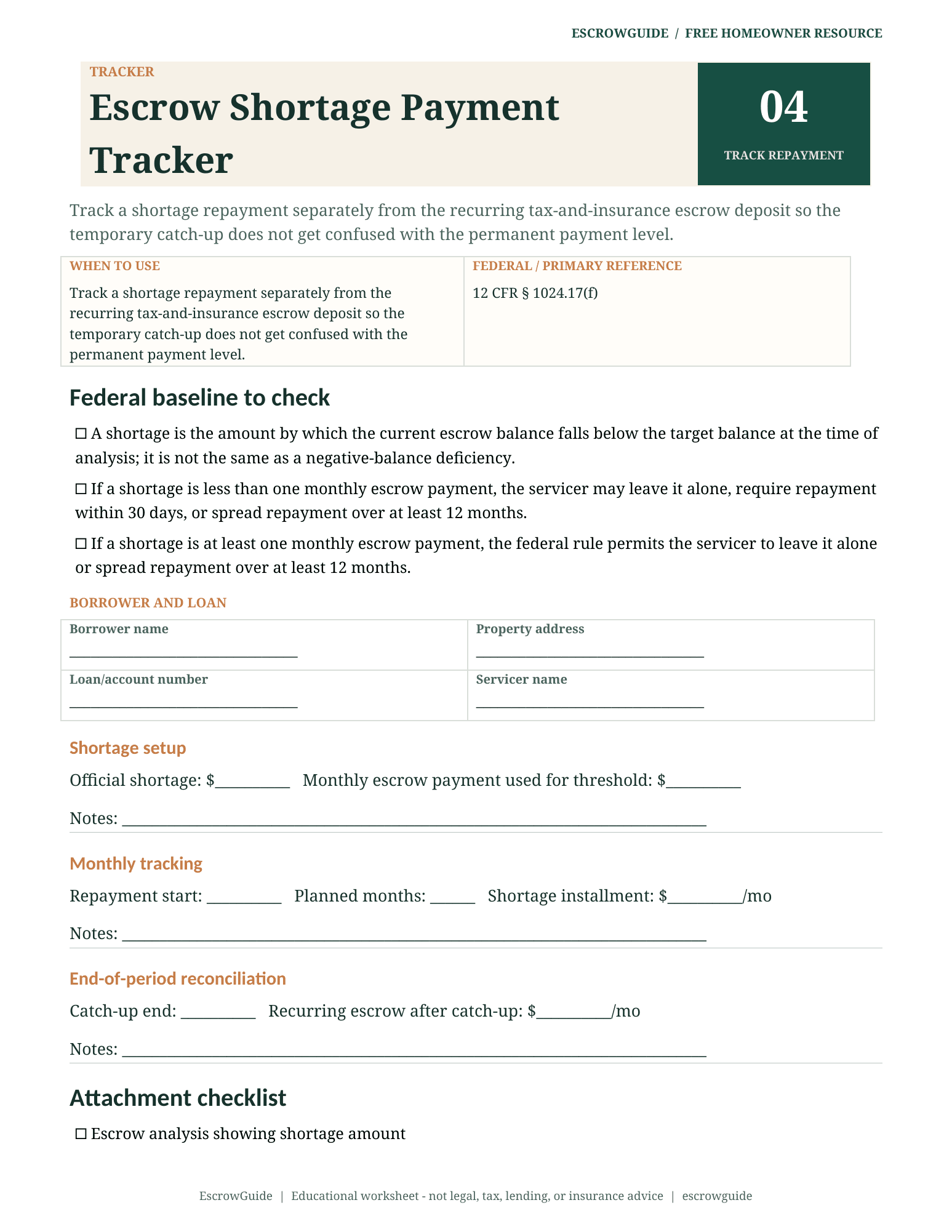
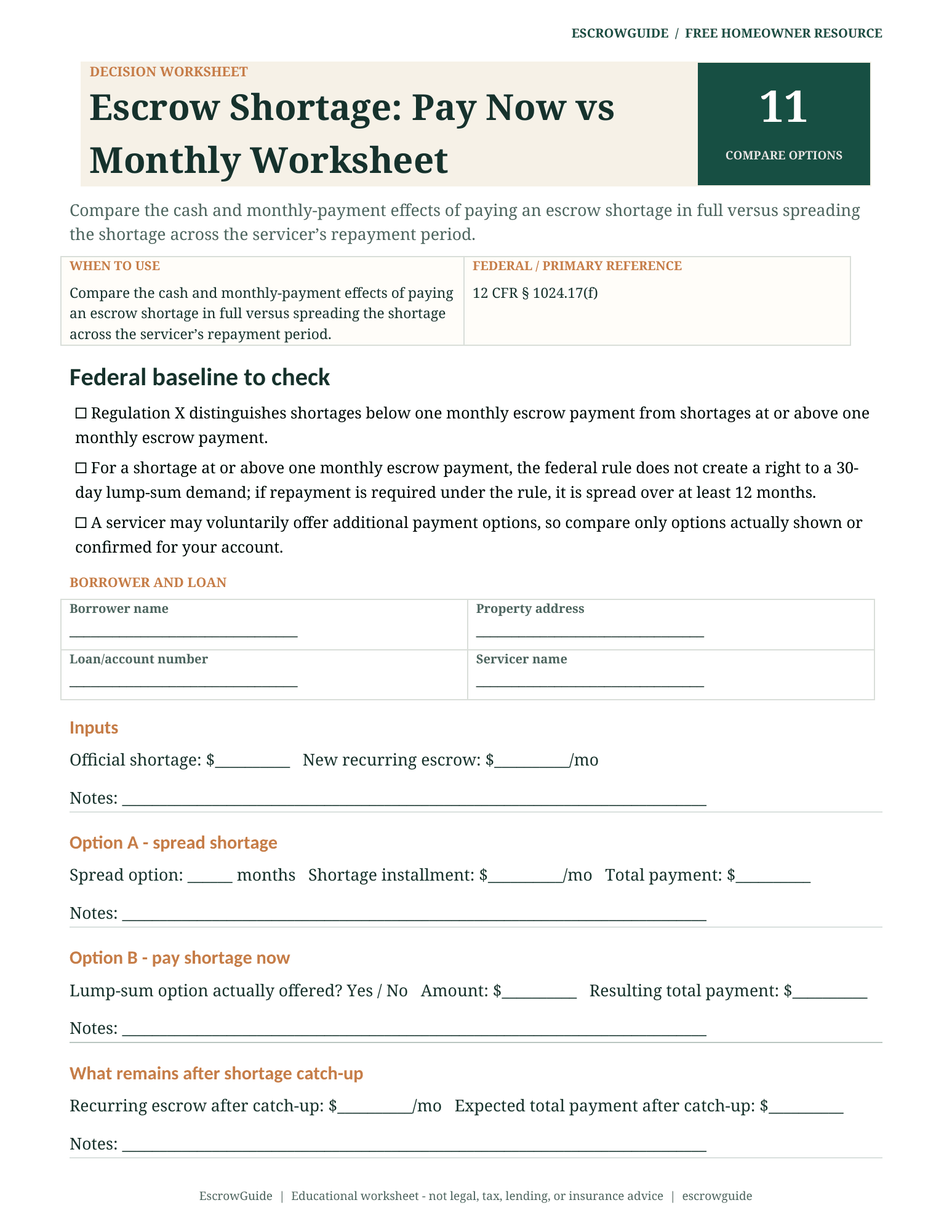
A shortage payment fixes a historical gap; it does not necessarily change the future cost of taxes and insurance. If your homeowners insurance or property tax increased, your new ongoing escrow deposit can remain higher even after you pay the shortage in full. The right comparison is old base escrow versus new base escrow, not old total payment versus a shortage-free payment.
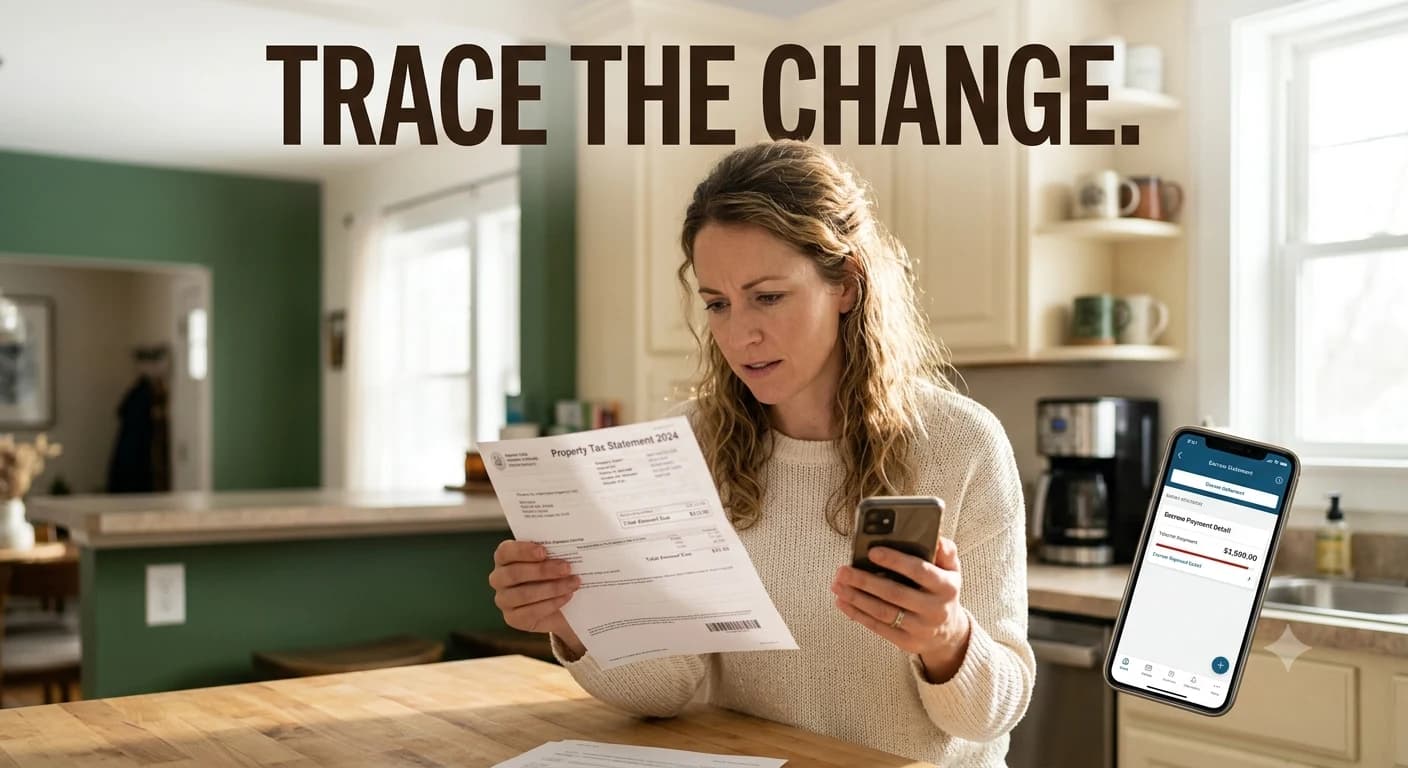
A total mortgage payment is a stack of components, so the diagnostic job is to identify which line moved and then verify the document behind that line. The useful result is an evidence trail, not merely a second estimate of the monthly total.
The payment question to isolate first
A useful first pass is mechanical: copy each payment component from the old statement into one column and the corresponding new component into another. Investigate the first difference instead of guessing from the total. For paid escrow shortage in full mortgage payment still increased, pair the disputed amount with the record that should control it. Turn the checklist into a short timeline. The order of collection, disbursement, analysis and notice dates often explains a balance that looks wrong when only month-end totals are compared.
The rule boundary
An escrow analysis projects future disbursements and separately determines whether the existing account has a shortage, surplus, or deficiency. Those are two distinct calculations. Paying a shortage addresses the existing gap. It does not force the servicer to project lower future disbursements when known taxes or insurance are higher.
Scope is part of the diagnosis. A cited federal provision may control timing or escrow treatment while another source controls whether the charge itself is due, how large it is, or whether a loan-specific option exists. Investor-specific guidance should be labeled as such rather than presented as a universal borrower right. A page-specific cross-check is to confirm the shortage payment posted to escrow rather than principal.
Run the numbers
Last year you deposited $550 a month into escrow. This year the known tax and insurance bills require $690 a month. The analysis also found a $1,200 shortage, or $100 a month if spread over 12 months. Paying the $1,200 can remove that $100 layer, but the ongoing escrow still rises $140. Your payment therefore remains $140 above the old level if principal and interest are unchanged.
The numerical check should end with one of two results: either the statement can be reproduced from known inputs or a discrete gap remains. Only the second result calls for searching for a missing posting or unexplained assumption. A page-specific cross-check is to identify the new annual tax and insurance projections.
Build the document trail
Prepare the file before contacting the servicer. Start with the current and prior analysis, recent statements and the tax or insurance evidence. A dated source beside each disputed amount is more useful than a thick folder of unrelated paperwork. A page-specific cross-check is to divide projected annual disbursements by 12 as a rough base-escrow check, recognizing that cushion and timing affect the exact analysis.
- Confirm the shortage payment posted to escrow rather than principal.
- Identify the new annual tax and insurance projections.
- Divide projected annual disbursements by 12 as a rough base-escrow check, recognizing that cushion and timing affect the exact analysis.
- Confirm when the servicer will issue or apply a revised payment amount after the lump-sum payment.
- Escalate only after you can identify a specific mismatch in the bills, posting, or analysis.
Keep the sequence visible instead of reducing it to one ending balance. Escrow is a running ledger, and timing can make two snapshots misleading even when all transactions eventually reconcile. For this issue, also rule out expecting a shortage payment to cancel an insurance renewal increase.
Before treating the result as an error
Keep the outside cost and the servicing treatment in separate columns. A tax increase may be valid while its projected amount is entered incorrectly, or a correct premium may be paid twice. Separating cause from administration allows both possibilities to be tested without assuming one proves the other. A page-specific cross-check is to confirm when the servicer will issue or apply a revised payment amount after the lump-sum payment.
If several explanations remain possible, list them rather than choosing the most alarming one. A projection update, posting lag, transfer cutoff and true outside-cost increase can produce similar symptoms. The next document request should be aimed at eliminating possibilities one at a time. For this issue, also rule out ignoring a changed tax assessment or lost exemption.
A clean reconciliation distinguishes what is known from what is inferred. Known facts come from dated bills, statements and rules; inferred facts are hypotheses about why a number moved. Keep those labels visible until another document converts the hypothesis into a supported explanation. A page-specific cross-check is to escalate only after you can identify a specific mismatch in the bills, posting, or analysis.
What would count as a real mismatch
- Expecting a shortage payment to cancel an insurance renewal increase.
- Ignoring a changed tax assessment or lost exemption.
- Assuming a servicer automatically recalculates the same day a lump sum posts.
- Confusing the escrow balance with the required monthly escrow deposit.
Watch for compounded explanations. Several legitimate changes can occur together, so the total may look dramatic even though no single component is unusually large. Test components before testing the emotion of the total. A page-specific cross-check is to confirm the shortage payment posted to escrow rather than principal.
Questions worth putting in writing
Before using a formal error process, make sure the allegation is operational: wrong amount, wrong date, missing transfer, duplicate disbursement, or unavailable calculation. That gives the servicer something testable to investigate. A page-specific cross-check is to identify the new annual tax and insurance projections.
The site can explain the mechanism and source framework, but it cannot determine the legal consequence for an individual loan. Keep required-payment decisions outside a general article unless the controlling loan-specific source is clear. For this issue, also rule out assuming a servicer automatically recalculates the same day a lump sum posts.
One final transaction-history check
If no correction is warranted, document that conclusion too. Note which outside bill or rule explained the payment and which calculation reproduced the result. Future escrow analyses are easier to review when the previous increase already has a traceable explanation. A page-specific cross-check is to divide projected annual disbursements by 12 as a rough base-escrow check, recognizing that cushion and timing affect the exact analysis.
Where the governing source is investor-specific, save the version or effective date of the published guidance. Program rules can change, and preserving the source that applied when the servicing action occurred is more reliable than relying on a later summary of the policy. For this issue, also rule out confusing the escrow balance with the required monthly escrow deposit.