A property-tax increase can raise a mortgage payment in two ways: the escrow account may have already paid a bill above last year's estimate, and the servicer may project the higher bill again for the next computation year. Verify the tax authority's actual bill first, then compare it with the escrow analysis before deciding the servicer's math is wrong.
Property-tax amounts come from the taxing authority while the servicer administers collection and disbursement, creating two records that can be compared independently. The same approach works even when several changes take effect in one billing cycle.
Identify the ledger event
Start with two adjacent billing periods and circle every line that differs. This keeps a real tax, insurance or servicing change from being hidden inside a single all-in number. For escrow shortage after property tax increase, pair the disputed amount with the record that should control it. Turn the checklist into a short timeline. The order of collection, disbursement, analysis and notice dates often explains a balance that looks wrong when only month-end totals are compared.
The federal baseline
Regulation X requires the servicer to estimate escrow disbursements and use a known charge when the next charge is known. The servicer also must perform the annual escrow analysis and determine the next periodic deposit plus any shortage or deficiency treatment.
The federal rule supplies the servicing framework, but it does not set a county assessment or write an insurance premium. Verify the rule's scope first, then compare the outside bill or loan record that supplies the number used in the account. Keep copies rather than originals when sending records and retain proof of delivery for formal servicing correspondence. A page-specific cross-check is to open the tax authority's current bill or online parcel record.
Example with dates and dollars
A tax bill rises from $4,800 to $6,000. The annual cost increase is $1,200, or about $100 a month before considering timing and cushion. If the account also ended $1,200 below target because the higher bill had already been paid, a 12-month shortage repayment could add another $100 temporarily. That can make the first year's increase appear roughly twice as large as the long-run tax effect.
Use the arithmetic to narrow the question. A match shifts attention to the validity of the tax, insurance or balance inputs; a mismatch shifts attention to posting, timing or a component that has not yet been accounted for. A page-specific cross-check is to verify the assessed value, tax rate, exemptions, and installment dates.
Cross-check three records
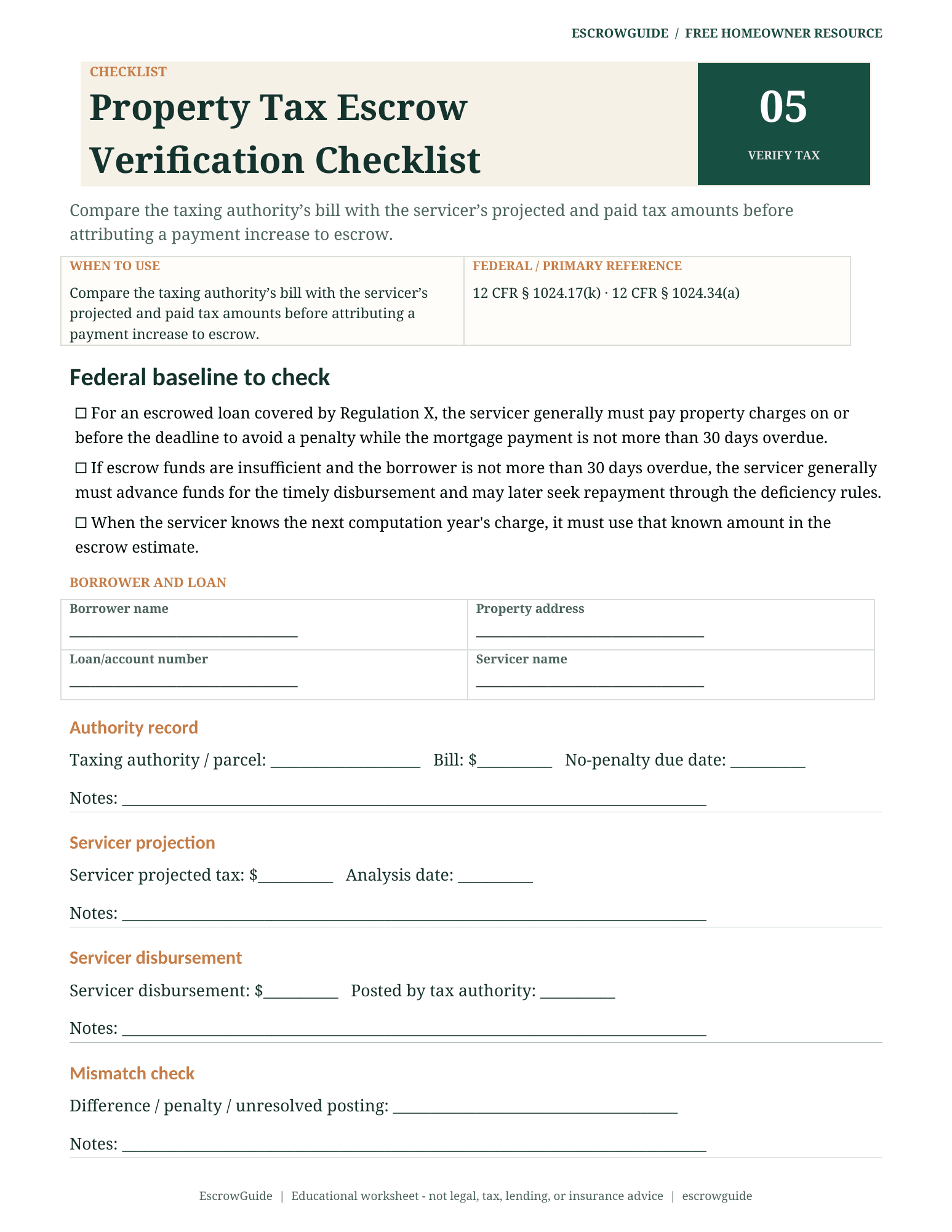
Prepare the file before contacting the servicer. Start with the current and prior analysis, recent statements and the tax or insurance evidence. A dated source beside each disputed amount is more useful than a thick folder of unrelated paperwork. A page-specific cross-check is to compare the bill actually paid from escrow with the servicer's transaction history.
- Open the tax authority's current bill or online parcel record.
- Verify the assessed value, tax rate, exemptions, and installment dates.
- Compare the bill actually paid from escrow with the servicer's transaction history.
- Compare next year's projected tax amount with the authority's known charge when available.
- Separate a corrected tax bill from an escrow-analysis error.
Write the supporting date and amount beside every completed check. That chronology can show whether an apparent balance gap is actually a bill paid near an analysis, transfer or reinstatement cutoff. For this issue, also rule out using a home-value estimate from a real-estate site as if it were the taxable assessed value.
Check the direction of the evidence
Ask whether the disputed number is an input, a calculation or an output. A tax bill and insurance premium are inputs; an escrow trial balance is a calculation; the new monthly draft is an output. The evidence needed to challenge each one is different, so locating the level of the problem saves time. A page-specific cross-check is to compare next year's projected tax amount with the authority's known charge when available.
Do not erase uncertainty with a confident label. If the evidence shows only that two records differ, say that. The next step is to identify which record should control and whether a correction, credit, recalculation or simply a clearer explanation is warranted under the applicable rule. For this issue, also rule out assuming the tax rate is the only driver of the bill.
A good worksheet also records what the article cannot determine from the statement alone. Loan-program eligibility, local tax liability, insurance coverage disputes and individualized legal consequences may require a different source. Marking that boundary keeps the escrow audit focused on facts the servicing records can actually prove. A page-specific cross-check is to separate a corrected tax bill from an escrow-analysis error.
What not to infer
- Using a home-value estimate from a real-estate site as if it were the taxable assessed value.
- Assuming the tax rate is the only driver of the bill.
- Ignoring a supplemental assessment or prior-year correction.
- Blaming the escrow cushion for an increase actually caused by a higher tax bill.
The strongest red flags are transactional: an amount cannot be tied to a source, a transfer loses a balance, a disbursement appears twice, or an outside bill and the servicer's projection disagree on the same date. A page-specific cross-check is to open the tax authority's current bill or online parcel record.
A cleaner way to contact the servicer
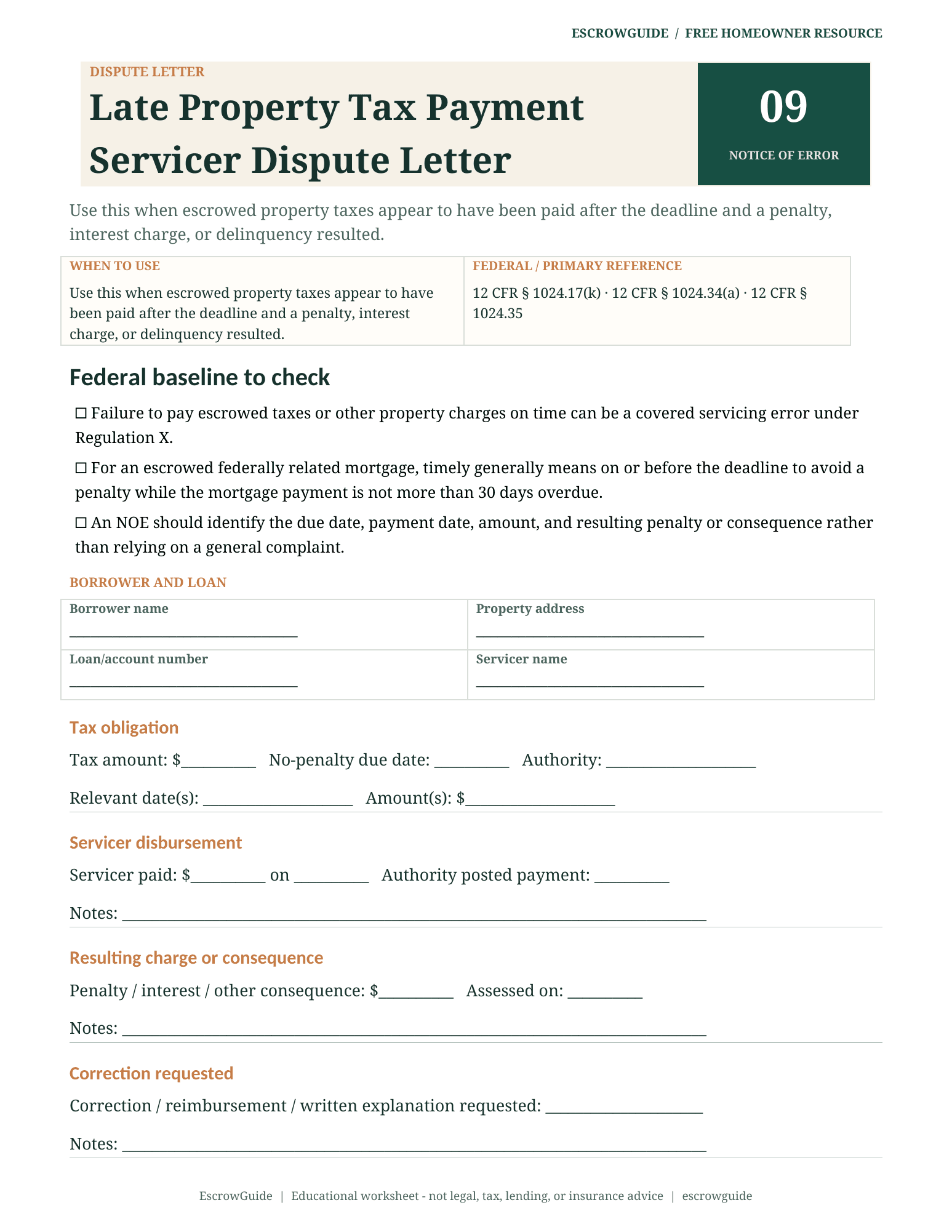
Escalate facts, not frustration. A written request should identify the loan, the transaction or projection at issue, the competing source record and the information or correction being sought. Keep copies and delivery evidence. A page-specific cross-check is to verify the assessed value, tax rate, exemptions, and installment dates.
Servicing research is different from personalized advice. Use the evidence to ask a precise question, while treating payment, legal and tax decisions as fact-specific matters beyond this general explanation. For this issue, also rule out ignoring a supplemental assessment or prior-year correction.
Keep a record for the next escrow cycle
Save any corrected analysis as a new version instead of replacing the original. Differences between the two documents can show exactly which input or balance changed and can be important if a later statement appears to revert to the earlier, incorrect figure. A page-specific cross-check is to compare the bill actually paid from escrow with the servicer's transaction history.
Where the governing source is investor-specific, save the version or effective date of the published guidance. Program rules can change, and preserving the source that applied when the servicing action occurred is more reliable than relying on a later summary of the policy. For this issue, also rule out blaming the escrow cushion for an increase actually caused by a higher tax bill.