Dispute letter · Free download
Late Property Tax Payment Servicer Dispute Letter
Use this when escrowed property taxes appear to have been paid after the deadline and a penalty, interest charge, or delinquency resulted.
2 pagesNo email requiredEditable + printable
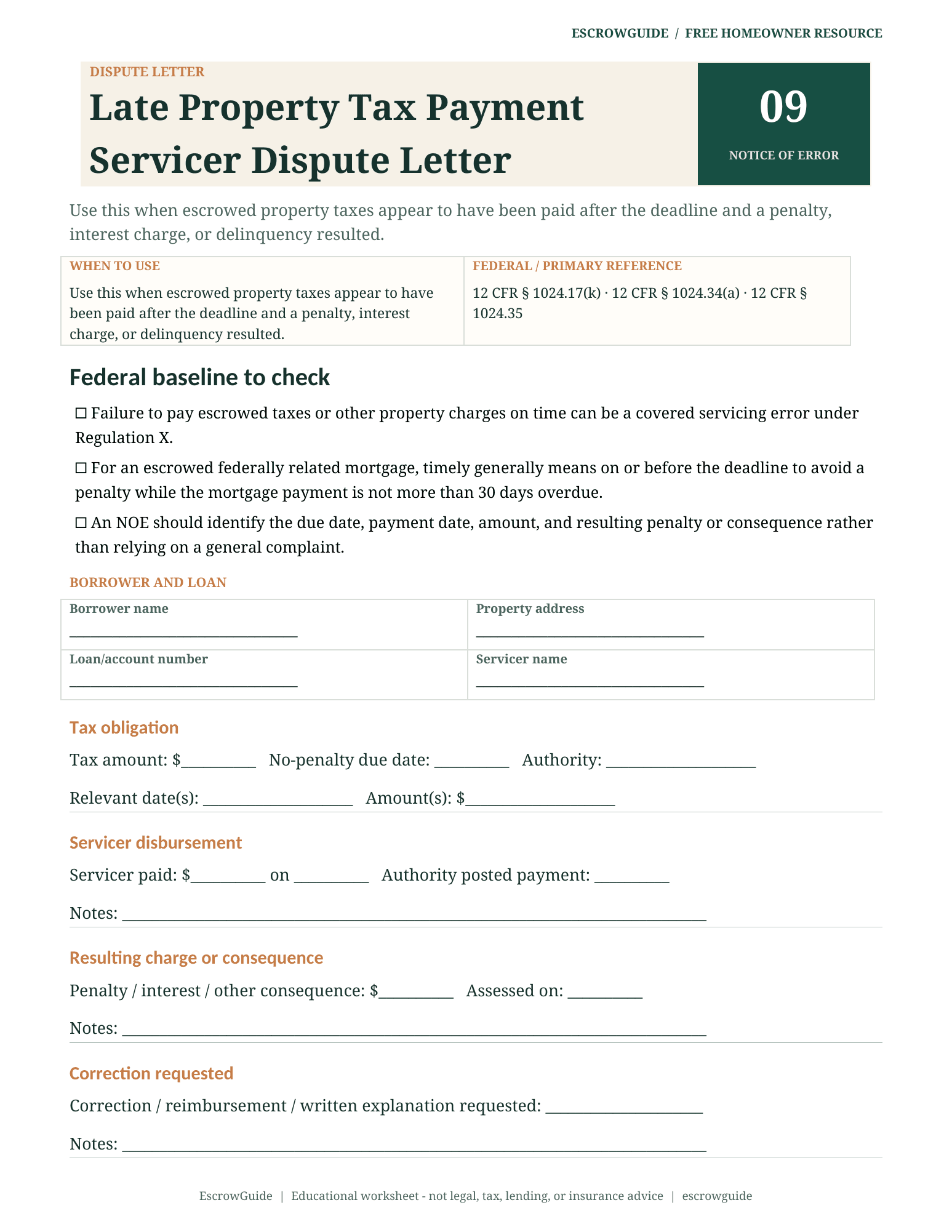
Actual first-page previewLate Property Tax Payment Servicer Dispute Letter
Before you fill it out
What this resource helps you document
Use this when escrowed property taxes appear to have been paid after the deadline and a penalty, interest charge, or delinquency resulted.
01Tax obligation
02Servicer disbursement
03Resulting charge or consequence
04Correction requested
Federal baseline to check
Use the form with the rule, not instead of the rule.
These templates organize facts and records. They do not create a borrower right that the underlying regulation, loan terms, investor rules, or state law does not provide.
- Failure to pay escrowed taxes or other property charges on time can be a covered servicing error under Regulation X.
- For an escrowed federally related mortgage, timely generally means on or before the deadline to avoid a penalty while the mortgage payment is not more than 30 days overdue.
- An NOE should identify the due date, payment date, amount, and resulting penalty or consequence rather than relying on a general complaint.
Use this resource carefully
- Confirm the taxing authority's no-penalty deadline and actual posting date. A bill date is not always the same as the penalty deadline.
- Separate the underlying tax amount from late fees, interest, or other consequences so the requested correction can be measured.
- If the servicer says it paid on time, request the payment confirmation or disbursement record it relied on and compare it with the authority's ledger.
12 CFR § 1024.17(k)CFPB Regulation X § 1024.17(k) — Timely escrow paymentsOpen primary source ↗12 CFR § 1024.34(a)CFPB Regulation X § 1024.34(a) — Timely escrow disbursementsOpen primary source ↗12 CFR § 1024.35CFPB Regulation X § 1024.35 — Error resolutionOpen primary source ↗CFPB consumer guidanceHow to dispute an error or request mortgage informationOpen CFPB guidance ↗