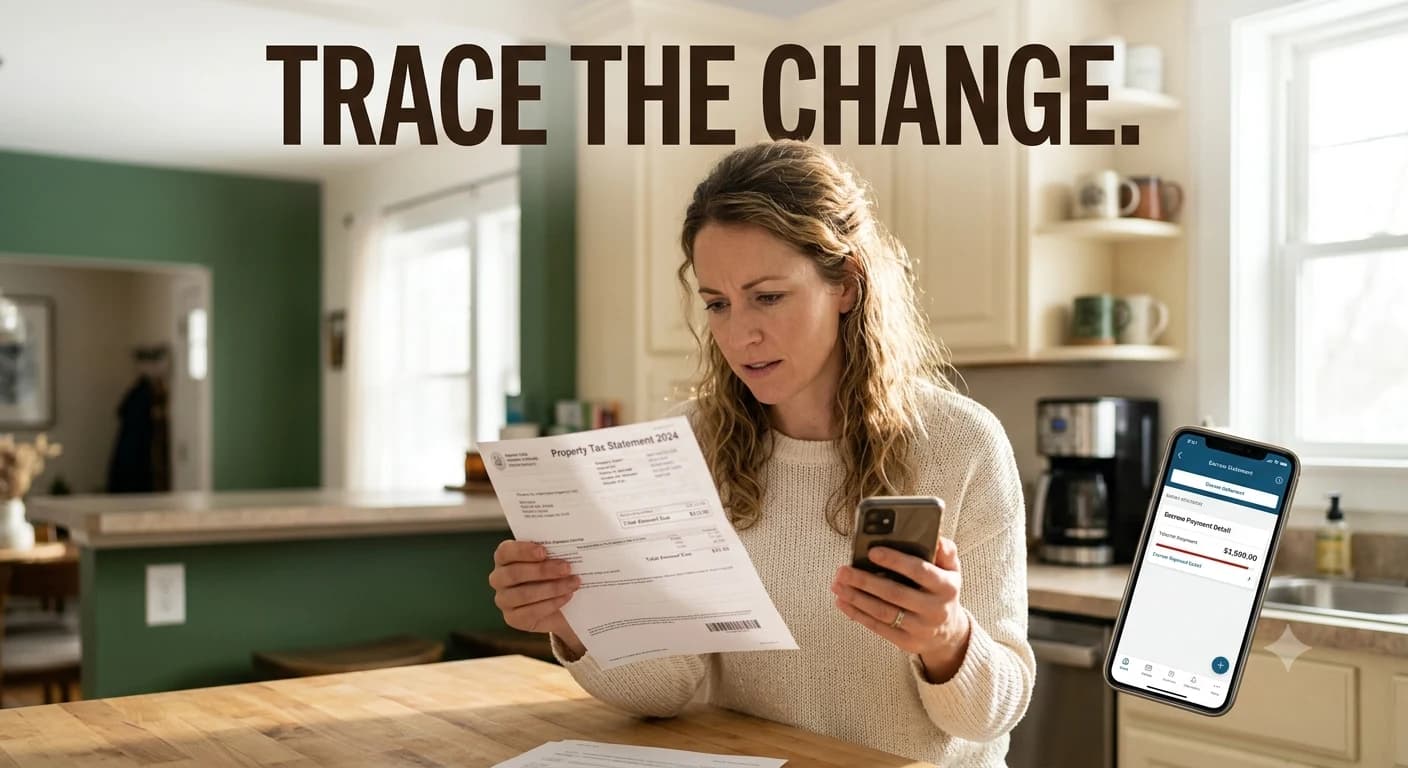
New construction is unusually prone to escrow shocks because the first tax estimate may reflect vacant land, a partially completed improvement, or another temporary assessment. Regulation X specifically recognizes unassessed new construction and allows a servicer to estimate using comparable residential property in the market area. Once the completed home receives its actual assessment, the tax bill and escrow deposit can change sharply.
New-construction tax values can change sharply when assessment moves from land or incomplete improvements to the completed property, making the timing of the tax record especially important. This turns a surprising payment into a set of smaller questions that can each be verified.
Separate past catch-up from future cost
Treat the monthly total as the result, not the evidence. Reconstruct it from P&I, escrow, shortage or deficiency treatment, mortgage insurance and any other listed charge so the first unexplained movement is visible. For new construction escrow shortage property taxes, pair the disputed amount with the record that should control it. Record both the finding and its source. A conclusion such as 'premium increased' is stronger when it sits beside the renewal amount, effective date and matching escrow disbursement.
The governing servicing framework
For unassessed new construction, §1024.17(c)(7) permits the servicer to base the escrow estimate on comparable residential property in the market area. That is an estimation rule, not a promise that the first-year tax amount will equal the eventual completed-property tax bill.
Regulation X can tell a servicer how to analyze or administer escrow without determining the underlying tax or insurance charge. Keep the rule question and the outside-bill question separate so a correct calculation does not validate a wrong input. If the servicer uses a designated address for written notices, ordinary customer-service chat may not substitute for that process. A page-specific cross-check is to before closing, ask whether the tax estimate reflects completed value or current assessed value.
Dollar example
A buyer closes when the parcel is taxed mainly as land and the first escrow projection assumes $2,400 a year. After completion, the jurisdiction assesses the home and the tax bill becomes $7,200. The ongoing difference alone is $400 a month. If the higher bill is paid before enough money has accumulated, the account can also show a shortage that temporarily adds to the new base escrow.
The numerical check should end with one of two results: either the statement can be reproduced from known inputs or a discrete gap remains. Only the second result calls for searching for a missing posting or unexplained assumption. A page-specific cross-check is to find the county or local assessor's rules for new-construction assessment timing.
Documents that settle the question
Use records that are independent where possible. A servicer's own statement can be checked against a tax collector, insurer or prior servicer record, which reduces the risk of treating one repeated internal number as confirmation. A page-specific cross-check is to budget using a reasonable completed-home tax estimate rather than the seller's current tax bill.
- Before closing, ask whether the tax estimate reflects completed value or current assessed value.
- Find the county or local assessor's rules for new-construction assessment timing.
- Budget using a reasonable completed-home tax estimate rather than the seller's current tax bill.
- Watch for supplemental or corrected tax bills after closing.
- When the first annual escrow analysis arrives, compare every projected tax installment with the tax authority record.
Write the supporting date and amount beside every completed check. That chronology can show whether an apparent balance gap is actually a bill paid near an analysis, transfer or reinstatement cutoff. For this issue, also rule out assuming the seller's tax bill predicts the buyer's completed-home bill.
Separate what happened from what happens next
Separate the answer into a historical question and a forward-looking question. The historical side asks whether prior collections and disbursements produced the displayed balance; the forward side asks whether the next projected bills justify the new periodic amount. A page can reconcile on one side and still contain a problem on the other. A page-specific cross-check is to watch for supplemental or corrected tax bills after closing.
For educational estimates, label assumptions explicitly. If a simple annual amount divided by 12 is being used only as a cross-check, it should not be presented as the formal aggregate-accounting result. That distinction keeps a useful estimate from becoming false evidence of servicing error. For this issue, also rule out treating the first mortgage payment as the permanent payment.
The final account note should be concise enough to reuse later: what changed, which record explained it, whether a correction was needed, and what the next statement should show. That summary reduces repeated research when the following annual analysis arrives. A page-specific cross-check is to when the first annual escrow analysis arrives, compare every projected tax installment with the tax authority record.
Where homeowners often misread the statement
- Assuming the seller's tax bill predicts the buyer's completed-home bill.
- Treating the first mortgage payment as the permanent payment.
- Ignoring a supplemental assessment mailed outside the normal annual cycle.
- Relying on a lender estimate without checking the local assessment process.
Do not let a surprising outcome substitute for evidence. A servicing error is easier to support when one dated entry is duplicated, missing, sent to the wrong payee or inconsistent with an official bill. A page-specific cross-check is to before closing, ask whether the tax estimate reflects completed value or current assessed value.
Turn the discrepancy into a testable question
When the remaining gap is specific, formal correspondence can be specific too. Quote the statement amount, quote the outside or prior-ledger amount, identify the date, and ask for the calculation or record that explains the difference. A page-specific cross-check is to find the county or local assessor's rules for new-construction assessment timing.
A written inquiry creates a record; it does not automatically freeze the loan. Borrowers with consequences beyond account reconciliation may need loan-specific guidance from the appropriate professional or agency. For this issue, also rule out ignoring a supplemental assessment mailed outside the normal annual cycle.
Recheck the account after the adjustment
Keep the next annual analysis in the same evidence file. Some corrections solve the current ledger but affect the following computation year as well. Comparing the new opening balance and projected bills with the resolved records can catch a stale input before it creates another unexplained shortage or surplus. A page-specific cross-check is to budget using a reasonable completed-home tax estimate rather than the seller's current tax bill.
For large changes, keep a simple spreadsheet with one row per material transaction and columns for source, expected amount, posted amount and date. The tool is not evidence by itself, but it makes missing or duplicate entries obvious and points back to the source documents that are evidence. For this issue, also rule out relying on a lender estimate without checking the local assessment process.