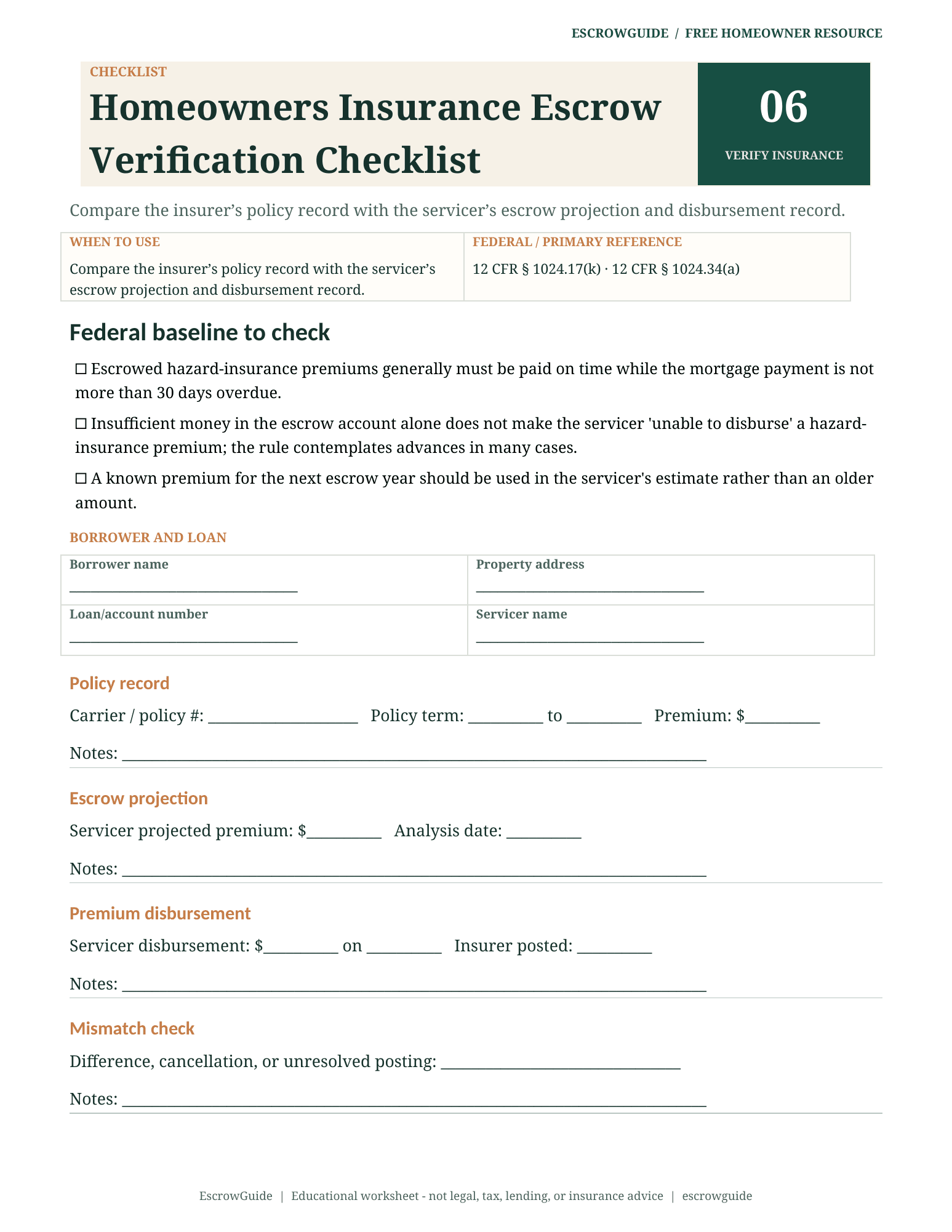
An escrow account can go negative because the servicer paid a required insurance bill even though the account did not contain enough money. For many covered escrowed items, Regulation X requires timely disbursement and can require the servicer to advance funds rather than let the bill become late. The resulting negative balance is an escrow deficiency; it should still trace to a real bill and a real disbursement.
Insurance is an outside bill administered through the escrow account, so the policy record and the servicing ledger have to agree before the payment change is explained. The point is not to reproduce proprietary servicing software; it is to make every material input traceable.
The payment question to isolate first
The strongest evidence is a three-document match: escrow ledger, insurer invoice, insurer payment confirmation. If all three agree, the remaining question is how the negative balance is being recovered. If one document disagrees, the dispute can point to an exact amount and date instead of broadly alleging that the escrow account is wrong.
The rule boundary
Section 1024.17(k) addresses timely payment of escrow items and servicer advances. When the borrower's mortgage payment is not more than 30 days overdue, the servicer generally must pay escrow items on time if the taxing or insurance charge is properly due. The rule contemplates advancing funds when the escrow balance is insufficient and then seeking repayment subject to the shortage and deficiency rules.
The federal rule supplies the servicing framework, but it does not set a county assessment or write an insurance premium. Verify the rule's scope first, then compare the outside bill or loan record that supplies the number used in the account. If an outside authority controls the underlying charge, verify that record before asking the servicer to change its projection. A page-specific cross-check is to confirm the insurance premium was actually due and the policy belonged to the mortgaged property.
Run the numbers
An escrow account has $900 immediately before a $2,400 homeowners premium is due. If the servicer advances the missing $1,500 and pays the premium on time, the escrow ledger can move to negative $1,500 before later deposits. That negative amount is not the same thing as a $1,500 fee. The borrower should be able to identify the $2,400 disbursement, the $900 available balance and the $1,500 gap in the transaction history.
The point of the scenario is traceability. Each number has a source and a role; repeating that mapping with the actual account prevents a temporary catch-up amount from being confused with a permanent recurring cost. A page-specific cross-check is to match the amount and date of the servicer's disbursement with the insurer's record.
Build the document trail
Gather records by function rather than by volume. One document should establish what the servicer used, another what the outside charge actually was, and a third should show how money moved through the account when timing is disputed. A page-specific cross-check is to review the escrow balance immediately before and after the payment.
- Confirm the insurance premium was actually due and the policy belonged to the mortgaged property.
- Match the amount and date of the servicer's disbursement with the insurer's record.
- Review the escrow balance immediately before and after the payment.
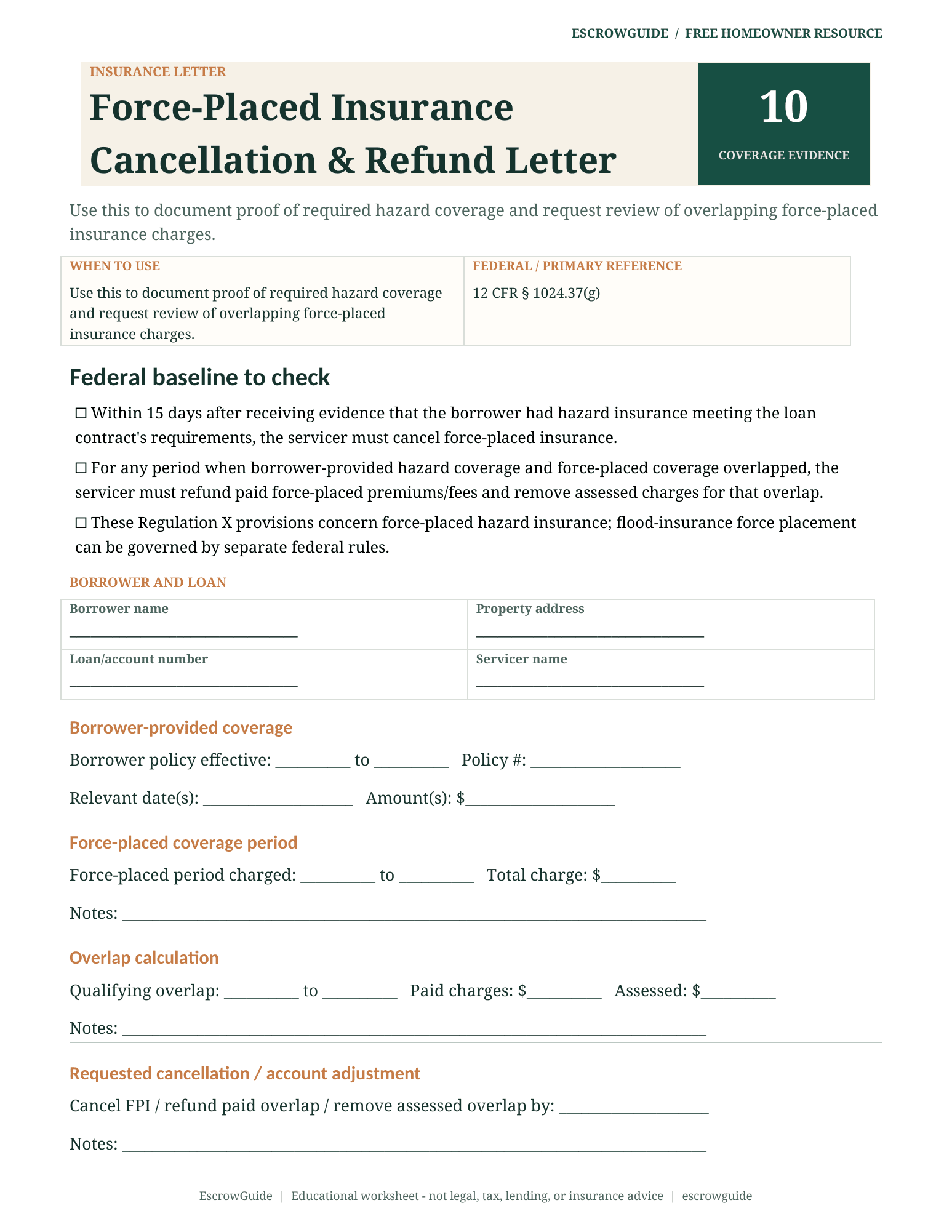
- Check whether a refund, policy cancellation or duplicate payment later changed the ledger.
- Read the annual analysis to see how the deficiency is scheduled for repayment.
Record both the finding and its source. A conclusion such as 'premium increased' is stronger when it sits beside the renewal amount, effective date and matching escrow disbursement. For this issue, also rule out calling a negative balance an unexplained fee before matching the insurance payment.
Before treating the result as an error
Keep the outside cost and the servicing treatment in separate columns. A tax increase may be valid while its projected amount is entered incorrectly, or a correct premium may be paid twice. Separating cause from administration allows both possibilities to be tested without assuming one proves the other. A page-specific cross-check is to check whether a refund, policy cancellation or duplicate payment later changed the ledger.
Recheck the following statement after any correction or lump-sum transaction. A servicer may fix the ledger before the visible monthly amount changes, or may recalculate the payment on a later cycle. Verification should therefore include both the account entry and the payment that follows it. For this issue, also rule out assuming insufficient escrow funds allowed the servicer simply to skip a properly due bill.
The final account note should be concise enough to reuse later: what changed, which record explained it, whether a correction was needed, and what the next statement should show. That summary reduces repeated research when the following annual analysis arrives. A page-specific cross-check is to read the annual analysis to see how the deficiency is scheduled for repayment.
What would count as a real mismatch
- Calling a negative balance an unexplained fee before matching the insurance payment.
- Assuming insufficient escrow funds allowed the servicer simply to skip a properly due bill.
- Ignoring a later insurer refund that should appear as a credit.
- Confusing a deficiency with the permitted escrow cushion.
Avoid treating a calculator disagreement as the error itself. Simplified estimates do not capture every running-balance timing rule, while an identified wrong bill or posting is a concrete fact the servicer can investigate. A page-specific cross-check is to confirm the insurance premium was actually due and the policy belonged to the mortgaged property.
Questions worth putting in writing
When the remaining gap is specific, formal correspondence can be specific too. Quote the statement amount, quote the outside or prior-ledger amount, identify the date, and ask for the calculation or record that explains the difference. A page-specific cross-check is to match the amount and date of the servicer's disbursement with the insurer's record.
The existence of a dispute does not itself mean scheduled mortgage obligations stop. This page explains general servicing mechanics; loan documents, account status, state law and individual facts can affect a particular borrower's next step. For this issue, also rule out ignoring a later insurer refund that should appear as a credit.
One final transaction-history check
Keep the next annual analysis in the same evidence file. Some corrections solve the current ledger but affect the following computation year as well. Comparing the new opening balance and projected bills with the resolved records can catch a stale input before it creates another unexplained shortage or surplus. A page-specific cross-check is to review the escrow balance immediately before and after the payment.
If the account is in hardship, bankruptcy, foreclosure or another special status, note that status and its dates in the timeline without assuming it answers every escrow question. Some statement, payment or notice rules can operate differently while underlying tax and insurance transactions continue. For this issue, also rule out confusing a deficiency with the permitted escrow cushion.