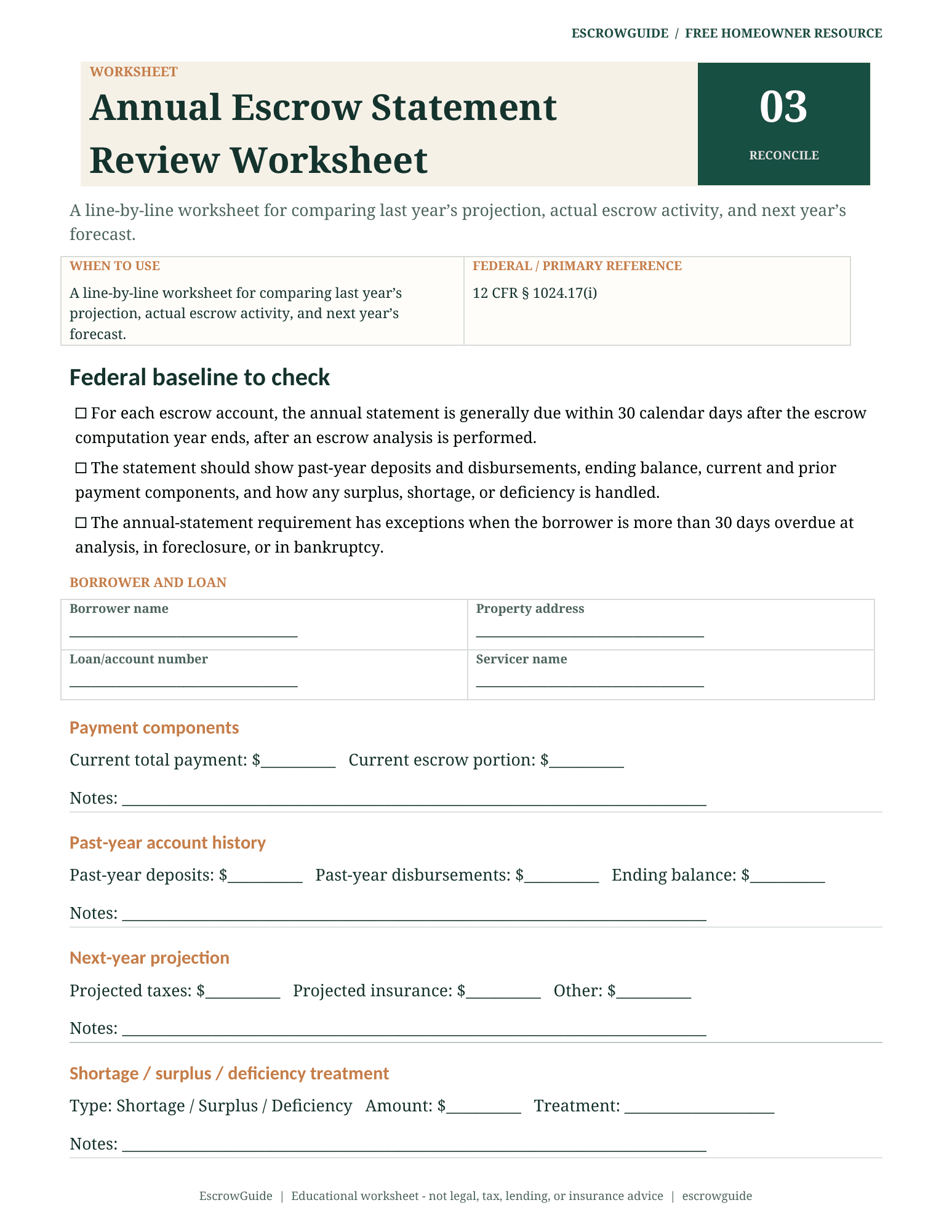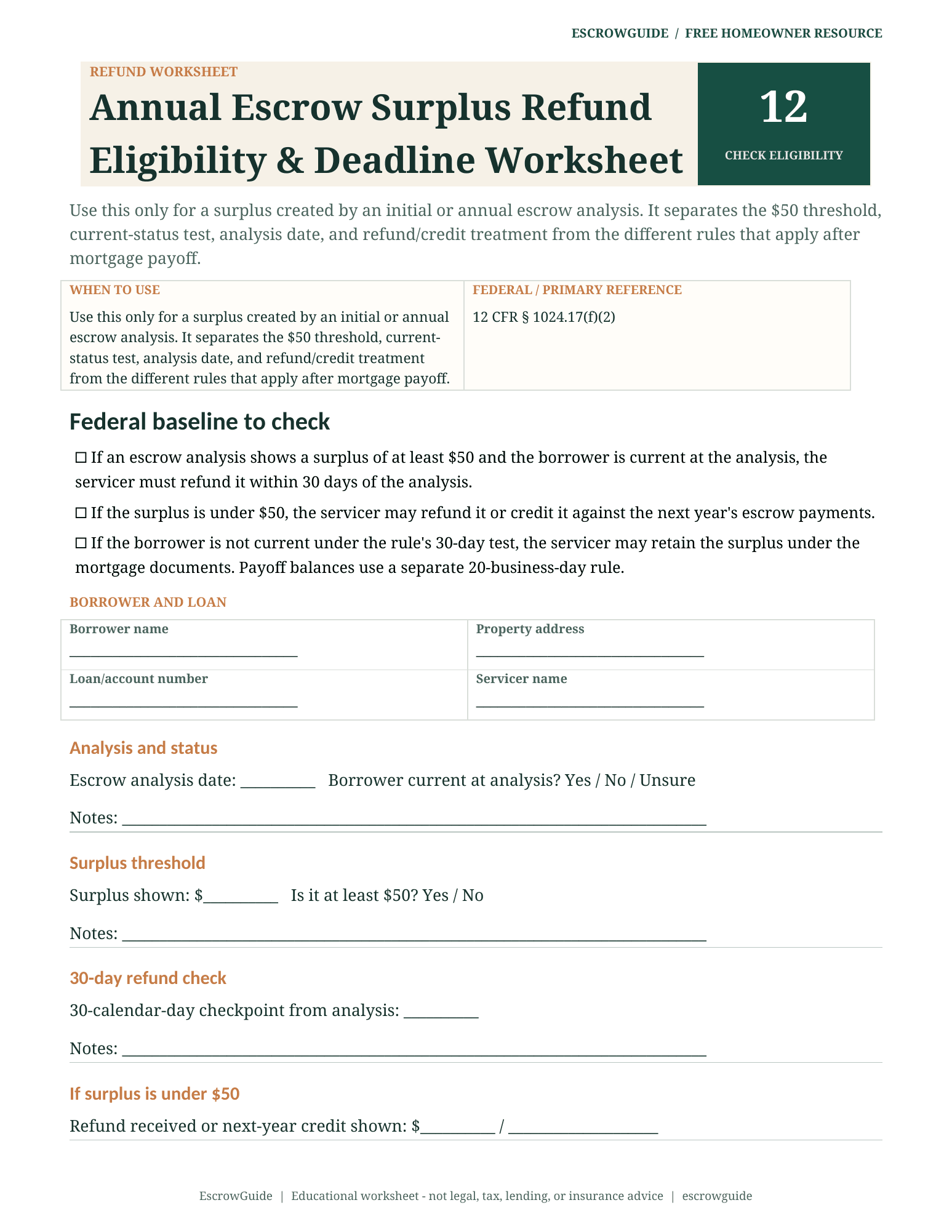
If an annual escrow analysis shows a surplus of at least $50 and the borrower is current, Regulation X requires the servicer to refund the surplus within 30 days from the date of the analysis. If the surplus is less than $50, the servicer may refund it or credit it against the next year's escrow payments. Different rules apply after the mortgage is paid in full.
The trigger for the refund matters because an annual-analysis surplus and a balance remaining after payoff are governed by different provisions and timelines. This turns a surprising payment into a set of smaller questions that can each be verified.
The payment question to isolate first
Build a before-and-after ledger before deciding why the payment changed. A note rate can remain untouched while an escrow deposit, insurance charge or temporary repayment changes the amount drafted each month. For escrow surplus refund 50 dollars 30 days, pair the disputed amount with the record that should control it. Each checked item should end with a citation to a statement page, bill or transaction. If one step has no source record, that unsupported step becomes the next research target.
The rule boundary
The $50 rule is in §1024.17(f)(2). The current-status condition matters: for this provision, the rule defines current by reference to receipt of payments within 30 days of the due date. If the borrower is not current, the servicer may retain the surplus as allowed by the mortgage documents.
Do not stretch the federal escrow rule beyond its job. It governs covered servicing conduct and accounting, while local tax law, insurance contracts, mortgage terms and program rules can supply facts the servicer must work with. Investor-specific guidance should be labeled as such rather than presented as a universal borrower right. A page-specific cross-check is to confirm the document is an annual or initial escrow analysis rather than a payoff statement.
Run the numbers
An annual analysis shows a $210 surplus and the loan is current. That amount falls above the $50 threshold, so the annual-analysis surplus rule calls for a refund within 30 days of the analysis. If the surplus were $35, the servicer could either refund it or credit it against next year's escrow payments.
The point of the scenario is traceability. Each number has a source and a role; repeating that mapping with the actual account prevents a temporary catch-up amount from being confused with a permanent recurring cost. A page-specific cross-check is to find the analysis date and surplus amount.
Build the document trail
Build a compact evidence packet that a second reader could follow without explanation. Include the statement that introduced the change, the prior comparison point, and the official record that should support the changed amount. A page-specific cross-check is to confirm whether the account was current under the rule at analysis.
- Confirm the document is an annual or initial escrow analysis rather than a payoff statement.
- Find the analysis date and surplus amount.
- Confirm whether the account was current under the rule at analysis.
- Check whether the servicer mailed a check, issued an electronic refund, or applied a small surplus to future escrow.
- If the loan was paid off, use the payoff-refund rule instead of the annual-surplus rule.
The checklist is complete only when every major changed amount has a source. Anything left as 'unknown' should be requested specifically rather than filled in with an assumption. For this issue, also rule out applying the $50 threshold to a payoff refund.
Before treating the result as an error
When the issue spans several statements, make one row per month rather than one large annual summary. A monthly sequence shows when a shortage repayment starts, when a credit lands, or when a transferred balance changes. That granularity can expose a single bad posting hidden inside an otherwise plausible annual total. A page-specific cross-check is to check whether the servicer mailed a check, issued an electronic refund, or applied a small surplus to future escrow.
A useful stopping rule is simple: do not escalate until the unresolved difference can be stated in one or two sentences with dates and dollars. That does not mean every complex case becomes simple; it means the initial request should identify the first point where the documented records stop agreeing. For this issue, also rule out counting from the day you receive the statement rather than the analysis date without checking the actual document date.
Do not force every issue into an escrow remedy. Sometimes the escrow ledger accurately reflects an underlying bill that the homeowner disputes for a separate reason. In that case, the servicing audit can confirm the math while the underlying tax, insurance or program question continues through its own channel. A page-specific cross-check is to if the loan was paid off, use the payoff-refund rule instead of the annual-surplus rule.
What would count as a real mismatch
- Applying the $50 threshold to a payoff refund.
- Counting from the day you receive the statement rather than the analysis date without checking the actual document date.
- Ignoring delinquency status.
- Assuming a small surplus must always be mailed as a check.
Avoid treating a calculator disagreement as the error itself. Simplified estimates do not capture every running-balance timing rule, while an identified wrong bill or posting is a concrete fact the servicer can investigate. A page-specific cross-check is to confirm the document is an annual or initial escrow analysis rather than a payoff statement.
Questions worth putting in writing
If the call center cannot reconcile the account, convert the timeline into a written question. Regulation X has procedures for certain servicing errors and information requests, but the submission should still be anchored to concrete account facts. A page-specific cross-check is to find the analysis date and surplus amount.
This reconciliation framework is educational. Mortgage terms, investor rules and account status may change the operational next step, so the article stops at explaining and documenting the servicing issue. For this issue, also rule out ignoring delinquency status.
One final transaction-history check
Save any corrected analysis as a new version instead of replacing the original. Differences between the two documents can show exactly which input or balance changed and can be important if a later statement appears to revert to the earlier, incorrect figure. A page-specific cross-check is to confirm whether the account was current under the rule at analysis.
For tax and insurance disputes, distinguish the billing address from the property and policy identifiers. A payment sent to the correct company can still be misapplied, so matching parcel number, policy number and covered period can matter as much as matching the dollar amount. For this issue, also rule out assuming a small surplus must always be mailed as a check.