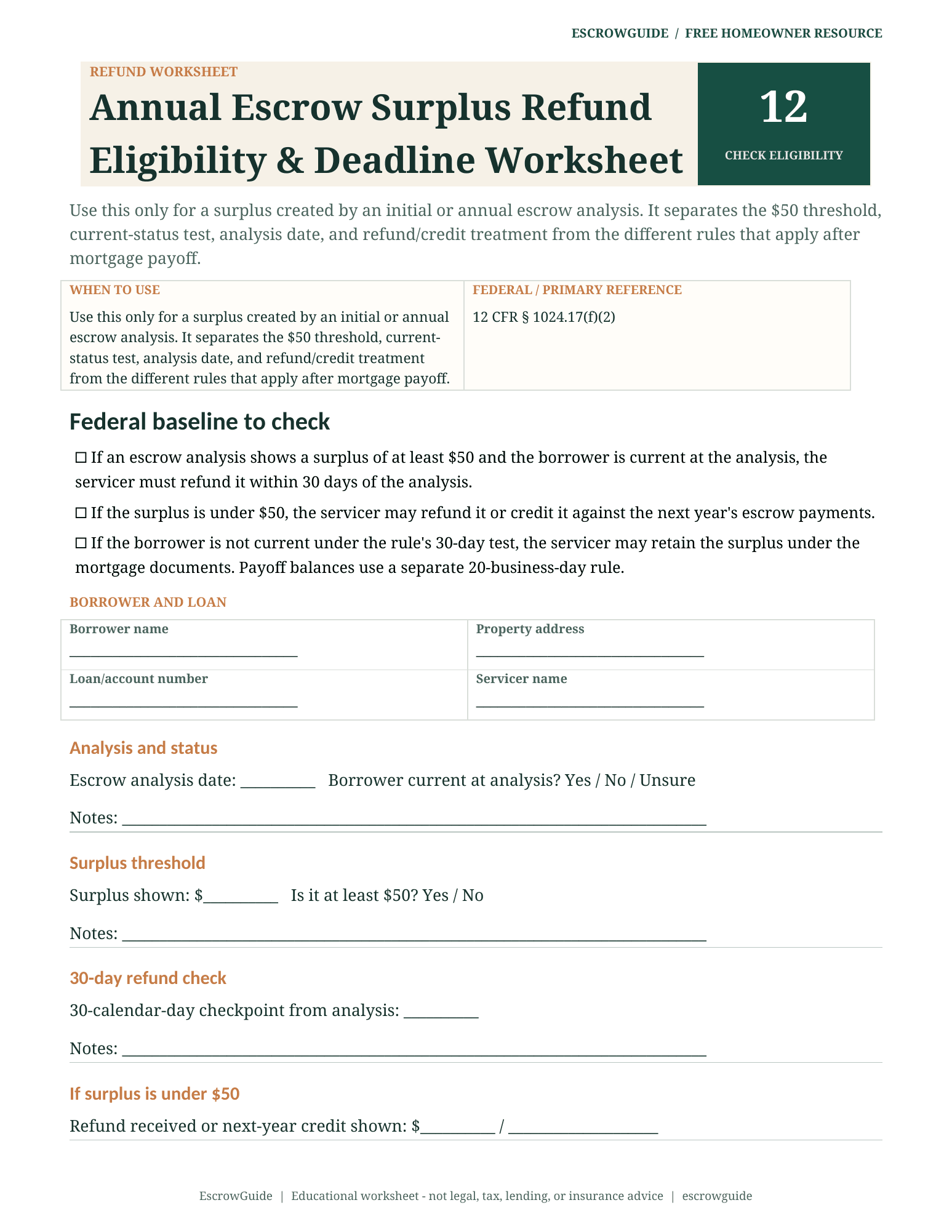
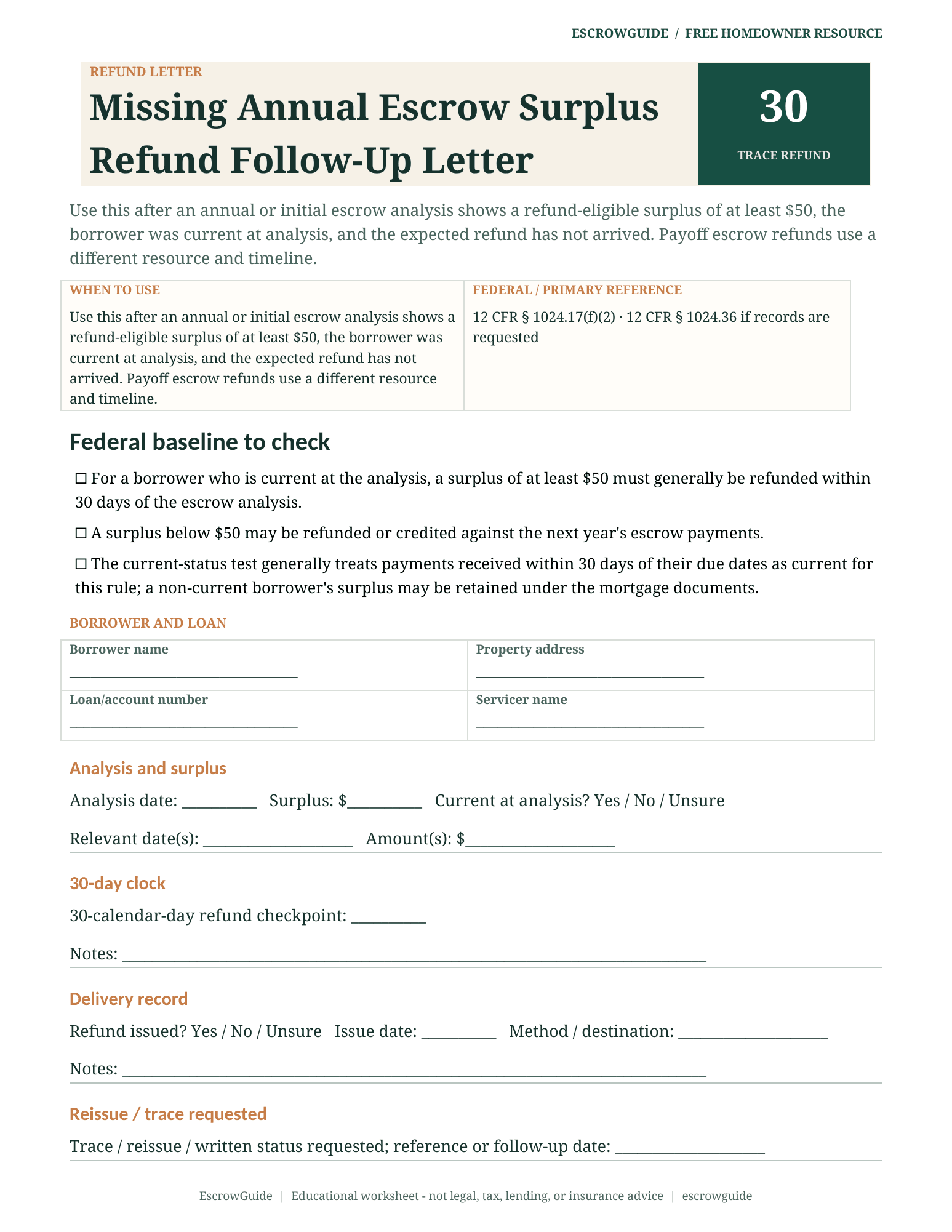
After a mortgage is paid in full, Regulation X generally requires the servicer to return any remaining escrow balance under its control within 20 days, excluding legal public holidays, Saturdays, and Sundays. A refinance or home sale usually triggers the same rule when it results in full payoff of the old mortgage. This payoff balance rule is different from the annual $50 surplus rule.
The trigger for the refund matters because an annual-analysis surplus and a balance remaining after payoff are governed by different provisions and timelines. The point is not to reproduce proprietary servicing software; it is to make every material input traceable.
Reconstruct the timeline before judging the total
Find the earliest document that shows the change. It may be an annual escrow analysis, policy renewal, tax bill, transfer history or workout statement. That starting record usually reveals which payment component deserves attention. For escrow refund after mortgage payoff refinance sale, pair the disputed amount with the record that should control it. Record both the finding and its source. A conclusion such as 'premium increased' is stronger when it sits beside the renewal amount, effective date and matching escrow disbursement.
Rule first, statement second
The payoff rule is in §1024.34(b). It applies after payment of the mortgage loan in full and directs the servicer to return remaining escrow funds within the stated 20-day period, subject to the regulation's exceptions. Do not count the deadline as 20 ordinary calendar days because specified nonbusiness days are excluded.
Regulation X can tell a servicer how to analyze or administer escrow without determining the underlying tax or insurance charge. Keep the rule question and the outside-bill question separate so a correct calculation does not validate a wrong input. The strongest follow-up names the disputed transaction instead of asserting that the entire escrow account is incorrect. A page-specific cross-check is to confirm the old servicer's recorded payoff date.
Put actual numbers beside the rule
Your refinance closes and the old loan payoff is received on August 3. The old servicer still holds $2,150 in escrow. That money is not automatically netted against the new loan's escrow unless the transaction and parties handle it that way. Under the federal payoff rule, the old servicer generally returns the balance within the regulatory period.
The example is a reconciliation method, not a forecast. Substituting the reader's dated figures should either reproduce the statement or isolate a smaller residual that can be investigated directly. A page-specific cross-check is to save the final payoff statement and escrow balance.
Audit the account
Prepare the file before contacting the servicer. Start with the current and prior analysis, recent statements and the tax or insurance evidence. A dated source beside each disputed amount is more useful than a thick folder of unrelated paperwork. A page-specific cross-check is to ask whether the refund will be mailed or delivered electronically and verify the address.
- Confirm the old servicer's recorded payoff date.
- Save the final payoff statement and escrow balance.
- Ask whether the refund will be mailed or delivered electronically and verify the address.
- Do not confuse lender-required prepaid taxes or insurance on the new loan with the refund from the old escrow account.
- If the refund is missing after the applicable period, contact the old servicer and consider a written information request or error notice.
If a check fails, stop and define the failure before moving on. A duplicated payment, missing credit and wrong projection are different problems and should not be bundled into one allegation. For this issue, also rule out applying the annual $50 threshold to payoff funds.
One more reconciliation before you decide
Test causation in chronological order. First identify the outside event or account entry, then the servicer's response, then the monthly-payment effect. Reversing that order—starting from the payment and guessing backward—makes unrelated events look connected and encourages conclusions the records may not support. A page-specific cross-check is to do not confuse lender-required prepaid taxes or insurance on the new loan with the refund from the old escrow account.
A useful stopping rule is simple: do not escalate until the unresolved difference can be stated in one or two sentences with dates and dollars. That does not mean every complex case becomes simple; it means the initial request should identify the first point where the documented records stop agreeing. For this issue, also rule out assuming the closing agent will always transfer old escrow directly into the new account.
Keep estimates labeled as estimates. A simple monthly division is useful for checking direction and scale, but Regulation X aggregate accounting can depend on disbursement dates and the running balance. A rough check should narrow the investigation, not be treated as conclusive proof that formal escrow math is wrong. A page-specific cross-check is to if the refund is missing after the applicable period, contact the old servicer and consider a written information request or error notice.
Mistakes that distort the diagnosis
- Applying the annual $50 threshold to payoff funds.
- Assuming the closing agent will always transfer old escrow directly into the new account.
- Counting the 20-day period incorrectly.
- Spending expected escrow money before confirming final taxes, insurance, and closing adjustments.
Also avoid comparing the new payment with a much older payment while skipping intervening events. Adjacent periods make it easier to isolate a single cause and to identify a genuine statement entry that conflicts with a known bill or ledger. A page-specific cross-check is to confirm the old servicer's recorded payoff date.
When a written servicing request makes sense
A useful written follow-up sounds like a reconciliation exception: 'the analysis uses X on date A, while source B shows Y.' That is more actionable than asking the servicer to recheck the entire mortgage without identifying the discrepancy. A page-specific cross-check is to save the final payoff statement and escrow balance.
The existence of a dispute does not itself mean scheduled mortgage obligations stop. This page explains general servicing mechanics; loan documents, account status, state law and individual facts can affect a particular borrower's next step. For this issue, also rule out counting the 20-day period incorrectly.
What to save after the issue is explained
Keep the next annual analysis in the same evidence file. Some corrections solve the current ledger but affect the following computation year as well. Comparing the new opening balance and projected bills with the resolved records can catch a stale input before it creates another unexplained shortage or surplus. A page-specific cross-check is to ask whether the refund will be mailed or delivered electronically and verify the address.
When contacting a tax authority, insurer or prior servicer, ask for a record that includes the property or loan reference, amount, effective date and payment status. Those fields are more useful for reconciliation than a generic confirmation that the account is 'fine.' For this issue, also rule out spending expected escrow money before confirming final taxes, insurance, and closing adjustments.