Refund letter · Free download
Missing Annual Escrow Surplus Refund Follow-Up Letter
Use this after an annual or initial escrow analysis shows a refund-eligible surplus of at least $50, the borrower was current at analysis, and the expected refund has not arrived. Payoff escrow refunds use a different resource and timeline.
2 pagesNo email requiredEditable + printable
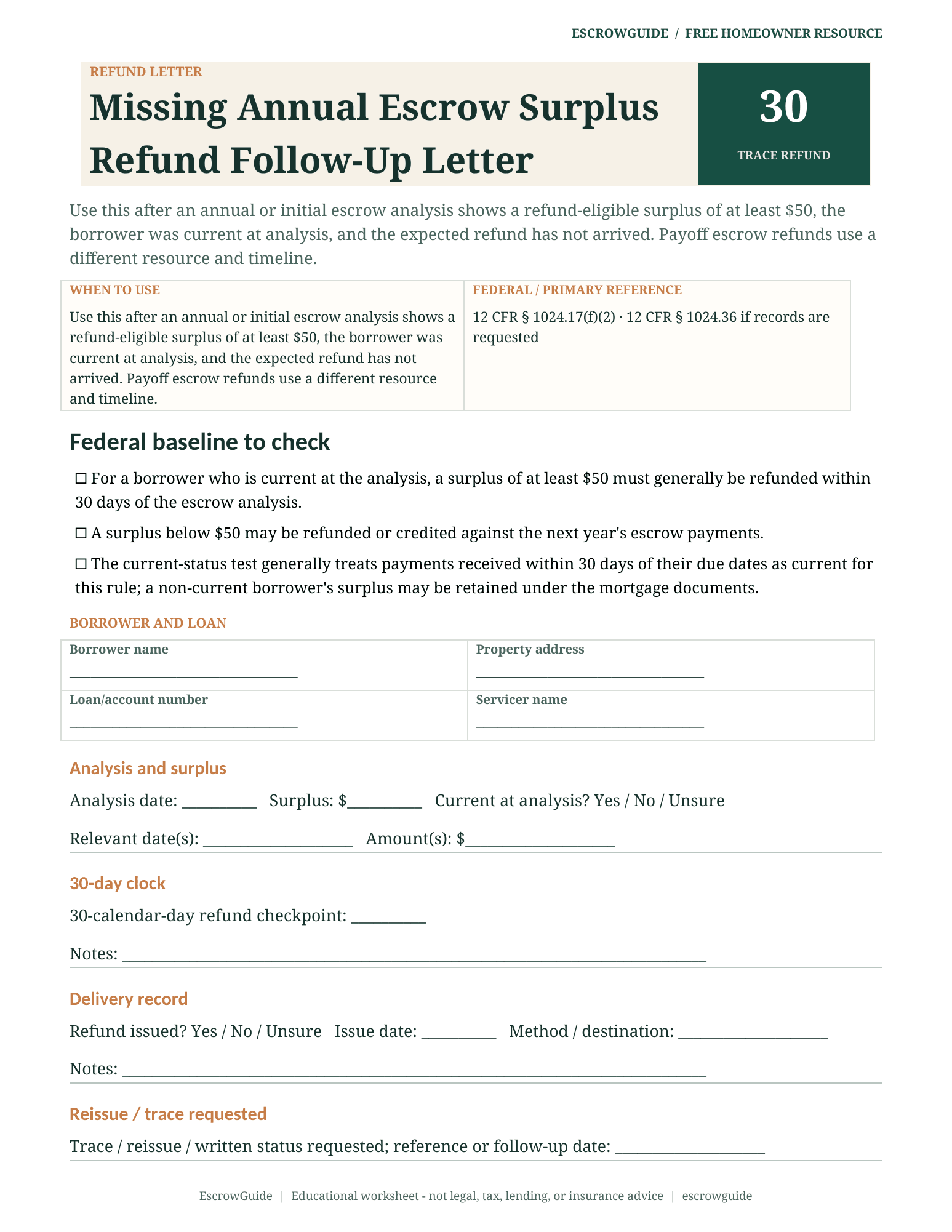
Actual first-page previewMissing Annual Escrow Surplus Refund Follow-Up Letter
Before you fill it out
What this resource helps you document
Use this after an annual or initial escrow analysis shows a refund-eligible surplus of at least $50, the borrower was current at analysis, and the expected refund has not arrived. Payoff escrow refunds use a different resource and timeline.
01Analysis and surplus
0230-day clock
03Delivery record
04Reissue / trace requested
Federal baseline to check
Use the form with the rule, not instead of the rule.
These templates organize facts and records. They do not create a borrower right that the underlying regulation, loan terms, investor rules, or state law does not provide.
- For a borrower who is current at the analysis, a surplus of at least $50 must generally be refunded within 30 days of the escrow analysis.
- A surplus below $50 may be refunded or credited against the next year's escrow payments.
- The current-status test generally treats payments received within 30 days of their due dates as current for this rule; a non-current borrower's surplus may be retained under the mortgage documents.
Use this resource carefully
- State the analysis date, surplus amount, and payment status at analysis. This distinguishes an eligibility dispute from a lost-check/reissue problem.
- If the servicer says the refund was issued, request the issue date, amount, delivery method, destination, and whether it was returned or negotiated.
- Do not use this letter for a loan paid in full; the remaining escrow balance after payoff is governed by the separate 20-business-day framework.
12 CFR § 1024.17(f)(2)CFPB Regulation X § 1024.17(f)(2) — SurplusesOpen primary source ↗12 CFR § 1024.36 if records are requestedCFPB Regulation X § 1024.36 — Requests for informationOpen primary source ↗CFPB consumer guidanceHow to dispute an error or request mortgage informationOpen CFPB guidance ↗