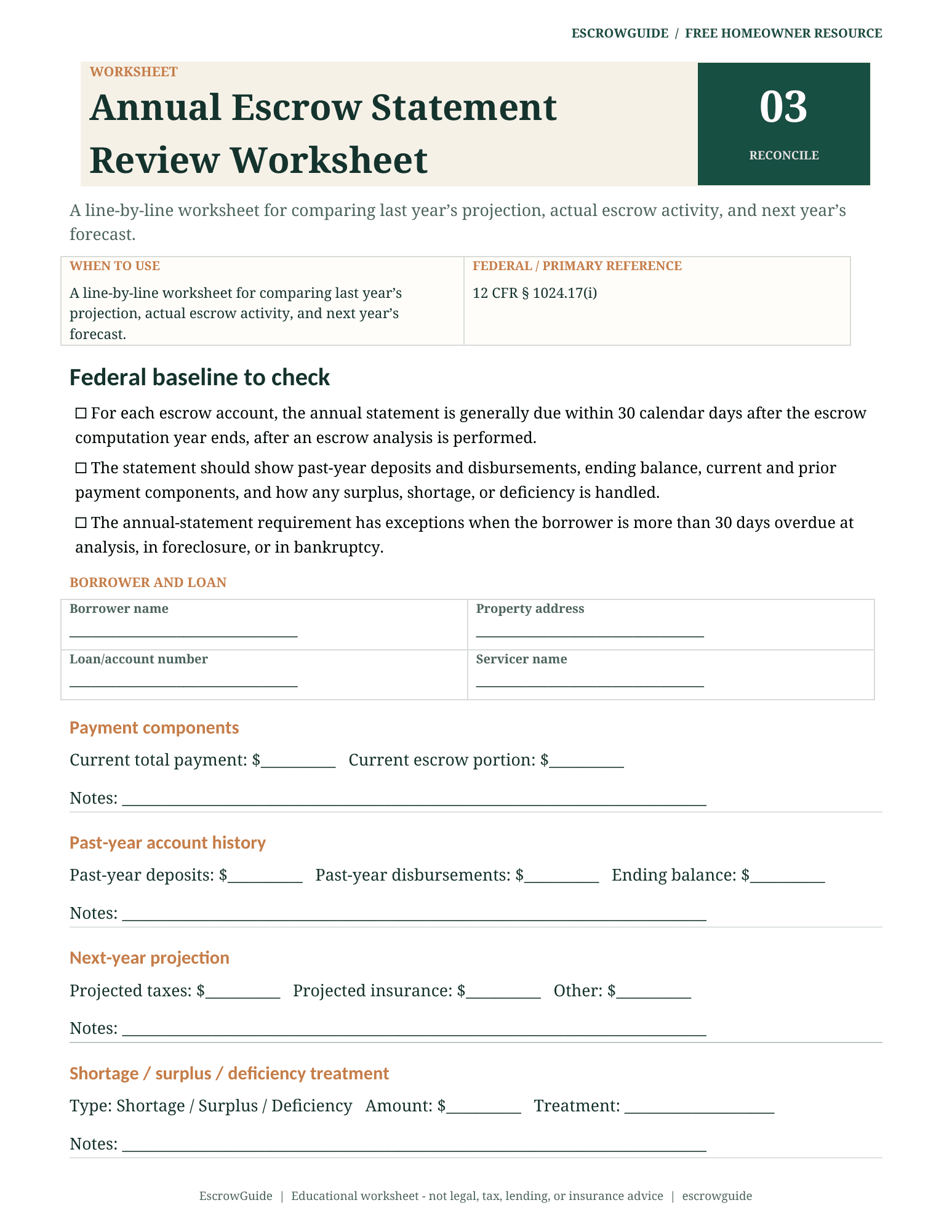
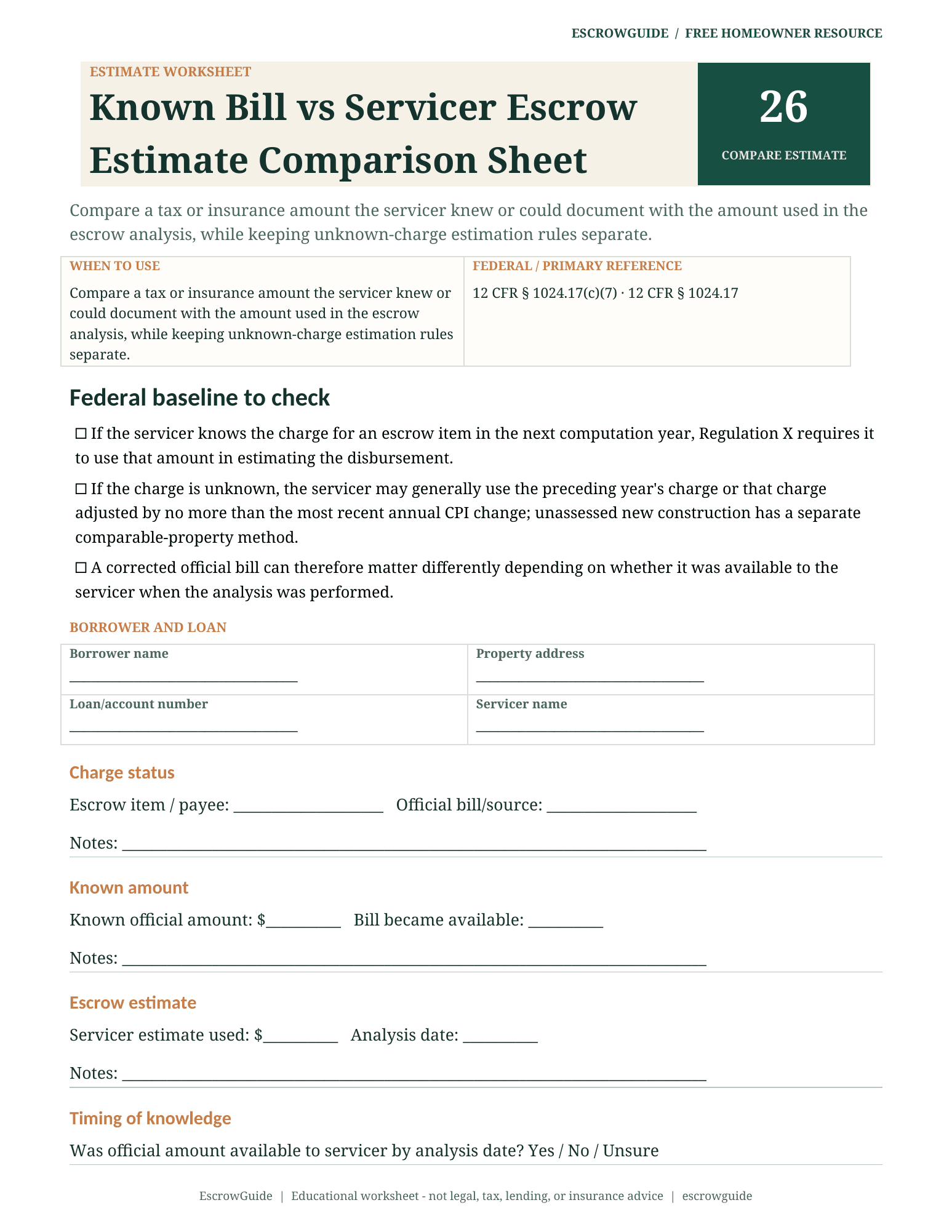
Yes. Regulation X requires certain escrow analyses, but it also says a servicer may conduct an escrow account analysis at other times during the escrow computation year. A second analysis is not automatically an error. The practical audit is to identify what new information or event changed the projection, starting balance, disbursement schedule or shortage treatment.
The phrase “annual escrow analysis” can mislead borrowers into thinking federal law permits exactly one analysis every twelve months. The rule instead establishes required moments and also permits additional analyses. The existence of a second analysis therefore is not enough to identify a servicing error.
Identify the date and type of each escrow analysis
Two analyses should not be compared only by their shortage lines. A later analysis begins from a different actual balance and may know about bills that were estimates during the first analysis. Put the old projected disbursements beside the later known disbursements and mark each changed input.
Long-tail question: can mortgage servicer run escrow analysis more than once a year. An additional analysis after a servicer advance has a specific purpose under the rule when the advance was not caused by borrower payment default: determine the extent of the deficiency before repayment is sought. That makes the disbursement record and the reason for the advance especially important evidence.
The rule that controls compare beginning balances used by the two analyses
Section 1024.17(f)(1)(ii) expressly permits an escrow account analysis at other times during the computation year. It also requires an analysis before a servicer seeks repayment of an advance used to pay an escrow disbursement when the advance was not caused by borrower payment default. The annual statement rules and short-year rules still matter, so a borrower should identify what type of statement followed the additional analysis.
A second analysis can also expose a previous assumption that never occurred. If an insurance premium was projected at $2,400 but renewed at $2,050, the new analysis should not be read as “changing the rule”; it is recalculating the future ledger from a new known charge and a new starting balance.
Worked example: List every tax and insurance estimate that changed
An annual analysis in February raises escrow because property insurance increased. In June the insurer issues a corrected premium and the county changes a tax installment. The servicer runs another analysis and the July payment changes again. The correct comparison is not simply February payment versus July payment. Rebuild February’s inputs, identify the two midyear changes, then determine which balance and disbursement schedule the June analysis used.
Borrowers should keep every version rather than replacing the earlier statement with the later one. The differences between versions are evidence: analysis date, beginning balance, projected bills, cushion, shortage or surplus, repayment period and effective monthly deposit.
Account audit from Identify the date and type of each escrow analysis to Preserve both statements and the intervening transaction history
Identify the date and type of each escrow analysis
The phrase “annual escrow analysis” can mislead borrowers into thinking federal law permits exactly one analysis every twelve months. The rule instead establishes required moments and also permits additional analyses. The existence of a second analysis therefore is not enough to identify a servicing error. Evidence target: Identify the date and type of each escrow analysis. Next comparison: Compare beginning balances used by the two analyses. Error to avoid: assuming a second analysis is prohibited because the statement is called annual.
Compare beginning balances used by the two analyses
Two analyses should not be compared only by their shortage lines. A later analysis begins from a different actual balance and may know about bills that were estimates during the first analysis. Put the old projected disbursements beside the later known disbursements and mark each changed input. Evidence target: Compare beginning balances used by the two analyses. Next comparison: List every tax and insurance estimate that changed. Error to avoid: comparing shortage amounts without comparing starting balances.
List every tax and insurance estimate that changed
An additional analysis after a servicer advance has a specific purpose under the rule when the advance was not caused by borrower payment default: determine the extent of the deficiency before repayment is sought. That makes the disbursement record and the reason for the advance especially important evidence. Evidence target: List every tax and insurance estimate that changed. Next comparison: Check for an escrow advance between analyses. Error to avoid: ignoring a refund or corrected bill received between analyses.
Check for an escrow advance between analyses
A second analysis can also expose a previous assumption that never occurred. If an insurance premium was projected at $2,400 but renewed at $2,050, the new analysis should not be read as “changing the rule”; it is recalculating the future ledger from a new known charge and a new starting balance. Evidence target: Check for an escrow advance between analyses. Next comparison: Separate recurring escrow from shortage repayment. Error to avoid: treating a principal-and-interest change as part of escrow.
Separate recurring escrow from shortage repayment
Borrowers should keep every version rather than replacing the earlier statement with the later one. The differences between versions are evidence: analysis date, beginning balance, projected bills, cushion, shortage or surplus, repayment period and effective monthly deposit. Evidence target: Separate recurring escrow from shortage repayment. Next comparison: Confirm whether a short-year statement changed the computation year. Error to avoid: discarding the earlier statement after the servicer recalculates.
Confirm whether a short-year statement changed the computation year
If the new payment changes twice in a short period, split the all-in payment into principal and interest, recurring escrow and temporary shortage or deficiency repayment. Only the escrow-related layers belong in this analysis; an ARM adjustment or modification can change another component at the same time. Evidence target: Confirm whether a short-year statement changed the computation year. Next comparison: Match the new payment effective date to the later analysis. Error to avoid: assuming a second analysis is prohibited because the statement is called annual.
Match the new payment effective date to the later analysis
The phrase “annual escrow analysis” can mislead borrowers into thinking federal law permits exactly one analysis every twelve months. The rule instead establishes required moments and also permits additional analyses. The existence of a second analysis therefore is not enough to identify a servicing error. Evidence target: Match the new payment effective date to the later analysis. Next comparison: Preserve both statements and the intervening transaction history. Error to avoid: comparing shortage amounts without comparing starting balances.
Preserve both statements and the intervening transaction history
Two analyses should not be compared only by their shortage lines. A later analysis begins from a different actual balance and may know about bills that were estimates during the first analysis. Put the old projected disbursements beside the later known disbursements and mark each changed input. Evidence target: Preserve both statements and the intervening transaction history. Next comparison: Identify the date and type of each escrow analysis. Error to avoid: ignoring a refund or corrected bill received between analyses.
Evidence table for “can mortgage servicer run escrow analysis more than once a year”
| Step | What to verify | Failure mode |
|---|---|---|
| 1 | Identify the date and type of each escrow analysis | assuming a second analysis is prohibited because the statement is called annual |
| 2 | Compare beginning balances used by the two analyses | comparing shortage amounts without comparing starting balances |
| 3 | List every tax and insurance estimate that changed | ignoring a refund or corrected bill received between analyses |
| 4 | Check for an escrow advance between analyses | treating a principal-and-interest change as part of escrow |
| 5 | Separate recurring escrow from shortage repayment | discarding the earlier statement after the servicer recalculates |
| 6 | Confirm whether a short-year statement changed the computation year | assuming a second analysis is prohibited because the statement is called annual |
| 7 | Match the new payment effective date to the later analysis | comparing shortage amounts without comparing starting balances |
| 8 | Preserve both statements and the intervening transaction history | ignoring a refund or corrected bill received between analyses |
What can change the answer
If the new payment changes twice in a short period, split the all-in payment into principal and interest, recurring escrow and temporary shortage or deficiency repayment. Only the escrow-related layers belong in this analysis; an ARM adjustment or modification can change another component at the same time.
- assuming a second analysis is prohibited because the statement is called annual
- comparing shortage amounts without comparing starting balances
- ignoring a refund or corrected bill received between analyses
- treating a principal-and-interest change as part of escrow
- discarding the earlier statement after the servicer recalculates
Primary authority for this servicing question
- CFPB Regulation X — § 1024.17 ↗
can mortgage servicer run escrow analysis more than once a year — use CFPB Regulation X — § 1024.17 to verify the federal or investor rule described above; use the borrower’s own statements, bills and transaction history for loan-level facts.
- CFPB Mortgage Servicing FAQs ↗
can mortgage servicer run escrow analysis more than once a year — use CFPB Mortgage Servicing FAQs to verify the federal or investor rule described above; use the borrower’s own statements, bills and transaction history for loan-level facts.
Scope: this guide explains mortgage-servicing mechanics for can mortgage servicer run escrow analysis more than once a year. It does not provide personalized legal, tax, insurance-coverage or loan-choice advice. Where local law, mortgage documents or investor rules matter, verify those authorities separately.