A positive current balance does not rule out a shortage. Regulation X aggregate analysis projects deposits and disbursements month by month and tests the lowest projected balance against the permitted target and cushion.
The “current balance” is a snapshot; the “lowest projected balance” is a point on a 12-month forecast. For lowest projected escrow balance vs current balance, start with “Copy the 12 projected monthly balances..”
Copy the 12 projected monthly balances.: starting record
Large seasonal tax bills are why dividing annual expenses by 12 cannot reproduce the entire aggregate analysis. Evidence anchor: Identify the lowest month.
A two-month cushion is a maximum federal baseline, not a requirement that every account use the full amount. Timing anchor: List the disbursement that creates that low point.
Rule boundary for lowest projected escrow balance vs current balance
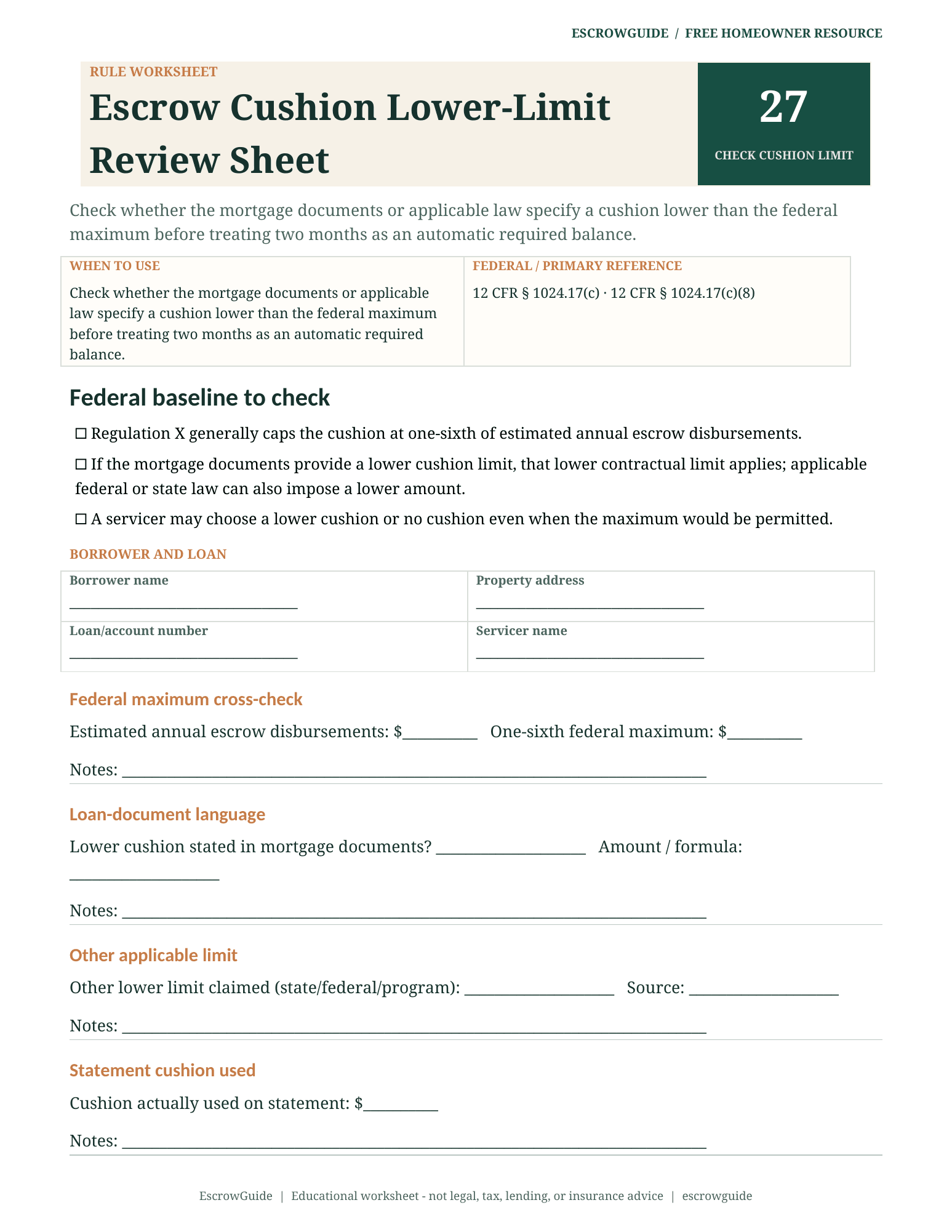
12 CFR § 1024.17 defines the trial running balance and target balance and limits the cushion to no more than one-sixth of estimated annual escrow disbursements, subject to lower loan-document or state-law limits.
Timing errors can change the low month even when annual totals are correct. Account test: Copy the 12 projected monthly balances. Then: Identify the lowest month. The payment total alone cannot answer lowest projected escrow balance vs current balance; those two records must agree first.
Worked account example: List the disbursement that creates that low point.
Illustrative account: $3,100 sits in escrow in January, but a $5,400 property-tax bill is projected for March before enough monthly deposits arrive. If the trial balance falls to $400 and the permitted target is $1,200, the analysis can show an $800 shortage even though the January balance was positive.
lowest projected escrow balance vs current balance: substitute borrower-specific figures for “Copy the 12 projected monthly balances..” Next test “List the disbursement that creates that low point..” Finish at “Rebuild the timeline if the low month does not match known bill due dates..” A due-date change can create a shortage without any annual bill increase. The figures show sequence only; they are not a forecast.
Six evidence tests for lowest projected escrow balance vs current balance
Copy the 12 projected monthly balances.
Source comparison: Copy the 12 projected monthly balances.. Large seasonal tax bills are why dividing annual expenses by 12 cannot reproduce the entire aggregate analysis. For lowest projected escrow balance vs current balance, capture this evidence: Copy the 12 projected monthly balances. Risk to flag: Looking only at today’s balance. Next cross-check: Identify the lowest month.. Timing errors can change the low month even when annual totals are correct.
Identify the lowest month.
Final bridge: Identify the lowest month.. A two-month cushion is a maximum federal baseline, not a requirement that every account use the full amount. For lowest projected escrow balance vs current balance, capture this evidence: Identify the lowest month. Risk to flag: Treating one-sixth as a mandatory cushion. Next cross-check: List the disbursement that creates that low point.. A due-date change can create a shortage without any annual bill increase.
List the disbursement that creates that low point.
Date-and-amount test: List the disbursement that creates that low point.. Timing errors can change the low month even when annual totals are correct. For lowest projected escrow balance vs current balance, capture this evidence: List the disbursement that creates that low point. Risk to flag: Ignoring bill timing. Next cross-check: Compute one-sixth of projected annual disbursements as a ceiling cross-check.. The statement’s running-balance table is more diagnostic than the single shortage number at the top.
Compute one-sixth of projected annual disbursements as a ceiling cross-check.
Reconciliation item: Compute one-sixth of projected annual disbursements as a ceiling cross-check.. A due-date change can create a shortage without any annual bill increase. For lowest projected escrow balance vs current balance, capture this evidence: Compute one-sixth of projected annual disbursements as a ceiling cross-check. Risk to flag: Assuming annual expense divided by 12 equals the complete analysis. Next cross-check: Check the mortgage documents for a lower cushion.. The “current balance” is a snapshot; the “lowest projected balance” is a point on a 12-month forecast.
Check the mortgage documents for a lower cushion.
Source comparison: Check the mortgage documents for a lower cushion.. The statement’s running-balance table is more diagnostic than the single shortage number at the top. For lowest projected escrow balance vs current balance, capture this evidence: Check the mortgage documents for a lower cushion. Risk to flag: Looking only at today’s balance. Next cross-check: Rebuild the timeline if the low month does not match known bill due dates.. Large seasonal tax bills are why dividing annual expenses by 12 cannot reproduce the entire aggregate analysis.
Rebuild the timeline if the low month does not match known bill due dates.
Final bridge: Rebuild the timeline if the low month does not match known bill due dates.. The “current balance” is a snapshot; the “lowest projected balance” is a point on a 12-month forecast. For lowest projected escrow balance vs current balance, capture this evidence: Rebuild the timeline if the low month does not match known bill due dates. Risk to flag: Treating one-sixth as a mandatory cushion. Next cross-check: Copy the 12 projected monthly balances.. A two-month cushion is a maximum federal baseline, not a requirement that every account use the full amount.
| Step | lowest projected escrow balance vs current balance evidence | Expected finding | Risk |
|---|---|---|---|
| 1 | Copy the 12 projected monthly balances. | The “current balance” is a snapshot; the “lowest projected balance” is a point on a 12-month forecast. | Looking only at today’s balance |
| 2 | Identify the lowest month. | Large seasonal tax bills are why dividing annual expenses by 12 cannot reproduce the entire aggregate analysis. | Treating one-sixth as a mandatory cushion |
| 3 | List the disbursement that creates that low point. | A two-month cushion is a maximum federal baseline, not a requirement that every account use the full amount. | Ignoring bill timing |
| 4 | Compute one-sixth of projected annual disbursements as a ceiling cross-check. | Timing errors can change the low month even when annual totals are correct. | Assuming annual expense divided by 12 equals the complete analysis |
| 5 | Check the mortgage documents for a lower cushion. | A due-date change can create a shortage without any annual bill increase. | Looking only at today’s balance |
| 6 | Rebuild the timeline if the low month does not match known bill due dates. | The statement’s running-balance table is more diagnostic than the single shortage number at the top. | Treating one-sixth as a mandatory cushion |
Check the mortgage documents for a lower cushion.: interpretation
A due-date change can create a shortage without any annual bill increase. Recalculate “Compute one-sixth of projected annual disbursements as a ceiling cross-check.” separately from any principal-and-interest change.
The statement’s running-balance table is more diagnostic than the single shortage number at the top. For lowest projected escrow balance vs current balance, the arithmetic is closed only when “Rebuild the timeline if the low month does not match known bill due dates.” reproduces both the recurring escrow and any temporary catch-up amount.
Copy the 12 projected monthly balances. → Rebuild the timeline if the low month does not match known bill due dates.: reconstruction
Bridge 1: Copy the 12 projected monthly balances.
A two-month cushion is a maximum federal baseline, not a requirement that every account use the full amount. Start record: Copy the 12 projected monthly balances.. Next record: Identify the lowest month.. lowest projected escrow balance vs current balance issue at this bridge: Treating one-sixth as a mandatory cushion. Account implication: The statement’s running-balance table is more diagnostic than the single shortage number at the top.
Bridge 2: Identify the lowest month.
Timing errors can change the low month even when annual totals are correct. Start record: Identify the lowest month.. Next record: List the disbursement that creates that low point.. lowest projected escrow balance vs current balance issue at this bridge: Ignoring bill timing. Account implication: The “current balance” is a snapshot; the “lowest projected balance” is a point on a 12-month forecast.
Bridge 3: List the disbursement that creates that low point.
A due-date change can create a shortage without any annual bill increase. Start record: List the disbursement that creates that low point.. Next record: Compute one-sixth of projected annual disbursements as a ceiling cross-check.. lowest projected escrow balance vs current balance issue at this bridge: Assuming annual expense divided by 12 equals the complete analysis. Account implication: Large seasonal tax bills are why dividing annual expenses by 12 cannot reproduce the entire aggregate analysis.
Bridge 4: Compute one-sixth of projected annual disbursements as a ceiling cross-check.
The statement’s running-balance table is more diagnostic than the single shortage number at the top. Start record: Compute one-sixth of projected annual disbursements as a ceiling cross-check.. Next record: Check the mortgage documents for a lower cushion.. lowest projected escrow balance vs current balance issue at this bridge: Looking only at today’s balance. Account implication: A two-month cushion is a maximum federal baseline, not a requirement that every account use the full amount.
Bridge 5: Check the mortgage documents for a lower cushion.
The “current balance” is a snapshot; the “lowest projected balance” is a point on a 12-month forecast. Start record: Check the mortgage documents for a lower cushion.. Next record: Rebuild the timeline if the low month does not match known bill due dates.. lowest projected escrow balance vs current balance issue at this bridge: Treating one-sixth as a mandatory cushion. Account implication: Timing errors can change the low month even when annual totals are correct.
Bridge 6: Rebuild the timeline if the low month does not match known bill due dates.
Large seasonal tax bills are why dividing annual expenses by 12 cannot reproduce the entire aggregate analysis. Start record: Rebuild the timeline if the low month does not match known bill due dates.. Next record: Copy the 12 projected monthly balances.. lowest projected escrow balance vs current balance issue at this bridge: Ignoring bill timing. Account implication: A due-date change can create a shortage without any annual bill increase.
lowest projected escrow balance vs current balance: final reconciliation checklist
- Copy the 12 projected monthly balances. — A two-month cushion is a maximum federal baseline, not a requirement that every account use the full amount.
- Identify the lowest month. — Timing errors can change the low month even when annual totals are correct.
- List the disbursement that creates that low point. — A due-date change can create a shortage without any annual bill increase.
- Compute one-sixth of projected annual disbursements as a ceiling cross-check. — The statement’s running-balance table is more diagnostic than the single shortage number at the top.
- Check the mortgage documents for a lower cushion. — The “current balance” is a snapshot; the “lowest projected balance” is a point on a 12-month forecast.
- Rebuild the timeline if the low month does not match known bill due dates. — Large seasonal tax bills are why dividing annual expenses by 12 cannot reproduce the entire aggregate analysis.
Primary sources for lowest projected escrow balance vs current balance
- CFPB Regulation X — 12 CFR § 1024.17 (Escrow Accounts) ↗
lowest projected escrow balance vs current balance — rule focus: escrow analysis, statements, cushion limits, shortage/surplus treatment, and disbursement mechanics. Borrower-file cross-check: Copy the 12 projected monthly balances..
- Chase — Annual Escrow Analysis FAQs ↗
lowest projected escrow balance vs current balance — rule focus: a large-servicer example of annual escrow analysis operations. Borrower-file cross-check: Identify the lowest month..
- PNC — Mortgage escrow guide ↗
lowest projected escrow balance vs current balance — rule focus: a large-servicer example of escrow administration. Borrower-file cross-check: List the disbursement that creates that low point..
Scope for lowest projected escrow balance vs current balance: mortgage-servicing mechanics. First verify “Copy the 12 projected monthly balances..” Last verify “Rebuild the timeline if the low month does not match known bill due dates..” Example dollars are illustrative. Tax law, insurance coverage, bankruptcy, probate, and investor eligibility can require separate authority.