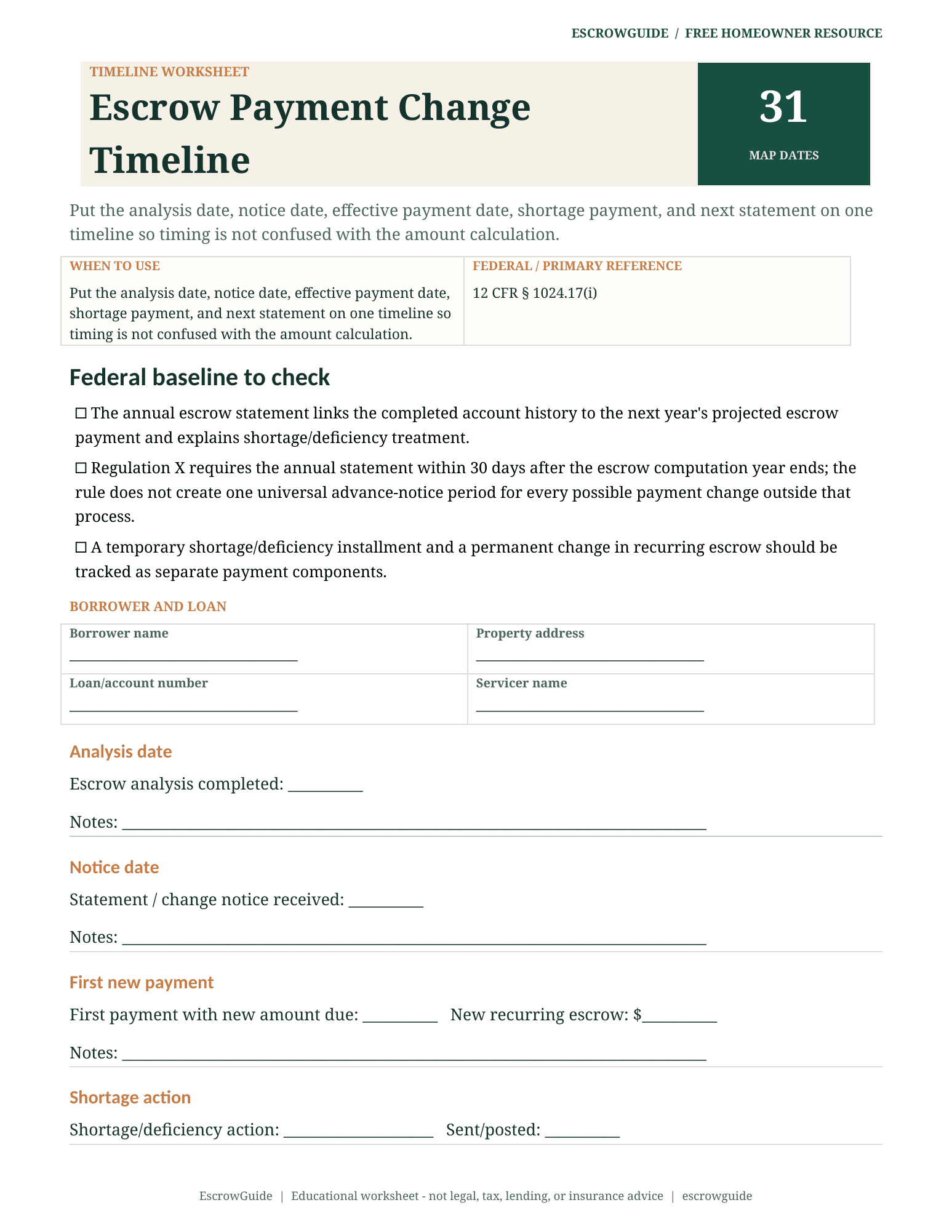
The safest answer is the effective date printed on the servicer’s escrow analysis or payment notice. Regulation X governs the analysis and statement contents, but a servicer’s operational calendar determines when the revised total first appears, subject to applicable disclosure rules.
Separate analysis completion, mailing, statement generation, and payment effective dates. For when does new escrow payment take effect after analysis, start with “Find the “effective” or “first payment due” line..”
Find the “effective” or “first payment due” line.: starting record
A shortage payment made after analysis can cause a recalculated payment to appear on a later statement. Evidence anchor: Compare the next two monthly statements.
Autopay should be checked after the analysis but before the first revised due date. Timing anchor: Verify autopay amount and change date.
Rule boundary for when does new escrow payment take effect after analysis
Regulation X requires an annual escrow analysis and statement, but it does not create one universal “all servicers change the payment exactly X days later” rule. Public servicer guidance illustrates that the implementation date can be tied to the servicer’s analysis cycle.
Some servicers publish state-specific analysis calendars; those calendars are servicer practice, not a federal universal. Account test: Find the “effective” or “first payment due” line. Then: Compare the next two monthly statements. The payment total alone cannot answer when does new escrow payment take effect after analysis; those two records must agree first.
Worked account example: Verify autopay amount and change date.
Example: an analysis is completed January 12, the notice states a new payment of $2,615 effective March 1, and February still shows $2,470. Paying $2,615 in February just because the notice arrived in January may create an unapplied or extra amount; the effective-date line controls the borrower’s operational check.
when does new escrow payment take effect after analysis: substitute borrower-specific figures for “Find the “effective” or “first payment due” line..” Next test “Verify autopay amount and change date..” Finish at “Contact the servicer before changing an automatic bank draft manually..” A changed payment may contain both new recurring escrow and temporary shortage repayment. The figures show sequence only; they are not a forecast.
Six evidence tests for when does new escrow payment take effect after analysis
Find the “effective” or “first payment due” line.
Ledger checkpoint: Find the “effective” or “first payment due” line.. A shortage payment made after analysis can cause a recalculated payment to appear on a later statement. For when does new escrow payment take effect after analysis, capture this evidence: Find the “effective” or “first payment due” line. Risk to flag: Using the notice date as the due date. Next cross-check: Compare the next two monthly statements.. Some servicers publish state-specific analysis calendars; those calendars are servicer practice, not a federal universal.
Compare the next two monthly statements.
Statement checkpoint: Compare the next two monthly statements.. Autopay should be checked after the analysis but before the first revised due date. For when does new escrow payment take effect after analysis, capture this evidence: Compare the next two monthly statements. Risk to flag: Assuming every servicer has the same one-month lag. Next cross-check: Verify autopay amount and change date.. A changed payment may contain both new recurring escrow and temporary shortage repayment.
Verify autopay amount and change date.
Cutoff test: Verify autopay amount and change date.. Some servicers publish state-specific analysis calendars; those calendars are servicer practice, not a federal universal. For when does new escrow payment take effect after analysis, capture this evidence: Verify autopay amount and change date. Risk to flag: Changing autopay before the old amount is actually replaced. Next cross-check: Separate recurring escrow from shortage repayment.. If the first changed draft does not match the analysis, compare component lines before assuming the analysis was ignored.
Separate recurring escrow from shortage repayment.
Before escalating: Separate recurring escrow from shortage repayment.. A changed payment may contain both new recurring escrow and temporary shortage repayment. For when does new escrow payment take effect after analysis, capture this evidence: Separate recurring escrow from shortage repayment. Risk to flag: Ignoring a mid-cycle shortage payment that triggers recalculation. Next cross-check: Save any confirmation after a lump-sum shortage payment.. Separate analysis completion, mailing, statement generation, and payment effective dates.
Save any confirmation after a lump-sum shortage payment.
Ledger checkpoint: Save any confirmation after a lump-sum shortage payment.. If the first changed draft does not match the analysis, compare component lines before assuming the analysis was ignored. For when does new escrow payment take effect after analysis, capture this evidence: Save any confirmation after a lump-sum shortage payment. Risk to flag: Using the notice date as the due date. Next cross-check: Contact the servicer before changing an automatic bank draft manually.. A shortage payment made after analysis can cause a recalculated payment to appear on a later statement.
Contact the servicer before changing an automatic bank draft manually.
Statement checkpoint: Contact the servicer before changing an automatic bank draft manually.. Separate analysis completion, mailing, statement generation, and payment effective dates. For when does new escrow payment take effect after analysis, capture this evidence: Contact the servicer before changing an automatic bank draft manually. Risk to flag: Assuming every servicer has the same one-month lag. Next cross-check: Find the “effective” or “first payment due” line.. Autopay should be checked after the analysis but before the first revised due date.
| Step | when does new escrow payment take effect after analysis evidence | Expected finding | Risk |
|---|---|---|---|
| 1 | Find the “effective” or “first payment due” line. | Separate analysis completion, mailing, statement generation, and payment effective dates. | Using the notice date as the due date |
| 2 | Compare the next two monthly statements. | A shortage payment made after analysis can cause a recalculated payment to appear on a later statement. | Assuming every servicer has the same one-month lag |
| 3 | Verify autopay amount and change date. | Autopay should be checked after the analysis but before the first revised due date. | Changing autopay before the old amount is actually replaced |
| 4 | Separate recurring escrow from shortage repayment. | Some servicers publish state-specific analysis calendars; those calendars are servicer practice, not a federal universal. | Ignoring a mid-cycle shortage payment that triggers recalculation |
| 5 | Save any confirmation after a lump-sum shortage payment. | A changed payment may contain both new recurring escrow and temporary shortage repayment. | Using the notice date as the due date |
| 6 | Contact the servicer before changing an automatic bank draft manually. | If the first changed draft does not match the analysis, compare component lines before assuming the analysis was ignored. | Assuming every servicer has the same one-month lag |
Save any confirmation after a lump-sum shortage payment.: interpretation
A changed payment may contain both new recurring escrow and temporary shortage repayment. Recalculate “Separate recurring escrow from shortage repayment.” separately from any principal-and-interest change.
If the first changed draft does not match the analysis, compare component lines before assuming the analysis was ignored. For when does new escrow payment take effect after analysis, the arithmetic is closed only when “Contact the servicer before changing an automatic bank draft manually.” reproduces both the recurring escrow and any temporary catch-up amount.
Find the “effective” or “first payment due” line. → Contact the servicer before changing an automatic bank draft manually.: reconstruction
Bridge 1: Find the “effective” or “first payment due” line.
Autopay should be checked after the analysis but before the first revised due date. Start record: Find the “effective” or “first payment due” line.. Next record: Compare the next two monthly statements.. when does new escrow payment take effect after analysis issue at this bridge: Assuming every servicer has the same one-month lag. Account implication: If the first changed draft does not match the analysis, compare component lines before assuming the analysis was ignored.
Bridge 2: Compare the next two monthly statements.
Some servicers publish state-specific analysis calendars; those calendars are servicer practice, not a federal universal. Start record: Compare the next two monthly statements.. Next record: Verify autopay amount and change date.. when does new escrow payment take effect after analysis issue at this bridge: Changing autopay before the old amount is actually replaced. Account implication: Separate analysis completion, mailing, statement generation, and payment effective dates.
Bridge 3: Verify autopay amount and change date.
A changed payment may contain both new recurring escrow and temporary shortage repayment. Start record: Verify autopay amount and change date.. Next record: Separate recurring escrow from shortage repayment.. when does new escrow payment take effect after analysis issue at this bridge: Ignoring a mid-cycle shortage payment that triggers recalculation. Account implication: A shortage payment made after analysis can cause a recalculated payment to appear on a later statement.
Bridge 4: Separate recurring escrow from shortage repayment.
If the first changed draft does not match the analysis, compare component lines before assuming the analysis was ignored. Start record: Separate recurring escrow from shortage repayment.. Next record: Save any confirmation after a lump-sum shortage payment.. when does new escrow payment take effect after analysis issue at this bridge: Using the notice date as the due date. Account implication: Autopay should be checked after the analysis but before the first revised due date.
Bridge 5: Save any confirmation after a lump-sum shortage payment.
Separate analysis completion, mailing, statement generation, and payment effective dates. Start record: Save any confirmation after a lump-sum shortage payment.. Next record: Contact the servicer before changing an automatic bank draft manually.. when does new escrow payment take effect after analysis issue at this bridge: Assuming every servicer has the same one-month lag. Account implication: Some servicers publish state-specific analysis calendars; those calendars are servicer practice, not a federal universal.
Bridge 6: Contact the servicer before changing an automatic bank draft manually.
A shortage payment made after analysis can cause a recalculated payment to appear on a later statement. Start record: Contact the servicer before changing an automatic bank draft manually.. Next record: Find the “effective” or “first payment due” line.. when does new escrow payment take effect after analysis issue at this bridge: Changing autopay before the old amount is actually replaced. Account implication: A changed payment may contain both new recurring escrow and temporary shortage repayment.
when does new escrow payment take effect after analysis: final reconciliation checklist
- Find the “effective” or “first payment due” line. — Autopay should be checked after the analysis but before the first revised due date.
- Compare the next two monthly statements. — Some servicers publish state-specific analysis calendars; those calendars are servicer practice, not a federal universal.
- Verify autopay amount and change date. — A changed payment may contain both new recurring escrow and temporary shortage repayment.
- Separate recurring escrow from shortage repayment. — If the first changed draft does not match the analysis, compare component lines before assuming the analysis was ignored.
- Save any confirmation after a lump-sum shortage payment. — Separate analysis completion, mailing, statement generation, and payment effective dates.
- Contact the servicer before changing an automatic bank draft manually. — A shortage payment made after analysis can cause a recalculated payment to appear on a later statement.
Primary sources for when does new escrow payment take effect after analysis
- CFPB Regulation X — 12 CFR § 1024.17 (Escrow Accounts) ↗
when does new escrow payment take effect after analysis — rule focus: escrow analysis, statements, cushion limits, shortage/surplus treatment, and disbursement mechanics. Borrower-file cross-check: Find the “effective” or “first payment due” line..
- Chase — Annual Escrow Analysis FAQs ↗
when does new escrow payment take effect after analysis — rule focus: a large-servicer example of annual escrow analysis operations. Borrower-file cross-check: Compare the next two monthly statements..
- Chase — Escrow shortage & surplus FAQs ↗
when does new escrow payment take effect after analysis — rule focus: a large-servicer example of shortage and surplus handling. Borrower-file cross-check: Verify autopay amount and change date..
Scope for when does new escrow payment take effect after analysis: mortgage-servicing mechanics. First verify “Find the “effective” or “first payment due” line..” Last verify “Contact the servicer before changing an automatic bank draft manually..” Example dollars are illustrative. Tax law, insurance coverage, bankruptcy, probate, and investor eligibility can require separate authority.