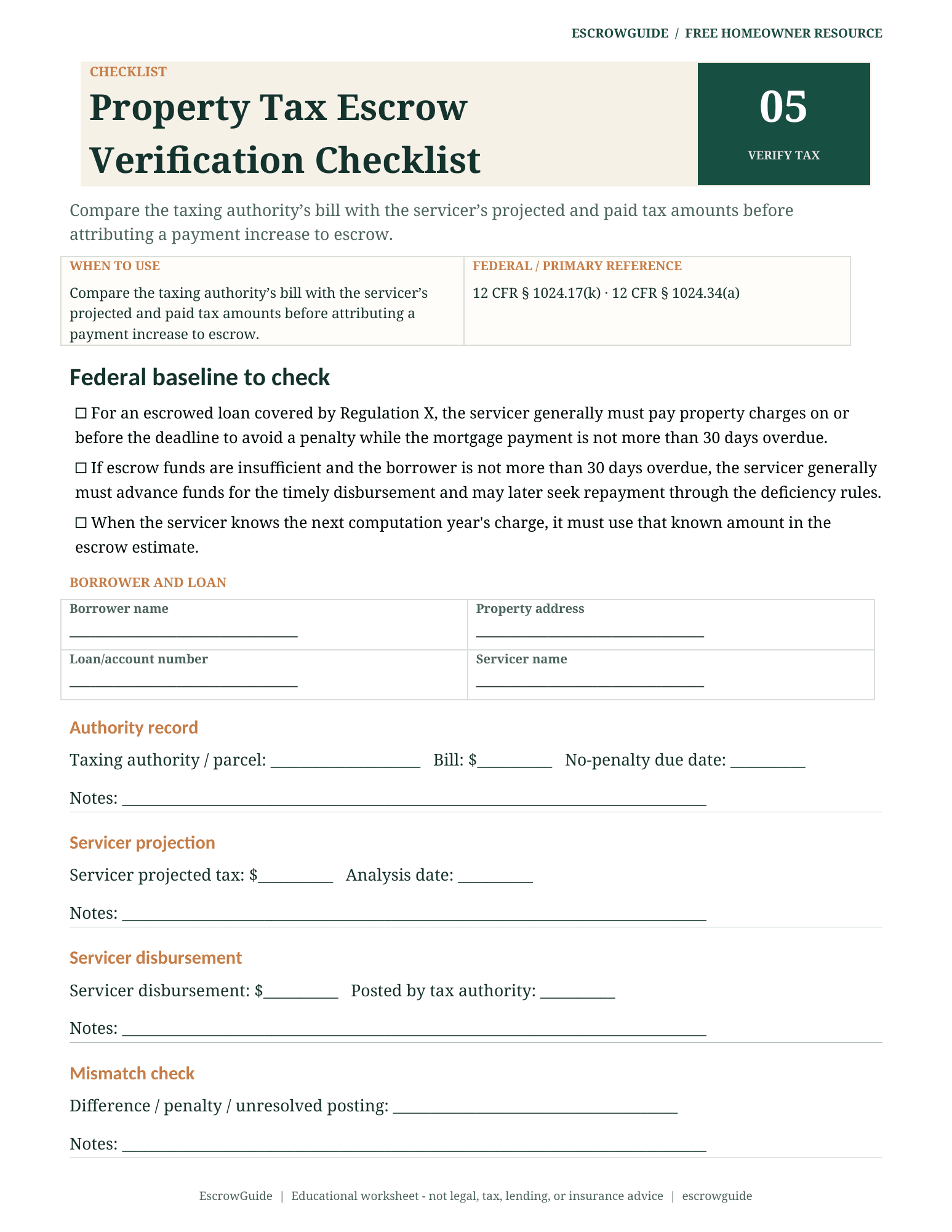
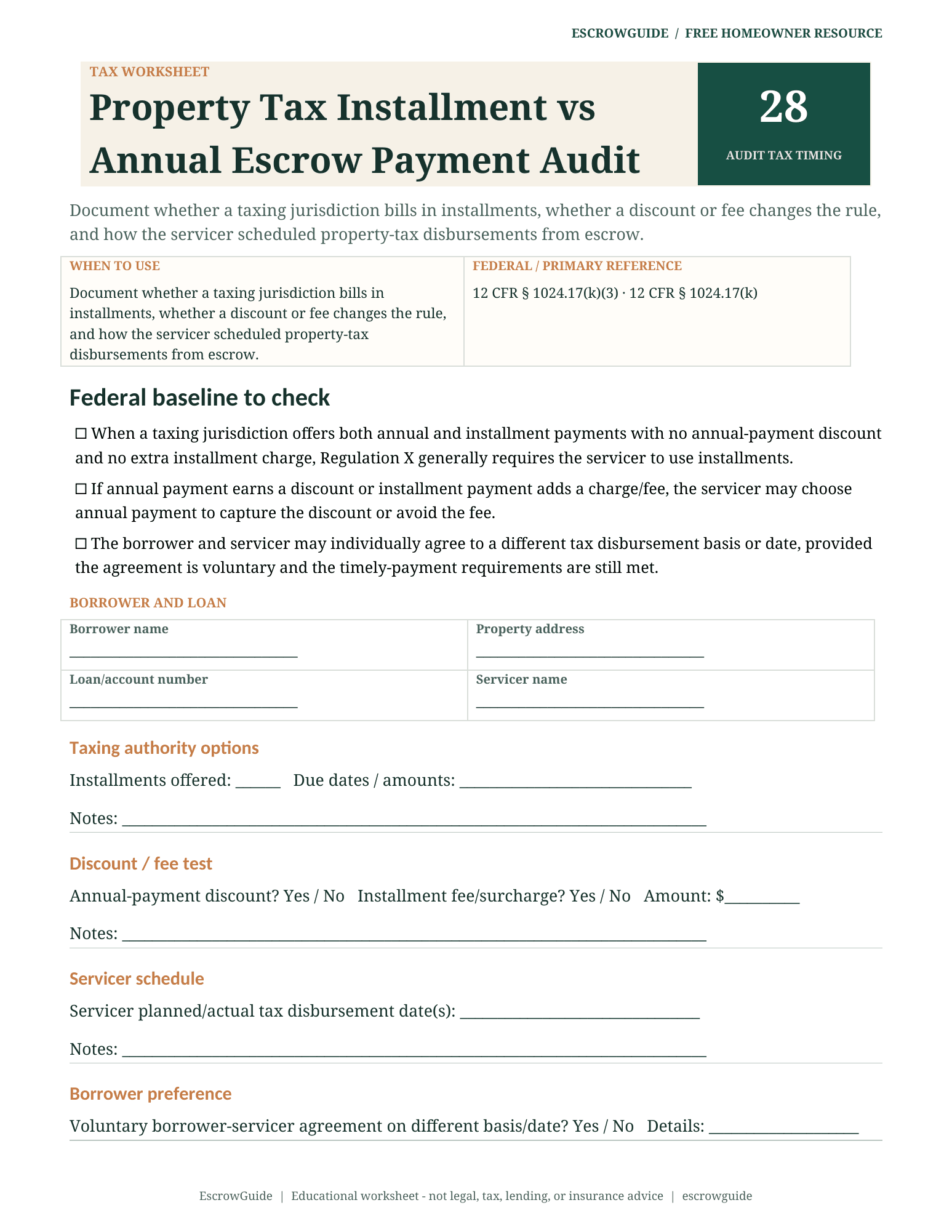
Multiple tax lines are not automatically duplicates. Regulation X says that when there are several taxing authorities, the initial escrow statement should identify each taxing body, and a payee receiving more than one payment should have each payment and disbursement date shown. The audit is to match every city, county, school or other tax line to a real bill, jurisdiction and due date.
Property-tax systems vary sharply by location. Some jurisdictions issue one consolidated bill; others have county, municipal, school, water or special-district obligations on different schedules. A national mortgage article cannot infer the correct set from the labels alone, so the local authority record is essential.
List every tax line exactly as shown on the escrow statement
The same taxing body can receive more than one installment during the escrow year. Multiple lines with the same authority are therefore not automatically duplicates either. Compare tax year, installment number, parcel, due date and amount.
Long-tail question: why escrow statement lists city school and county property taxes separately. Duplicate risk often appears when a bill structure changes. A county may begin collecting a levy that was previously billed separately, or a new servicer may import legacy tax lines during transfer. The current official bill should be mapped against every active escrow projection after such a change.
The rule that controls match each line to a taxing authority or consolidated bill
Section 1024.17(h)(3) allows generic descriptions when they sufficiently identify the use of funds, but it specifically says that several taxing authorities or insurers should each be identified, with examples such as City Taxes and School Taxes. The annual statement likewise reports amounts paid out for taxes, insurance and other charges as separately identified. The regulation does not decide which local taxing bodies lawfully assess a particular property; the local tax records do.
Timing matters to the trial balance. Three authorities with different due months can require a different monthly escrow deposit than one consolidated annual bill with the same total. The annual total alone does not reproduce the balance path.
Worked example: Verify parcel or property identifiers
A homeowner sees three projected lines: County Tax $4,200, City Tax $1,100 and School Tax $2,700. The combined $8,000 is not necessarily a duplicate annual tax. The borrower should obtain the three official bills or one consolidated tax record that breaks down the authorities, confirm parcel identifiers and due dates, then compare each projected disbursement. If the county bill already includes the school levy while the servicer also projects a separate school payment, that overlap becomes a specific reconciliation issue.
A supplemental assessment or special district charge can be a real additional obligation rather than part of the ordinary city/county/school tax. Give it its own row and source instead of forcing it into the regular-tax total.
Account audit from List every tax line exactly as shown on the escrow statement to Request source data for any unmatched projected tax line
List every tax line exactly as shown on the escrow statement
Property-tax systems vary sharply by location. Some jurisdictions issue one consolidated bill; others have county, municipal, school, water or special-district obligations on different schedules. A national mortgage article cannot infer the correct set from the labels alone, so the local authority record is essential. Evidence target: List every tax line exactly as shown on the escrow statement. Next comparison: Match each line to a taxing authority or consolidated bill. Error to avoid: adding city school and county lines without checking whether a bill is consolidated.
Match each line to a taxing authority or consolidated bill
The same taxing body can receive more than one installment during the escrow year. Multiple lines with the same authority are therefore not automatically duplicates either. Compare tax year, installment number, parcel, due date and amount. Evidence target: Match each line to a taxing authority or consolidated bill. Next comparison: Verify parcel or property identifiers. Error to avoid: calling repeated installments duplicate payments.
Verify parcel or property identifiers
Duplicate risk often appears when a bill structure changes. A county may begin collecting a levy that was previously billed separately, or a new servicer may import legacy tax lines during transfer. The current official bill should be mapped against every active escrow projection after such a change. Evidence target: Verify parcel or property identifiers. Next comparison: Record tax year and installment number for each payment. Error to avoid: matching only dollar amounts and not parcel or tax year.
Record tax year and installment number for each payment
Timing matters to the trial balance. Three authorities with different due months can require a different monthly escrow deposit than one consolidated annual bill with the same total. The annual total alone does not reproduce the balance path. Evidence target: Record tax year and installment number for each payment. Next comparison: Compare projected and actual disbursement dates. Error to avoid: ignoring a billing-system change after servicing transfer.
Compare projected and actual disbursement dates
A supplemental assessment or special district charge can be a real additional obligation rather than part of the ordinary city/county/school tax. Give it its own row and source instead of forcing it into the regular-tax total. Evidence target: Compare projected and actual disbursement dates. Next comparison: Check whether one authority now collects a formerly separate levy. Error to avoid: folding a special assessment into ordinary property tax without a source.
Check whether one authority now collects a formerly separate levy
When a line cannot be matched to any current taxing authority, request the servicer’s tax record or vendor data for that specific projected disbursement. A narrow request naming the line, amount and date is easier to investigate than a general complaint that “my taxes look duplicated.” Evidence target: Check whether one authority now collects a formerly separate levy. Next comparison: Separate supplemental or special assessments from regular tax. Error to avoid: adding city school and county lines without checking whether a bill is consolidated.
Separate supplemental or special assessments from regular tax
Property-tax systems vary sharply by location. Some jurisdictions issue one consolidated bill; others have county, municipal, school, water or special-district obligations on different schedules. A national mortgage article cannot infer the correct set from the labels alone, so the local authority record is essential. Evidence target: Separate supplemental or special assessments from regular tax. Next comparison: Request source data for any unmatched projected tax line. Error to avoid: calling repeated installments duplicate payments.
Request source data for any unmatched projected tax line
The same taxing body can receive more than one installment during the escrow year. Multiple lines with the same authority are therefore not automatically duplicates either. Compare tax year, installment number, parcel, due date and amount. Evidence target: Request source data for any unmatched projected tax line. Next comparison: List every tax line exactly as shown on the escrow statement. Error to avoid: matching only dollar amounts and not parcel or tax year.
Evidence table for “why escrow statement lists city school and county property taxes separately”
| Step | What to verify | Failure mode |
|---|---|---|
| 1 | List every tax line exactly as shown on the escrow statement | adding city school and county lines without checking whether a bill is consolidated |
| 2 | Match each line to a taxing authority or consolidated bill | calling repeated installments duplicate payments |
| 3 | Verify parcel or property identifiers | matching only dollar amounts and not parcel or tax year |
| 4 | Record tax year and installment number for each payment | ignoring a billing-system change after servicing transfer |
| 5 | Compare projected and actual disbursement dates | folding a special assessment into ordinary property tax without a source |
| 6 | Check whether one authority now collects a formerly separate levy | adding city school and county lines without checking whether a bill is consolidated |
| 7 | Separate supplemental or special assessments from regular tax | calling repeated installments duplicate payments |
| 8 | Request source data for any unmatched projected tax line | matching only dollar amounts and not parcel or tax year |
What can change the answer
When a line cannot be matched to any current taxing authority, request the servicer’s tax record or vendor data for that specific projected disbursement. A narrow request naming the line, amount and date is easier to investigate than a general complaint that “my taxes look duplicated.”
- adding city school and county lines without checking whether a bill is consolidated
- calling repeated installments duplicate payments
- matching only dollar amounts and not parcel or tax year
- ignoring a billing-system change after servicing transfer
- folding a special assessment into ordinary property tax without a source
Primary authority for this servicing question
- CFPB Regulation X — § 1024.17(h)(3), (i) ↗
why escrow statement lists city school and county property taxes separately — use CFPB Regulation X — § 1024.17(h)(3), (i) to verify the federal or investor rule described above; use the borrower’s own statements, bills and transaction history for loan-level facts.
- eCFR — 12 CFR § 1024.17(h)(3), (i) ↗
why escrow statement lists city school and county property taxes separately — use eCFR — 12 CFR § 1024.17(h)(3), (i) to verify the federal or investor rule described above; use the borrower’s own statements, bills and transaction history for loan-level facts.
Scope: this guide explains mortgage-servicing mechanics for why escrow statement lists city school and county property taxes separately. It does not provide personalized legal, tax, insurance-coverage or loan-choice advice. Where local law, mortgage documents or investor rules matter, verify those authorities separately.