A property-tax due-date change is a pure timing problem that can alter escrow shortage math without changing tax liability. Because aggregate escrow analysis is month-by-month, an earlier outflow can require more cash on hand sooner.
Confirm the jurisdiction actually changed the deadline. For property tax due date change escrow shortage, start with “Obtain official tax calendar..”
Obtain official tax calendar.: starting record
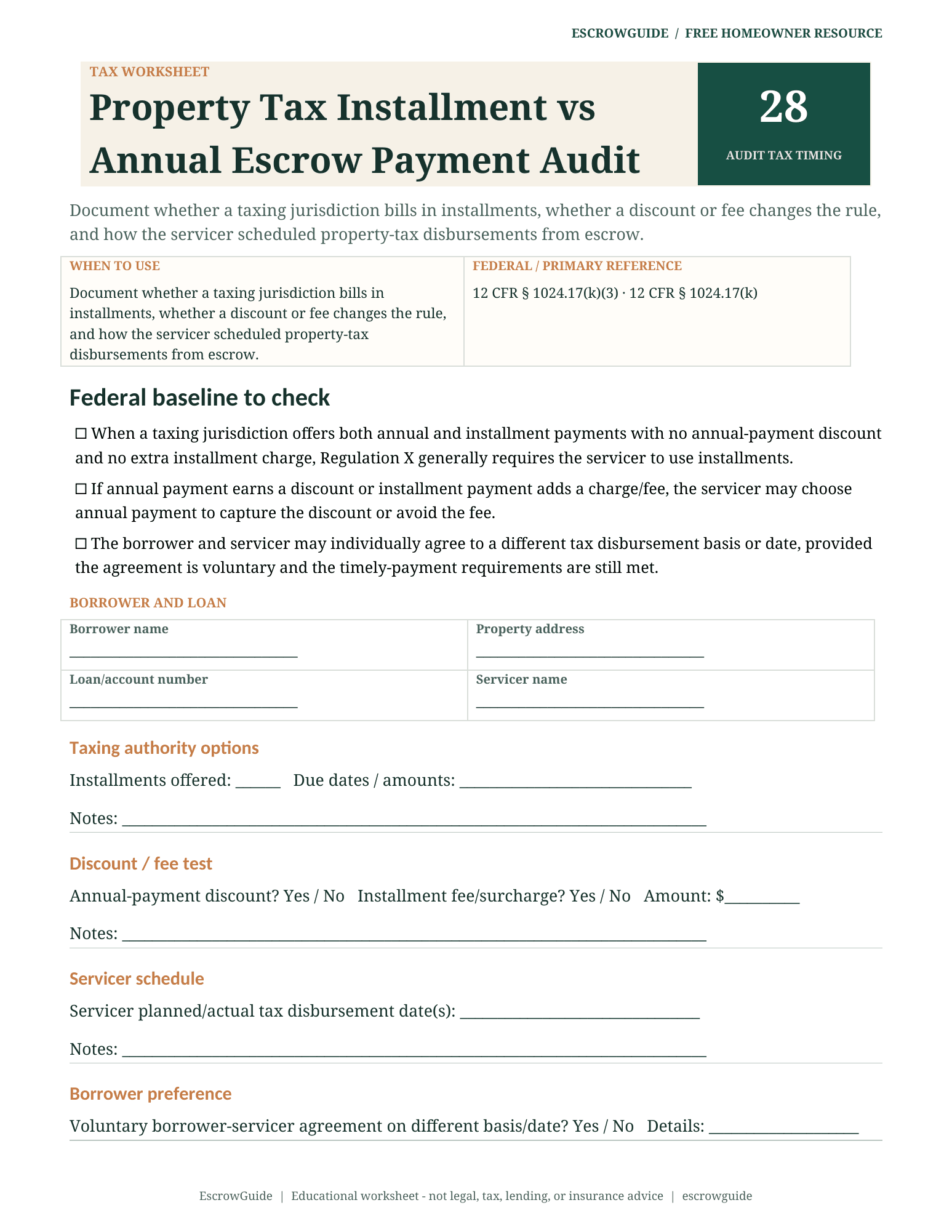
A servicer can also choose between annual and installment methods in limited circumstances described by the rule. Evidence anchor: Compare prior due dates.
The escrow forecast should use the correct penalty-avoidance date. Timing anchor: Map projected disbursement dates.
Rule boundary for property tax due date change escrow shortage
Regulation X requires servicers to project disbursements on or before the deadline to avoid a penalty and contains special rules for installment versus annual tax payments when the jurisdiction offers choices.
The annual statement may explain why the prior low balance was not reached. Account test: Obtain official tax calendar. Then: Compare prior due dates. The payment total alone cannot answer property tax due date change escrow shortage; those two records must agree first.
Worked account example: Map projected disbursement dates.
Example: two $3,000 installments were due June and December. The jurisdiction shifts the first installment to April. Annual tax remains $6,000, but two fewer months of $500 base tax escrow deposits are available before the first payment, lowering the forecast by roughly $1,000 at that point.
property tax due date change escrow shortage: substitute borrower-specific figures for “Obtain official tax calendar..” Next test “Map projected disbursement dates..” Finish at “Request correction if servicer date is wrong..” Same annual tax does not guarantee same monthly escrow when timing changes. The figures show sequence only; they are not a forecast.
Six evidence tests for property tax due date change escrow shortage
Obtain official tax calendar.
Evidence checkpoint: Obtain official tax calendar.. A servicer can also choose between annual and installment methods in limited circumstances described by the rule. For property tax due date change escrow shortage, capture this evidence: Obtain official tax calendar. Risk to flag: Focusing only on annual total. Next cross-check: Compare prior due dates.. The annual statement may explain why the prior low balance was not reached.
Compare prior due dates.
Account-history test: Compare prior due dates.. The escrow forecast should use the correct penalty-avoidance date. For property tax due date change escrow shortage, capture this evidence: Compare prior due dates. Risk to flag: Using last year’s due date. Next cross-check: Map projected disbursement dates.. Same annual tax does not guarantee same monthly escrow when timing changes.
Map projected disbursement dates.
Control record: Map projected disbursement dates.. The annual statement may explain why the prior low balance was not reached. For property tax due date change escrow shortage, capture this evidence: Map projected disbursement dates. Risk to flag: Ignoring installment rules. Next cross-check: Recompute low-balance month.. A wrong projected due date should be challenged with the tax authority schedule.
Recompute low-balance month.
Independent cross-check: Recompute low-balance month.. Same annual tax does not guarantee same monthly escrow when timing changes. For property tax due date change escrow shortage, capture this evidence: Recompute low-balance month. Risk to flag: Assuming timing-driven shortage is an extra fee. Next cross-check: Check installment rule if relevant.. Confirm the jurisdiction actually changed the deadline.
Check installment rule if relevant.
Evidence checkpoint: Check installment rule if relevant.. A wrong projected due date should be challenged with the tax authority schedule. For property tax due date change escrow shortage, capture this evidence: Check installment rule if relevant. Risk to flag: Focusing only on annual total. Next cross-check: Request correction if servicer date is wrong.. A servicer can also choose between annual and installment methods in limited circumstances described by the rule.
Request correction if servicer date is wrong.
Account-history test: Request correction if servicer date is wrong.. Confirm the jurisdiction actually changed the deadline. For property tax due date change escrow shortage, capture this evidence: Request correction if servicer date is wrong. Risk to flag: Using last year’s due date. Next cross-check: Obtain official tax calendar.. The escrow forecast should use the correct penalty-avoidance date.
| Step | property tax due date change escrow shortage evidence | Expected finding | Risk |
|---|---|---|---|
| 1 | Obtain official tax calendar. | Confirm the jurisdiction actually changed the deadline. | Focusing only on annual total |
| 2 | Compare prior due dates. | A servicer can also choose between annual and installment methods in limited circumstances described by the rule. | Using last year’s due date |
| 3 | Map projected disbursement dates. | The escrow forecast should use the correct penalty-avoidance date. | Ignoring installment rules |
| 4 | Recompute low-balance month. | The annual statement may explain why the prior low balance was not reached. | Assuming timing-driven shortage is an extra fee |
| 5 | Check installment rule if relevant. | Same annual tax does not guarantee same monthly escrow when timing changes. | Focusing only on annual total |
| 6 | Request correction if servicer date is wrong. | A wrong projected due date should be challenged with the tax authority schedule. | Using last year’s due date |
Check installment rule if relevant.: interpretation
Same annual tax does not guarantee same monthly escrow when timing changes. Match “Recompute low-balance month.” to the correct tax year, jurisdiction, installment, and property.
A wrong projected due date should be challenged with the tax authority schedule. For property tax due date change escrow shortage, a tax-authority correction matters only after “Request correction if servicer date is wrong.” is traced into the escrow ledger.
Obtain official tax calendar. → Request correction if servicer date is wrong.: reconstruction
Bridge 1: Obtain official tax calendar.
The escrow forecast should use the correct penalty-avoidance date. Start record: Obtain official tax calendar.. Next record: Compare prior due dates.. property tax due date change escrow shortage issue at this bridge: Using last year’s due date. Account implication: A wrong projected due date should be challenged with the tax authority schedule.
Bridge 2: Compare prior due dates.
The annual statement may explain why the prior low balance was not reached. Start record: Compare prior due dates.. Next record: Map projected disbursement dates.. property tax due date change escrow shortage issue at this bridge: Ignoring installment rules. Account implication: Confirm the jurisdiction actually changed the deadline.
Bridge 3: Map projected disbursement dates.
Same annual tax does not guarantee same monthly escrow when timing changes. Start record: Map projected disbursement dates.. Next record: Recompute low-balance month.. property tax due date change escrow shortage issue at this bridge: Assuming timing-driven shortage is an extra fee. Account implication: A servicer can also choose between annual and installment methods in limited circumstances described by the rule.
Bridge 4: Recompute low-balance month.
A wrong projected due date should be challenged with the tax authority schedule. Start record: Recompute low-balance month.. Next record: Check installment rule if relevant.. property tax due date change escrow shortage issue at this bridge: Focusing only on annual total. Account implication: The escrow forecast should use the correct penalty-avoidance date.
Bridge 5: Check installment rule if relevant.
Confirm the jurisdiction actually changed the deadline. Start record: Check installment rule if relevant.. Next record: Request correction if servicer date is wrong.. property tax due date change escrow shortage issue at this bridge: Using last year’s due date. Account implication: The annual statement may explain why the prior low balance was not reached.
Bridge 6: Request correction if servicer date is wrong.
A servicer can also choose between annual and installment methods in limited circumstances described by the rule. Start record: Request correction if servicer date is wrong.. Next record: Obtain official tax calendar.. property tax due date change escrow shortage issue at this bridge: Ignoring installment rules. Account implication: Same annual tax does not guarantee same monthly escrow when timing changes.
property tax due date change escrow shortage: final reconciliation checklist
- Obtain official tax calendar. — The escrow forecast should use the correct penalty-avoidance date.
- Compare prior due dates. — The annual statement may explain why the prior low balance was not reached.
- Map projected disbursement dates. — Same annual tax does not guarantee same monthly escrow when timing changes.
- Recompute low-balance month. — A wrong projected due date should be challenged with the tax authority schedule.
- Check installment rule if relevant. — Confirm the jurisdiction actually changed the deadline.
- Request correction if servicer date is wrong. — A servicer can also choose between annual and installment methods in limited circumstances described by the rule.
Primary sources for property tax due date change escrow shortage
- CFPB Regulation X — 12 CFR § 1024.17 (Escrow Accounts) ↗
property tax due date change escrow shortage — rule focus: escrow analysis, statements, cushion limits, shortage/surplus treatment, and disbursement mechanics. Borrower-file cross-check: Obtain official tax calendar..
- CFPB Regulation X — 12 CFR § 1024.34 (Timely Escrow Payments and Balances) ↗
property tax due date change escrow shortage — rule focus: timely escrow disbursements and payoff escrow balances. Borrower-file cross-check: Compare prior due dates..
- Chase — Escrow shortage & surplus FAQs ↗
property tax due date change escrow shortage — rule focus: a large-servicer example of shortage and surplus handling. Borrower-file cross-check: Map projected disbursement dates..
Scope for property tax due date change escrow shortage: mortgage-servicing mechanics. First verify “Obtain official tax calendar..” Last verify “Request correction if servicer date is wrong..” Example dollars are illustrative. Tax law, insurance coverage, bankruptcy, probate, and investor eligibility can require separate authority.