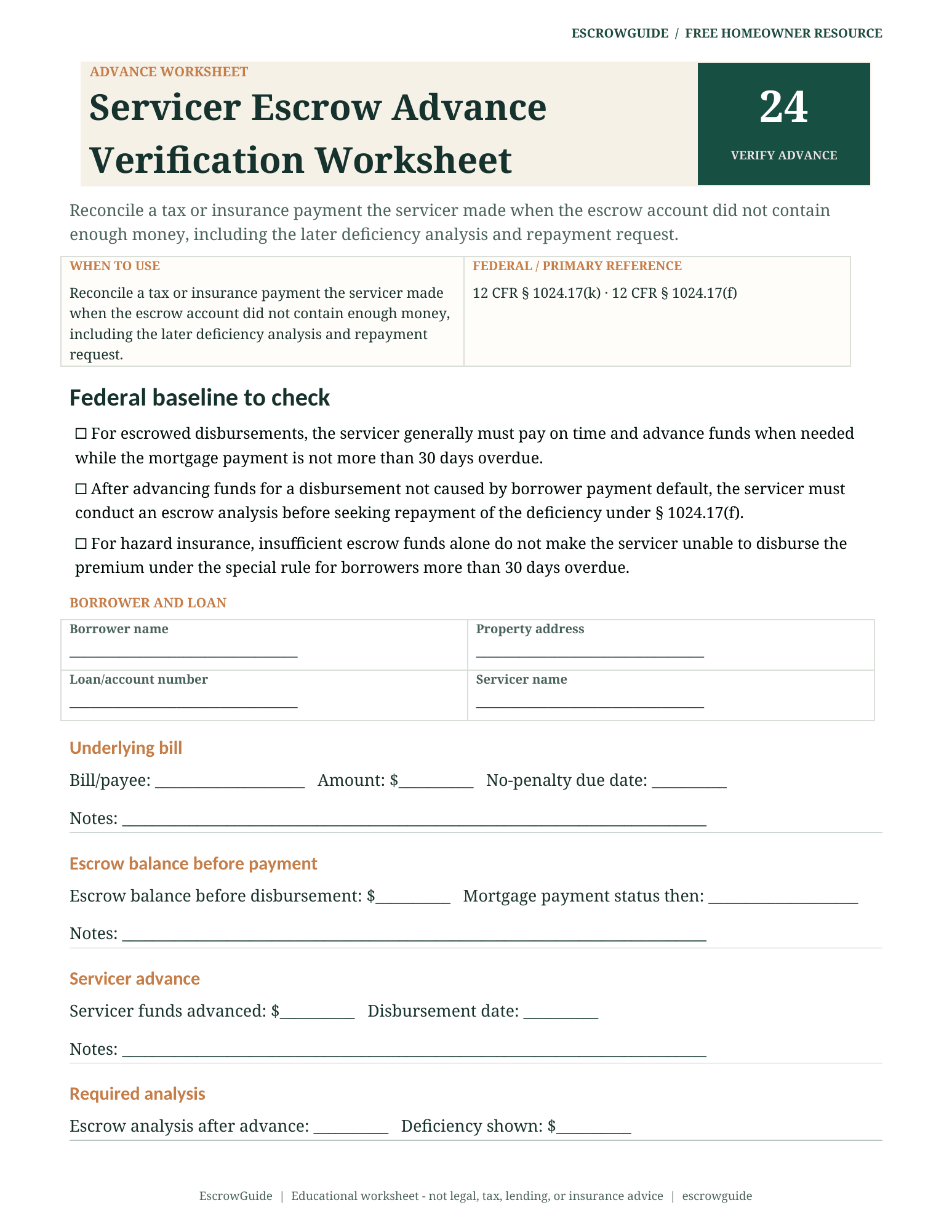
Fannie Mae’s Servicing Guide says that when the servicer waived escrow and the borrower fails to pay insurance premiums, taxes or other related charges, the servicer must advance the payment, including late penalties, revoke the escrow waiver and establish an escrow account to collect repayment of the advance and fund future bills. This is an investor-specific servicing rule, so first verify that Fannie Mae owns or securitizes the loan.
Investor verification comes first. A Fannie Mae servicing-guide rule should not be applied merely because a servicer also services Fannie loans. The borrower should use an ownership lookup or written servicing information to establish that the loan is actually subject to the Fannie rule.
Verify Fannie Mae ownership or securitization
The trigger is nonpayment of a charge that the borrower was responsible for after escrow was waived. A tax bill that the borrower paid on time but the servicer failed to recognize presents a different factual problem; proof of payment can change the entire analysis.
Long-tail question: Fannie Mae escrow waiver revoked after unpaid taxes or insurance. Fannie directs the servicer to advance the property charge, including late-payment penalties, from its own funds in the described situation. The advance should therefore be traceable to the tax or insurance record rather than appearing as an unexplained generic escrow balance.
The rule that controls locate the written escrow waiver
Fannie Mae Servicing Guide B-1-01 contains both escrow-waiver eligibility rules and the response to unpaid property charges on a waived account. The rule is not a general federal right or requirement for every mortgage. Regulation X still supplies the federal escrow-account limits once a covered escrow account is administered, while the Fannie guide supplies the investor servicing obligation for a Fannie loan.
Revoking the waiver and collecting future bills is different from collecting reimbursement for the historical advance. The new analysis should separate the recurring amount needed for future taxes and insurance from whatever repayment mechanism applies to the advance.
Worked example: Confirm the tax or insurance charge was actually unpaid
A borrower with a documented escrow waiver fails to pay a county tax installment. The servicer confirms the nonpayment, advances the tax and penalty to protect the lien, revokes the waiver and establishes escrow. The new monthly payment may now contain future tax collection plus repayment associated with the advance. The borrower should verify Fannie ownership, the original waiver, the tax-authority record, the servicer advance and the new escrow analysis rather than assuming the waiver can never be revoked.
Fannie also lists conditions under which a request to waive escrow should be denied, including recent delinquency and certain prior waiver failures. Those eligibility rules matter when a borrower later asks to remove the newly established escrow again.
Account audit from Verify Fannie Mae ownership or securitization to Save the applicable Fannie servicing-guide version
Verify Fannie Mae ownership or securitization
Investor verification comes first. A Fannie Mae servicing-guide rule should not be applied merely because a servicer also services Fannie loans. The borrower should use an ownership lookup or written servicing information to establish that the loan is actually subject to the Fannie rule. Evidence target: Verify Fannie Mae ownership or securitization. Next comparison: Locate the written escrow waiver. Error to avoid: applying Fannie rules to a loan without verifying the investor.
Locate the written escrow waiver
The trigger is nonpayment of a charge that the borrower was responsible for after escrow was waived. A tax bill that the borrower paid on time but the servicer failed to recognize presents a different factual problem; proof of payment can change the entire analysis. Evidence target: Locate the written escrow waiver. Next comparison: Confirm the tax or insurance charge was actually unpaid. Error to avoid: assuming an unpaid record is correct when the borrower has proof of payment.
Confirm the tax or insurance charge was actually unpaid
Fannie directs the servicer to advance the property charge, including late-payment penalties, from its own funds in the described situation. The advance should therefore be traceable to the tax or insurance record rather than appearing as an unexplained generic escrow balance. Evidence target: Confirm the tax or insurance charge was actually unpaid. Next comparison: Match any servicer advance to the outside bill and penalty. Error to avoid: mixing the historical advance with future recurring escrow.
Match any servicer advance to the outside bill and penalty
Revoking the waiver and collecting future bills is different from collecting reimbursement for the historical advance. The new analysis should separate the recurring amount needed for future taxes and insurance from whatever repayment mechanism applies to the advance. Evidence target: Match any servicer advance to the outside bill and penalty. Next comparison: Identify the written waiver-revocation notice. Error to avoid: treating the investor rule as a universal federal escrow rule.
Identify the written waiver-revocation notice
Fannie also lists conditions under which a request to waive escrow should be denied, including recent delinquency and certain prior waiver failures. Those eligibility rules matter when a borrower later asks to remove the newly established escrow again. Evidence target: Identify the written waiver-revocation notice. Next comparison: Separate repayment of the advance from future escrow deposits. Error to avoid: ignoring the effective version of the servicing guide.
Separate repayment of the advance from future escrow deposits
Because the guide can change, save the effective version relied on by the servicer. A page reviewed years later should not assume the 2026 rule text was identical at the time of the event. Evidence target: Separate repayment of the advance from future escrow deposits. Next comparison: Review the new escrow analysis under Regulation X limits. Error to avoid: applying Fannie rules to a loan without verifying the investor.
Review the new escrow analysis under Regulation X limits
Investor verification comes first. A Fannie Mae servicing-guide rule should not be applied merely because a servicer also services Fannie loans. The borrower should use an ownership lookup or written servicing information to establish that the loan is actually subject to the Fannie rule. Evidence target: Review the new escrow analysis under Regulation X limits. Next comparison: Save the applicable Fannie servicing-guide version. Error to avoid: assuming an unpaid record is correct when the borrower has proof of payment.
Save the applicable Fannie servicing-guide version
The trigger is nonpayment of a charge that the borrower was responsible for after escrow was waived. A tax bill that the borrower paid on time but the servicer failed to recognize presents a different factual problem; proof of payment can change the entire analysis. Evidence target: Save the applicable Fannie servicing-guide version. Next comparison: Verify Fannie Mae ownership or securitization. Error to avoid: mixing the historical advance with future recurring escrow.
Evidence table for “Fannie Mae escrow waiver revoked after unpaid taxes or insurance”
| Step | What to verify | Failure mode |
|---|---|---|
| 1 | Verify Fannie Mae ownership or securitization | applying Fannie rules to a loan without verifying the investor |
| 2 | Locate the written escrow waiver | assuming an unpaid record is correct when the borrower has proof of payment |
| 3 | Confirm the tax or insurance charge was actually unpaid | mixing the historical advance with future recurring escrow |
| 4 | Match any servicer advance to the outside bill and penalty | treating the investor rule as a universal federal escrow rule |
| 5 | Identify the written waiver-revocation notice | ignoring the effective version of the servicing guide |
| 6 | Separate repayment of the advance from future escrow deposits | applying Fannie rules to a loan without verifying the investor |
| 7 | Review the new escrow analysis under Regulation X limits | assuming an unpaid record is correct when the borrower has proof of payment |
| 8 | Save the applicable Fannie servicing-guide version | mixing the historical advance with future recurring escrow |
What can change the answer
Because the guide can change, save the effective version relied on by the servicer. A page reviewed years later should not assume the 2026 rule text was identical at the time of the event.
- applying Fannie rules to a loan without verifying the investor
- assuming an unpaid record is correct when the borrower has proof of payment
- mixing the historical advance with future recurring escrow
- treating the investor rule as a universal federal escrow rule
- ignoring the effective version of the servicing guide
Verify Fannie Mae ownership or securitization — reconciliation note Fannie directs the servicer to advance the property charge, including late-payment penalties, from its own funds in the described situation. The advance should therefore be traceable to the tax or insurance record rather than appearing as an unexplained generic escrow balance. For this account, pair “Verify Fannie Mae ownership or securitization” with “Match any servicer advance to the outside bill and penalty” before carrying a dollar figure forward. If the documents do not agree, preserve the variance rather than resolving it by mixing the historical advance with future recurring escrow.
Primary authority for this servicing question
- Fannie Mae Servicing Guide B-1-01 ↗
Fannie Mae escrow waiver revoked after unpaid taxes or insurance — use Fannie Mae Servicing Guide B-1-01 to verify the federal or investor rule described above; use the borrower’s own statements, bills and transaction history for loan-level facts.
- CFPB Regulation X — § 1024.17 ↗
Fannie Mae escrow waiver revoked after unpaid taxes or insurance — use CFPB Regulation X — § 1024.17 to verify the federal or investor rule described above; use the borrower’s own statements, bills and transaction history for loan-level facts.
Scope: this guide explains mortgage-servicing mechanics for Fannie Mae escrow waiver revoked after unpaid taxes or insurance. It does not provide personalized legal, tax, insurance-coverage or loan-choice advice. Where local law, mortgage documents or investor rules matter, verify those authorities separately.