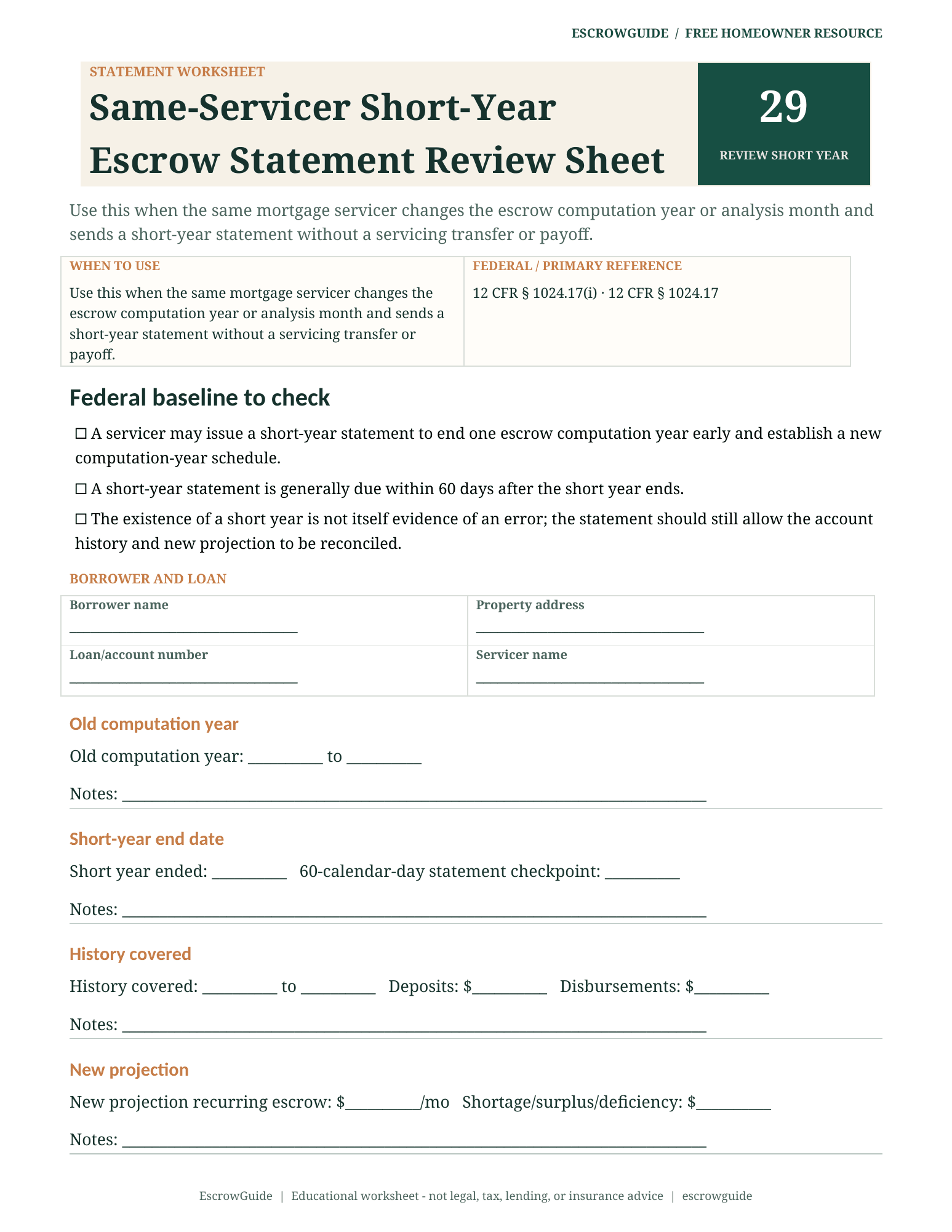
A changed annual-analysis month after servicing transfer is not automatically a servicing error. Regulation X gives the new servicer pathways to continue the old computation year or establish a different one, depending on what else changes.
The analysis month and the transfer effective date are separate dates. For new servicer changed escrow computation year, start with “Record old analysis month..”
Record old analysis month.: starting record
Changing the computation year should not make the escrow balance disappear. Evidence anchor: Record transfer date.
A short-year statement should close the old period. Timing anchor: Identify any short-year statement.
Rule boundary for new servicer changed escrow computation year
Under § 1024.17(e), if the new servicer retains the old monthly payment and accounting method, it may continue the existing escrow year or establish a different year using a short-year statement. If it changes the monthly payment or accounting method, an initial escrow statement is required within 60 days of transfer.
The new servicer must still treat transferred shortages/surpluses/deficiencies under the escrow rules. Account test: Record old analysis month. Then: Record transfer date. The payment total alone cannot answer new servicer changed escrow computation year; those two records must agree first.
Worked account example: Identify any short-year statement.
Example: old servicer analyzed every October, transfer effective May 1. New servicer keeps the same payment but issues a short-year statement ending August 31 and begins a September-to-August cycle. The changed month may be permissible if the required statements and analyses bridge the periods.
new servicer changed escrow computation year: substitute borrower-specific figures for “Record old analysis month..” Next test “Identify any short-year statement..” Finish at “Confirm no transaction gap or overlap..” A new analysis near the transfer date can look repetitive but may serve a different regulatory function. The figures show sequence only; they are not a forecast.
Six evidence tests for new servicer changed escrow computation year
Record old analysis month.
Evidence checkpoint: Record old analysis month.. Changing the computation year should not make the escrow balance disappear. For new servicer changed escrow computation year, capture this evidence: Record old analysis month. Risk to flag: Calling any changed analysis month an error. Next cross-check: Record transfer date.. The new servicer must still treat transferred shortages/surpluses/deficiencies under the escrow rules.
Record transfer date.
Account-history test: Record transfer date.. A short-year statement should close the old period. For new servicer changed escrow computation year, capture this evidence: Record transfer date. Risk to flag: Ignoring short-year statement. Next cross-check: Identify any short-year statement.. A new analysis near the transfer date can look repetitive but may serve a different regulatory function.
Identify any short-year statement.
Control record: Identify any short-year statement.. The new servicer must still treat transferred shortages/surpluses/deficiencies under the escrow rules. For new servicer changed escrow computation year, capture this evidence: Identify any short-year statement. Risk to flag: Comparing two statements that cover overlapping periods. Next cross-check: Check whether payment/accounting method changed.. The right audit asks whether every day and transaction belongs to exactly one accounting period.
Check whether payment/accounting method changed.
Independent cross-check: Check whether payment/accounting method changed.. A new analysis near the transfer date can look repetitive but may serve a different regulatory function. For new servicer changed escrow computation year, capture this evidence: Check whether payment/accounting method changed. Risk to flag: Assuming new cycle permits a new cushion beyond federal limits. Next cross-check: Map new computation-year start.. The analysis month and the transfer effective date are separate dates.
Map new computation-year start.
Evidence checkpoint: Map new computation-year start.. The right audit asks whether every day and transaction belongs to exactly one accounting period. For new servicer changed escrow computation year, capture this evidence: Map new computation-year start. Risk to flag: Calling any changed analysis month an error. Next cross-check: Confirm no transaction gap or overlap.. Changing the computation year should not make the escrow balance disappear.
Confirm no transaction gap or overlap.
Account-history test: Confirm no transaction gap or overlap.. The analysis month and the transfer effective date are separate dates. For new servicer changed escrow computation year, capture this evidence: Confirm no transaction gap or overlap. Risk to flag: Ignoring short-year statement. Next cross-check: Record old analysis month.. A short-year statement should close the old period.
| Step | new servicer changed escrow computation year evidence | Expected finding | Risk |
|---|---|---|---|
| 1 | Record old analysis month. | The analysis month and the transfer effective date are separate dates. | Calling any changed analysis month an error |
| 2 | Record transfer date. | Changing the computation year should not make the escrow balance disappear. | Ignoring short-year statement |
| 3 | Identify any short-year statement. | A short-year statement should close the old period. | Comparing two statements that cover overlapping periods |
| 4 | Check whether payment/accounting method changed. | The new servicer must still treat transferred shortages/surpluses/deficiencies under the escrow rules. | Assuming new cycle permits a new cushion beyond federal limits |
| 5 | Map new computation-year start. | A new analysis near the transfer date can look repetitive but may serve a different regulatory function. | Calling any changed analysis month an error |
| 6 | Confirm no transaction gap or overlap. | The right audit asks whether every day and transaction belongs to exactly one accounting period. | Ignoring short-year statement |
Map new computation-year start.: interpretation
A new analysis near the transfer date can look repetitive but may serve a different regulatory function. Compare “Check whether payment/accounting method changed.” with “Map new computation-year start..” A handoff difference is unresolved until those entries share one cutoff date.
The right audit asks whether every day and transaction belongs to exactly one accounting period. For new servicer changed escrow computation year, preserve both servicer histories whenever “Confirm no transaction gap or overlap.” cannot be reproduced from the handoff documents.
Record old analysis month. → Confirm no transaction gap or overlap.: reconstruction
Bridge 1: Record old analysis month.
A short-year statement should close the old period. Start record: Record old analysis month.. Next record: Record transfer date.. new servicer changed escrow computation year issue at this bridge: Ignoring short-year statement. Account implication: The right audit asks whether every day and transaction belongs to exactly one accounting period.
Bridge 2: Record transfer date.
The new servicer must still treat transferred shortages/surpluses/deficiencies under the escrow rules. Start record: Record transfer date.. Next record: Identify any short-year statement.. new servicer changed escrow computation year issue at this bridge: Comparing two statements that cover overlapping periods. Account implication: The analysis month and the transfer effective date are separate dates.
Bridge 3: Identify any short-year statement.
A new analysis near the transfer date can look repetitive but may serve a different regulatory function. Start record: Identify any short-year statement.. Next record: Check whether payment/accounting method changed.. new servicer changed escrow computation year issue at this bridge: Assuming new cycle permits a new cushion beyond federal limits. Account implication: Changing the computation year should not make the escrow balance disappear.
Bridge 4: Check whether payment/accounting method changed.
The right audit asks whether every day and transaction belongs to exactly one accounting period. Start record: Check whether payment/accounting method changed.. Next record: Map new computation-year start.. new servicer changed escrow computation year issue at this bridge: Calling any changed analysis month an error. Account implication: A short-year statement should close the old period.
Bridge 5: Map new computation-year start.
The analysis month and the transfer effective date are separate dates. Start record: Map new computation-year start.. Next record: Confirm no transaction gap or overlap.. new servicer changed escrow computation year issue at this bridge: Ignoring short-year statement. Account implication: The new servicer must still treat transferred shortages/surpluses/deficiencies under the escrow rules.
Bridge 6: Confirm no transaction gap or overlap.
Changing the computation year should not make the escrow balance disappear. Start record: Confirm no transaction gap or overlap.. Next record: Record old analysis month.. new servicer changed escrow computation year issue at this bridge: Comparing two statements that cover overlapping periods. Account implication: A new analysis near the transfer date can look repetitive but may serve a different regulatory function.
new servicer changed escrow computation year: final reconciliation checklist
- Record old analysis month. — A short-year statement should close the old period.
- Record transfer date. — The new servicer must still treat transferred shortages/surpluses/deficiencies under the escrow rules.
- Identify any short-year statement. — A new analysis near the transfer date can look repetitive but may serve a different regulatory function.
- Check whether payment/accounting method changed. — The right audit asks whether every day and transaction belongs to exactly one accounting period.
- Map new computation-year start. — The analysis month and the transfer effective date are separate dates.
- Confirm no transaction gap or overlap. — Changing the computation year should not make the escrow balance disappear.
Primary sources for new servicer changed escrow computation year
- CFPB Regulation X — 12 CFR § 1024.17 (Escrow Accounts) ↗
new servicer changed escrow computation year — rule focus: escrow analysis, statements, cushion limits, shortage/surplus treatment, and disbursement mechanics. Borrower-file cross-check: Record old analysis month..
- CFPB Regulation X — 12 CFR § 1024.33 (Mortgage Servicing Transfers) ↗
new servicer changed escrow computation year — rule focus: servicing-transfer notices and the transfer boundary. Borrower-file cross-check: Record transfer date..
- CFPB Mortgage Servicing FAQs ↗
new servicer changed escrow computation year — rule focus: CFPB escrow and mortgage-servicing explanations. Borrower-file cross-check: Identify any short-year statement..
Scope for new servicer changed escrow computation year: mortgage-servicing mechanics. First verify “Record old analysis month..” Last verify “Confirm no transaction gap or overlap..” Example dollars are illustrative. Tax law, insurance coverage, bankruptcy, probate, and investor eligibility can require separate authority.