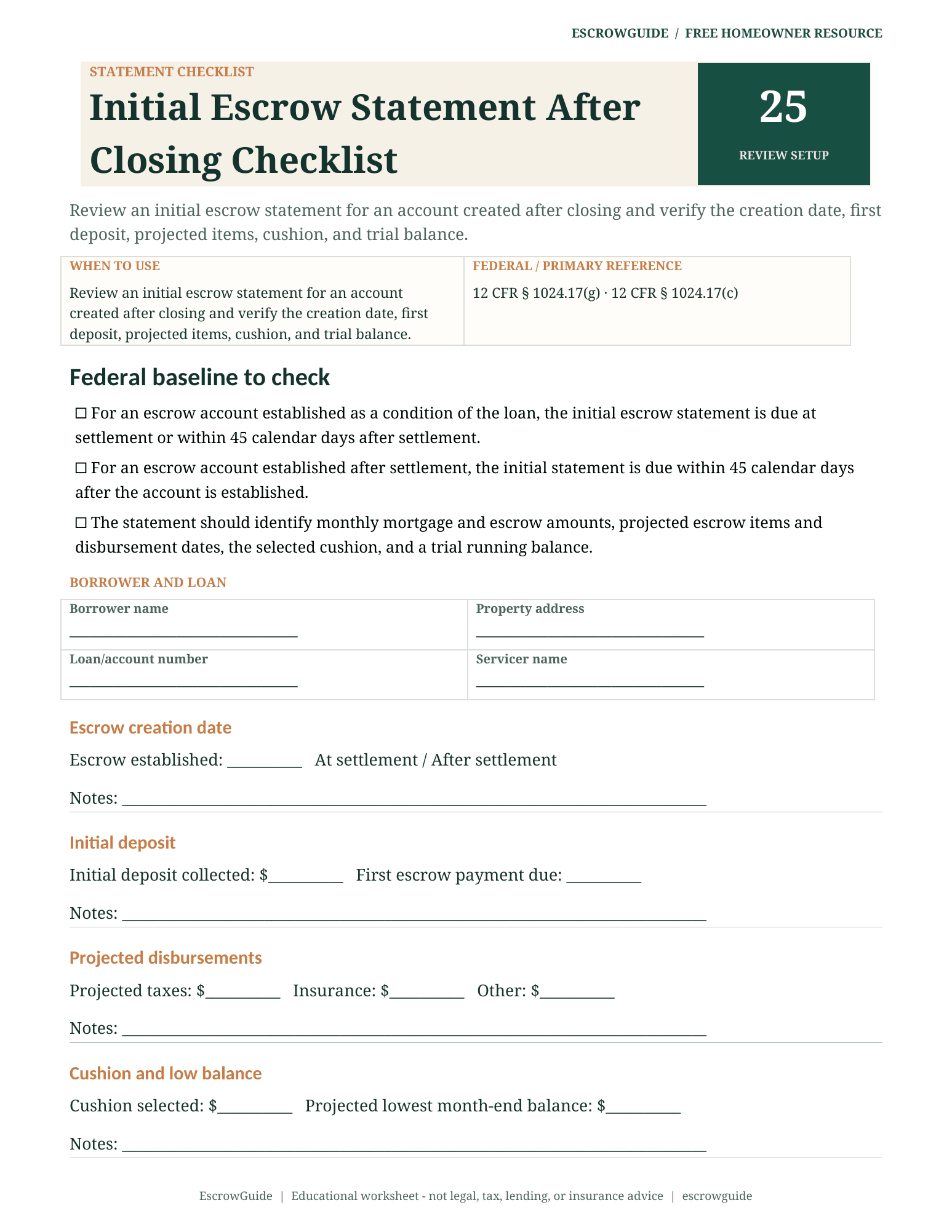
The key trigger is whether the new servicer changes either the monthly payment amount or the accounting method used by the old servicer. If it does, Regulation X requires an initial escrow statement within 60 days of the servicing transfer.
A transfer notice is not the same document as an initial escrow statement. For initial escrow statement after servicing transfer, start with “Confirm whether payment changed..”
Confirm whether payment changed.: starting record
A new servicer that keeps payment and method can follow a different statement path. Evidence anchor: Confirm whether accounting method changed.
The initial statement should itemize estimated escrow charges and disbursement dates. Timing anchor: Record transfer date.
Rule boundary for initial escrow statement after servicing transfer
12 CFR § 1024.17(e)(1) states that when the new servicer changes the monthly payment amount or accounting method, it must provide an initial escrow account statement within 60 days and use the transfer effective date to establish the new computation year.
The opening balance should still tie to the transferred account history. Account test: Confirm whether payment changed. Then: Confirm whether accounting method changed. The payment total alone cannot answer initial escrow statement after servicing transfer; those two records must agree first.
Worked account example: Record transfer date.
Example: transfer effective March 10. New servicer raises monthly escrow from $610 to $655 based on a new analysis. An initial escrow statement due within the transfer rule’s 60-day window should explain the new computation-year projections and trial balance, separate from the transfer notice itself.
initial escrow statement after servicing transfer: substitute borrower-specific figures for “Confirm whether payment changed..” Next test “Record transfer date..” Finish at “Request statement/history if missing..” If the servicer changes the payment but no statement explains the change, request the escrow analysis rather than relying on a phone estimate. The figures show sequence only; they are not a forecast.
Six evidence tests for initial escrow statement after servicing transfer
Confirm whether payment changed.
Final bridge: Confirm whether payment changed.. A new servicer that keeps payment and method can follow a different statement path. For initial escrow statement after servicing transfer, capture this evidence: Confirm whether payment changed. Risk to flag: Confusing transfer notice with escrow statement. Next cross-check: Confirm whether accounting method changed.. The opening balance should still tie to the transferred account history.
Confirm whether accounting method changed.
Date-and-amount test: Confirm whether accounting method changed.. The initial statement should itemize estimated escrow charges and disbursement dates. For initial escrow statement after servicing transfer, capture this evidence: Confirm whether accounting method changed. Risk to flag: Assuming every transfer requires initial statement. Next cross-check: Record transfer date.. If the servicer changes the payment but no statement explains the change, request the escrow analysis rather than relying on a phone estimate.
Record transfer date.
Reconciliation item: Record transfer date.. The opening balance should still tie to the transferred account history. For initial escrow statement after servicing transfer, capture this evidence: Record transfer date. Risk to flag: Ignoring a payment change. Next cross-check: Look for initial escrow statement within 60 days.. The 60-day transfer rule is a specific timing checkpoint.
Look for initial escrow statement within 60 days.
Source comparison: Look for initial escrow statement within 60 days.. If the servicer changes the payment but no statement explains the change, request the escrow analysis rather than relying on a phone estimate. For initial escrow statement after servicing transfer, capture this evidence: Look for initial escrow statement within 60 days. Risk to flag: Missing the transfer effective date when counting timeline. Next cross-check: Check opening trial balance and disbursements.. A transfer notice is not the same document as an initial escrow statement.
Check opening trial balance and disbursements.
Final bridge: Check opening trial balance and disbursements.. The 60-day transfer rule is a specific timing checkpoint. For initial escrow statement after servicing transfer, capture this evidence: Check opening trial balance and disbursements. Risk to flag: Confusing transfer notice with escrow statement. Next cross-check: Request statement/history if missing.. A new servicer that keeps payment and method can follow a different statement path.
Request statement/history if missing.
Date-and-amount test: Request statement/history if missing.. A transfer notice is not the same document as an initial escrow statement. For initial escrow statement after servicing transfer, capture this evidence: Request statement/history if missing. Risk to flag: Assuming every transfer requires initial statement. Next cross-check: Confirm whether payment changed.. The initial statement should itemize estimated escrow charges and disbursement dates.
| Step | initial escrow statement after servicing transfer evidence | Expected finding | Risk |
|---|---|---|---|
| 1 | Confirm whether payment changed. | A transfer notice is not the same document as an initial escrow statement. | Confusing transfer notice with escrow statement |
| 2 | Confirm whether accounting method changed. | A new servicer that keeps payment and method can follow a different statement path. | Assuming every transfer requires initial statement |
| 3 | Record transfer date. | The initial statement should itemize estimated escrow charges and disbursement dates. | Ignoring a payment change |
| 4 | Look for initial escrow statement within 60 days. | The opening balance should still tie to the transferred account history. | Missing the transfer effective date when counting timeline |
| 5 | Check opening trial balance and disbursements. | If the servicer changes the payment but no statement explains the change, request the escrow analysis rather than relying on a phone estimate. | Confusing transfer notice with escrow statement |
| 6 | Request statement/history if missing. | The 60-day transfer rule is a specific timing checkpoint. | Assuming every transfer requires initial statement |
Check opening trial balance and disbursements.: interpretation
If the servicer changes the payment but no statement explains the change, request the escrow analysis rather than relying on a phone estimate. Compare “Look for initial escrow statement within 60 days.” with “Check opening trial balance and disbursements..” A handoff difference is unresolved until those entries share one cutoff date.
The 60-day transfer rule is a specific timing checkpoint. For initial escrow statement after servicing transfer, preserve both servicer histories whenever “Request statement/history if missing.” cannot be reproduced from the handoff documents.
Confirm whether payment changed. → Request statement/history if missing.: reconstruction
Bridge 1: Confirm whether payment changed.
The initial statement should itemize estimated escrow charges and disbursement dates. Start record: Confirm whether payment changed.. Next record: Confirm whether accounting method changed.. initial escrow statement after servicing transfer issue at this bridge: Assuming every transfer requires initial statement. Account implication: The 60-day transfer rule is a specific timing checkpoint.
Bridge 2: Confirm whether accounting method changed.
The opening balance should still tie to the transferred account history. Start record: Confirm whether accounting method changed.. Next record: Record transfer date.. initial escrow statement after servicing transfer issue at this bridge: Ignoring a payment change. Account implication: A transfer notice is not the same document as an initial escrow statement.
Bridge 3: Record transfer date.
If the servicer changes the payment but no statement explains the change, request the escrow analysis rather than relying on a phone estimate. Start record: Record transfer date.. Next record: Look for initial escrow statement within 60 days.. initial escrow statement after servicing transfer issue at this bridge: Missing the transfer effective date when counting timeline. Account implication: A new servicer that keeps payment and method can follow a different statement path.
Bridge 4: Look for initial escrow statement within 60 days.
The 60-day transfer rule is a specific timing checkpoint. Start record: Look for initial escrow statement within 60 days.. Next record: Check opening trial balance and disbursements.. initial escrow statement after servicing transfer issue at this bridge: Confusing transfer notice with escrow statement. Account implication: The initial statement should itemize estimated escrow charges and disbursement dates.
Bridge 5: Check opening trial balance and disbursements.
A transfer notice is not the same document as an initial escrow statement. Start record: Check opening trial balance and disbursements.. Next record: Request statement/history if missing.. initial escrow statement after servicing transfer issue at this bridge: Assuming every transfer requires initial statement. Account implication: The opening balance should still tie to the transferred account history.
Bridge 6: Request statement/history if missing.
A new servicer that keeps payment and method can follow a different statement path. Start record: Request statement/history if missing.. Next record: Confirm whether payment changed.. initial escrow statement after servicing transfer issue at this bridge: Ignoring a payment change. Account implication: If the servicer changes the payment but no statement explains the change, request the escrow analysis rather than relying on a phone estimate.
initial escrow statement after servicing transfer: final reconciliation checklist
- Confirm whether payment changed. — The initial statement should itemize estimated escrow charges and disbursement dates.
- Confirm whether accounting method changed. — The opening balance should still tie to the transferred account history.
- Record transfer date. — If the servicer changes the payment but no statement explains the change, request the escrow analysis rather than relying on a phone estimate.
- Look for initial escrow statement within 60 days. — The 60-day transfer rule is a specific timing checkpoint.
- Check opening trial balance and disbursements. — A transfer notice is not the same document as an initial escrow statement.
- Request statement/history if missing. — A new servicer that keeps payment and method can follow a different statement path.
Primary sources for initial escrow statement after servicing transfer
- CFPB Regulation X — 12 CFR § 1024.17 (Escrow Accounts) ↗
initial escrow statement after servicing transfer — rule focus: escrow analysis, statements, cushion limits, shortage/surplus treatment, and disbursement mechanics. Borrower-file cross-check: Confirm whether payment changed..
- CFPB Regulation X — 12 CFR § 1024.33 (Mortgage Servicing Transfers) ↗
initial escrow statement after servicing transfer — rule focus: servicing-transfer notices and the transfer boundary. Borrower-file cross-check: Confirm whether accounting method changed..
- CFPB Mortgage Servicing FAQs ↗
initial escrow statement after servicing transfer — rule focus: CFPB escrow and mortgage-servicing explanations. Borrower-file cross-check: Record transfer date..
Scope for initial escrow statement after servicing transfer: mortgage-servicing mechanics. First verify “Confirm whether payment changed..” Last verify “Request statement/history if missing..” Example dollars are illustrative. Tax law, insurance coverage, bankruptcy, probate, and investor eligibility can require separate authority.