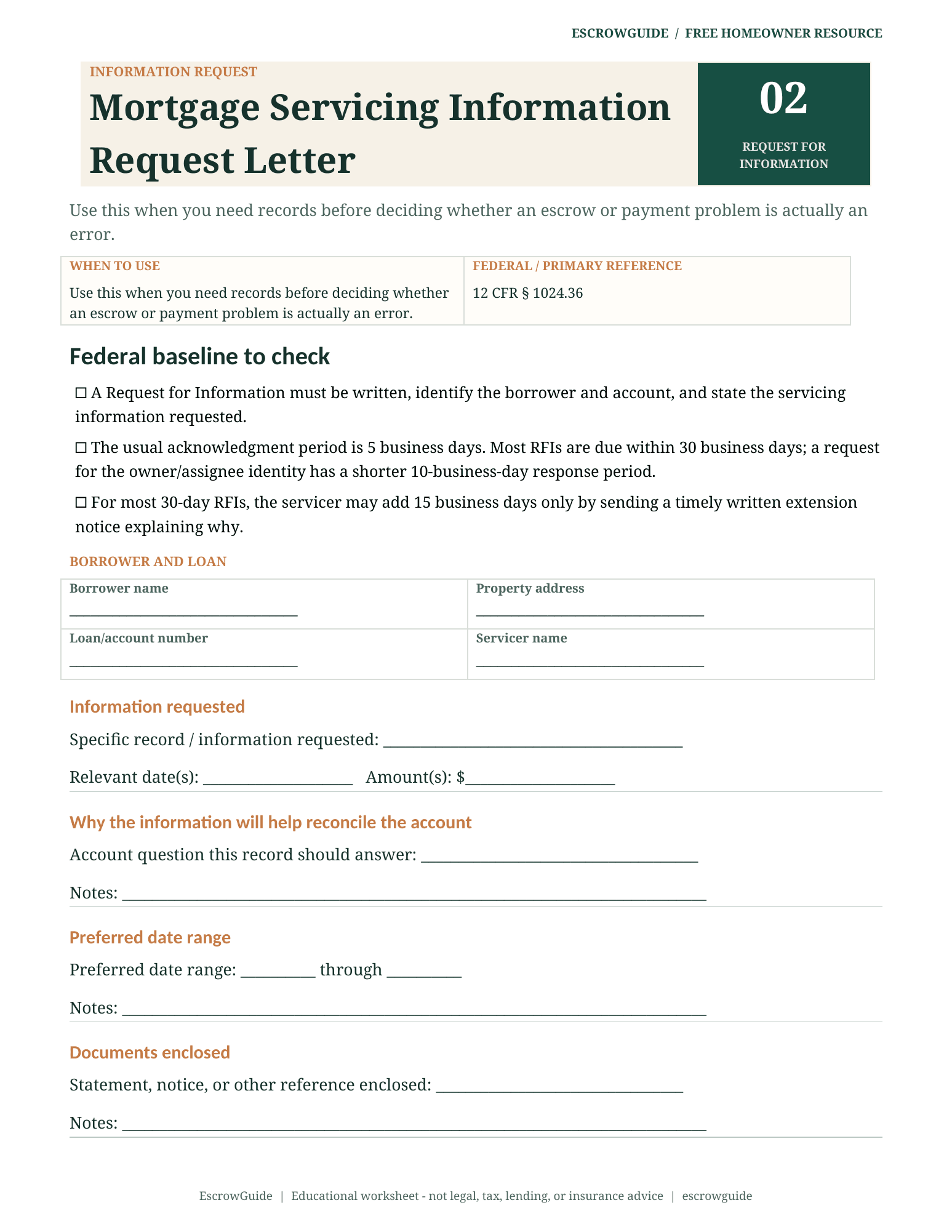
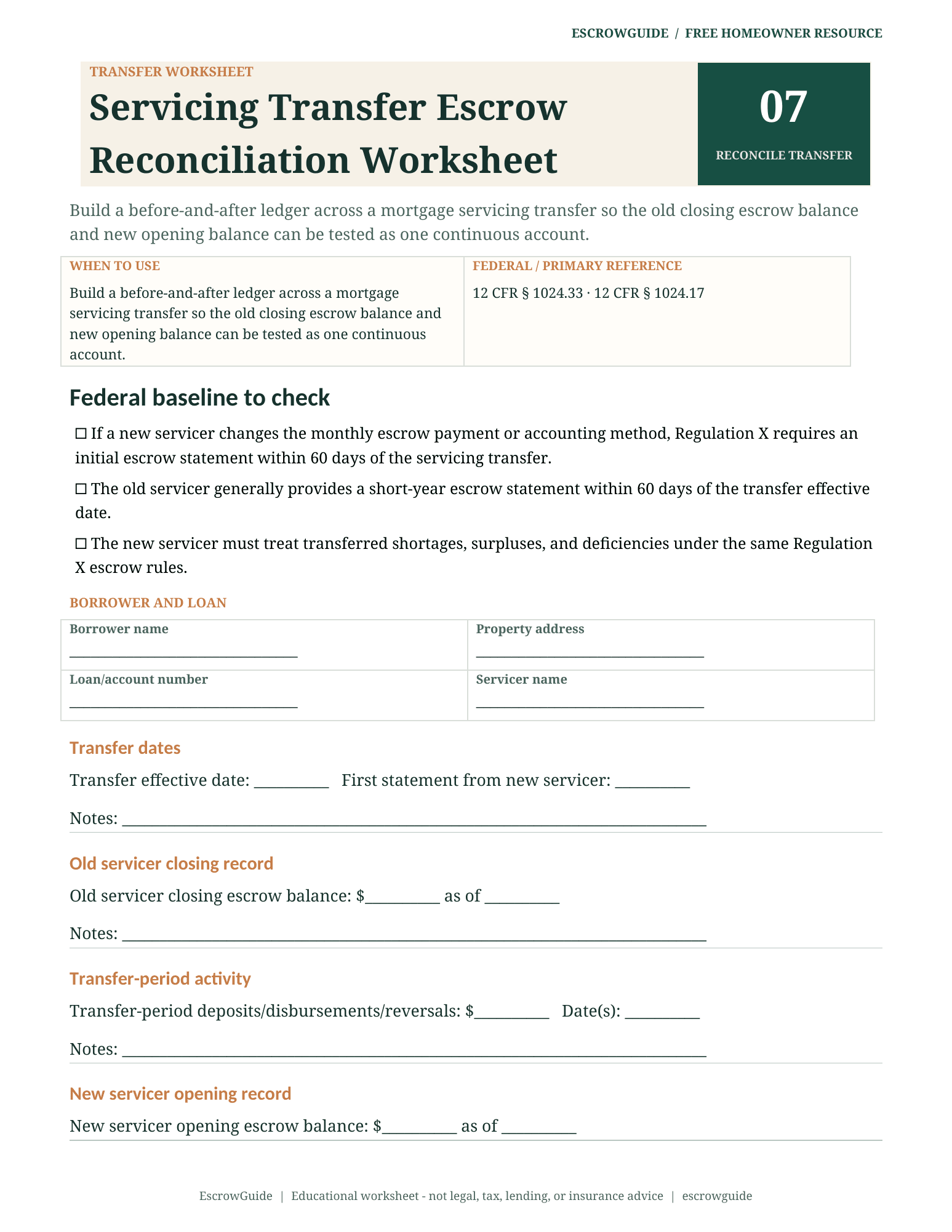
A servicing transfer should not make the escrow ledger disappear. If the new servicer's opening balance looks wrong, reconcile the old servicer's closing balance, every transaction around the transfer date, and the new servicer's opening history. Regulation X contains specific transfer rules for escrow accounting, and federal servicing rules also protect certain timely payments sent to the old servicer during the 60-day transfer window.
A servicing handoff is best audited like a reconciliation: the old closing ledger, transfer-period transactions and new opening ledger should form one continuous account history. This turns a surprising payment into a set of smaller questions that can each be verified.
Break the all-in payment into parts
Think of the transfer as a bank reconciliation, not a brand change. A correct transfer can still make the visible balance jump because bills post near the cutoff. Conversely, a polished welcome statement can still contain bad transferred data. Dates, amounts and third-party payment records resolve the difference.
Scope the rule carefully
Section 1024.17 addresses transferred escrow accounts, including how a new servicer handles the computation year and shortages, surpluses or deficiencies. Section 1024.33 governs mortgage servicing transfers. CFPB consumer guidance explains the transfer notices and the 60-day period during which a payment sent on time to the old servicer generally may not be treated as late for charging a late fee or reporting delinquency solely because it went to the old servicer.
A regulation and a mortgage statement answer different questions. The rule defines servicing duties; the statement shows what the servicer actually posted or projected. The tax authority, insurer or investor record may still control the underlying input. If the servicer uses a designated address for written notices, ordinary customer-service chat may not substitute for that process. A page-specific cross-check is to save the old servicer's last full transaction history and the new servicer's first full history.
Numerical walk-through
The old servicer's final statement shows $3,240 in escrow on June 30. On July 2 it posts a $2,100 tax disbursement that belonged to the property, leaving $1,140. The new servicer opens its visible history at $1,140 on July 8. A borrower comparing only $3,240 with $1,140 could think $2,100 vanished; a transfer-date ledger shows it was paid to the tax authority. If no matching disbursement exists, the same reconciliation identifies a concrete $2,100 gap to investigate.
Replace the example numbers with the amounts on the actual loan documents. If the rebuilt total matches, test whether the inputs were correct; if it does not, the remaining difference points to an omitted component, posting or arithmetic issue. A page-specific cross-check is to pick a transfer cutoff date and list every escrow credit and debit for at least one statement cycle on either side.
Evidence checklist
Gather records by function rather than by volume. One document should establish what the servicer used, another what the outside charge actually was, and a third should show how money moved through the account when timing is disputed. A page-specific cross-check is to match tax and insurance disbursements to third-party records so a legitimate payment is not mistaken for missing cash.
- Save the old servicer's last full transaction history and the new servicer's first full history.
- Pick a transfer cutoff date and list every escrow credit and debit for at least one statement cycle on either side.
- Match tax and insurance disbursements to third-party records so a legitimate payment is not mistaken for missing cash.
- Compare the new servicer's opening balance with the old servicer's closing balance after all transfer-period transactions.
- If an entry is absent or duplicated, send a written request or notice identifying the exact date and amount.
The checklist is complete only when every major changed amount has a source. Anything left as 'unknown' should be requested specifically rather than filled in with an assumption. For this issue, also rule out comparing two statement balances without accounting for a bill paid between them.
A second-pass test for the account
When the issue spans several statements, make one row per month rather than one large annual summary. A monthly sequence shows when a shortage repayment starts, when a credit lands, or when a transferred balance changes. That granularity can expose a single bad posting hidden inside an otherwise plausible annual total. A page-specific cross-check is to compare the new servicer's opening balance with the old servicer's closing balance after all transfer-period transactions.
The analysis is complete when another reader can reproduce it without relying on a phone conversation. Written statements, transaction histories and official bills should carry the argument. Notes from calls can add context, but the core explanation should survive even if those notes are removed. For this issue, also rule out assuming the transfer date printed on a welcome letter is the posting date of every transferred transaction.
For a rule-based claim, preserve the exact official page or section used in the analysis. That makes future review easier if agency guidance, investor instructions or servicing procedures change and prevents a later summary from being mistaken for the authority that applied at the time. A page-specific cross-check is to if an entry is absent or duplicated, send a written request or notice identifying the exact date and amount.
Normal change or servicing problem?
- Comparing two statement balances without accounting for a bill paid between them.
- Assuming the transfer date printed on a welcome letter is the posting date of every transferred transaction.
- Discarding the old servicer's statements after the first payment to the new company.
- Reporting a missing balance without first checking whether a tax or insurance payment posted during the handoff.
Do not merge cause and remedy. First establish what changed and whether it is correct; only then evaluate how a shortage, deficiency, refund or other servicing treatment should be handled. A page-specific cross-check is to save the old servicer's last full transaction history and the new servicer's first full history.
Document the remaining gap
If a concrete difference survives ordinary customer service, state the dates and amounts in writing. Ask what record supports the servicer's figure and, for covered servicing issues, consider the Regulation X error-resolution or information-request process using the servicer's designated instructions. A page-specific cross-check is to pick a transfer cutoff date and list every escrow credit and debit for at least one statement cycle on either side.
A written inquiry creates a record; it does not automatically freeze the loan. Borrowers with consequences beyond account reconciliation may need loan-specific guidance from the appropriate professional or agency. For this issue, also rule out discarding the old servicer's statements after the first payment to the new company.
Confirm the result instead of assuming it posted
For a payment change with both temporary and recurring layers, calendar when the temporary layer is expected to end. The payment after that date should still reflect whatever ongoing escrow, insurance or other recurring amounts remain. This makes the later statement a useful confirmation of the original analysis. A page-specific cross-check is to match tax and insurance disbursements to third-party records so a legitimate payment is not mistaken for missing cash.
For tax and insurance disputes, distinguish the billing address from the property and policy identifiers. A payment sent to the correct company can still be misapplied, so matching parcel number, policy number and covered period can matter as much as matching the dollar amount. For this issue, also rule out reporting a missing balance without first checking whether a tax or insurance payment posted during the handoff.