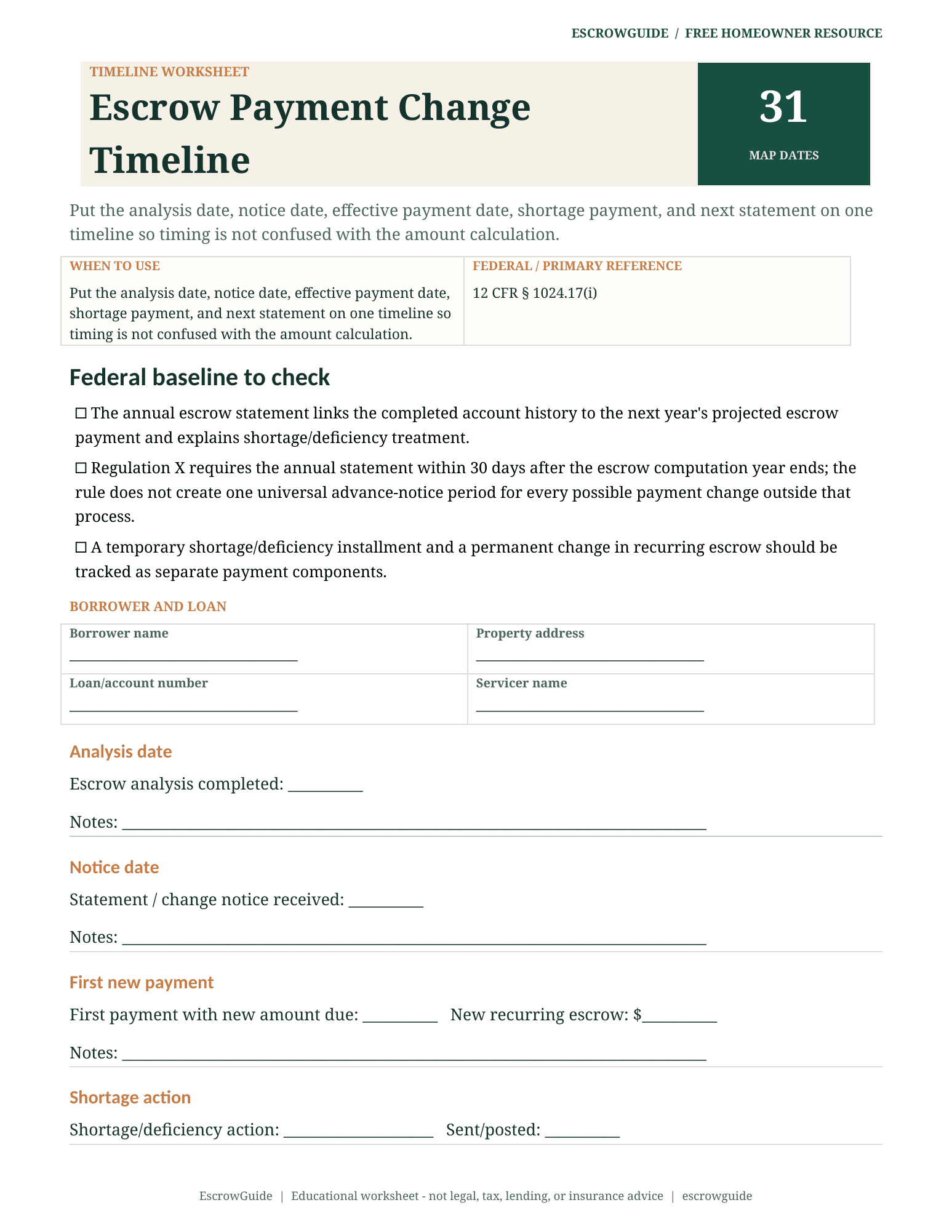
When an ARM rate adjustment and an escrow change hit the same payment, treat them as two separate servicing events. Regulation Z governs ARM adjustment disclosures; Regulation X governs escrow analysis. Rebuild principal and interest from the ARM notice, then add the recurring escrow amount and any shortage repayment from the escrow statement.
The most useful document is a component bridge: old principal and interest, new principal and interest, old recurring escrow, new recurring escrow, and temporary shortage or deficiency repayment. The total should equal the new payment only after each line has its own source.
Find the first payment due at the adjusted ARM rate
The ARM notice should identify the current and new interest rates, the current and new payments and the date the first new payment is due for the covered adjustment. The escrow statement should instead identify taxes, insurance, balance projections and shortage or surplus treatment.
Long-tail question: why did ARM rate and escrow increase in same mortgage payment. Timing can make the two notices arrive weeks apart even though the resulting changes first appear on the same monthly bill. Do not judge compliance by expecting one combined notice or identical mailing dates.
The rule that controls record old and new principal-and-interest amounts
For covered ARMs, 12 CFR § 1026.20 contains notice requirements for payment-changing rate adjustments. Ongoing adjustment disclosures are generally provided at least 60 and no more than 120 days before the first payment at the adjusted level, subject to stated exceptions; the initial adjustment has a separate 210-to-240-day framework. Escrow changes come from the separate Regulation X analysis. Neither notice should be used as a substitute for the other.
An ARM payment may also have caps, index and margin mechanics that affect principal and interest. Those are not escrow inputs. Conversely, an escrow shortage does not change the mortgage note rate. Keeping those systems separate prevents a correct calculation on one side from masking an error on the other.
Worked example: Record old and new recurring escrow deposits
A homeowner’s scheduled principal-and-interest payment rises by $84 after an ARM reset. In the same month, a new escrow analysis raises recurring tax-and-insurance collection by $62 and adds a temporary $45 shortage installment. The all-in payment rises $191. Calling the entire $191 an “interest-rate increase” hides two escrow layers; calling it an “escrow increase” hides the $84 ARM component. The notices should reproduce all three changes separately.
If the all-in payment does not equal the sum of the two notices, inspect effective dates first. One component may start a month later, a shortage may have been paid separately, or the servicing statement may include another item such as mortgage insurance.
Account audit from Find the first payment due at the adjusted ARM rate to Investigate only the line that does not bridge
Find the first payment due at the adjusted ARM rate
The most useful document is a component bridge: old principal and interest, new principal and interest, old recurring escrow, new recurring escrow, and temporary shortage or deficiency repayment. The total should equal the new payment only after each line has its own source. Evidence target: Find the first payment due at the adjusted ARM rate. Next comparison: Record old and new principal-and-interest amounts. Error to avoid: calling the whole increase an interest-rate change.
Record old and new principal-and-interest amounts
The ARM notice should identify the current and new interest rates, the current and new payments and the date the first new payment is due for the covered adjustment. The escrow statement should instead identify taxes, insurance, balance projections and shortage or surplus treatment. Evidence target: Record old and new principal-and-interest amounts. Next comparison: Record old and new recurring escrow deposits. Error to avoid: calling the whole increase an escrow change.
Record old and new recurring escrow deposits
Timing can make the two notices arrive weeks apart even though the resulting changes first appear on the same monthly bill. Do not judge compliance by expecting one combined notice or identical mailing dates. Evidence target: Record old and new recurring escrow deposits. Next comparison: Separate any temporary shortage repayment. Error to avoid: using the ARM notice to validate tax or insurance amounts.
Separate any temporary shortage repayment
An ARM payment may also have caps, index and margin mechanics that affect principal and interest. Those are not escrow inputs. Conversely, an escrow shortage does not change the mortgage note rate. Keeping those systems separate prevents a correct calculation on one side from masking an error on the other. Evidence target: Separate any temporary shortage repayment. Next comparison: Compare the ARM notice effective date with the escrow effective date. Error to avoid: using the escrow analysis to infer the new note rate.
Compare the ARM notice effective date with the escrow effective date
If the all-in payment does not equal the sum of the two notices, inspect effective dates first. One component may start a month later, a shortage may have been paid separately, or the servicing statement may include another item such as mortgage insurance. Evidence target: Compare the ARM notice effective date with the escrow effective date. Next comparison: Check for mortgage insurance or another payment component. Error to avoid: ignoring different effective dates for the two notices.
Check for mortgage insurance or another payment component
This page explains how to reconcile servicing notices; it does not recommend whether to refinance, modify, or otherwise change the loan. Any decision about loan terms is outside the site’s post-origination escrow scope. Evidence target: Check for mortgage insurance or another payment component. Next comparison: Add the components and reproduce the new total payment. Error to avoid: calling the whole increase an interest-rate change.
Add the components and reproduce the new total payment
The most useful document is a component bridge: old principal and interest, new principal and interest, old recurring escrow, new recurring escrow, and temporary shortage or deficiency repayment. The total should equal the new payment only after each line has its own source. Evidence target: Add the components and reproduce the new total payment. Next comparison: Investigate only the line that does not bridge. Error to avoid: calling the whole increase an escrow change.
Investigate only the line that does not bridge
The ARM notice should identify the current and new interest rates, the current and new payments and the date the first new payment is due for the covered adjustment. The escrow statement should instead identify taxes, insurance, balance projections and shortage or surplus treatment. Evidence target: Investigate only the line that does not bridge. Next comparison: Find the first payment due at the adjusted ARM rate. Error to avoid: using the ARM notice to validate tax or insurance amounts.
Evidence table for “why did ARM rate and escrow increase in same mortgage payment”
| Step | What to verify | Failure mode |
|---|---|---|
| 1 | Find the first payment due at the adjusted ARM rate | calling the whole increase an interest-rate change |
| 2 | Record old and new principal-and-interest amounts | calling the whole increase an escrow change |
| 3 | Record old and new recurring escrow deposits | using the ARM notice to validate tax or insurance amounts |
| 4 | Separate any temporary shortage repayment | using the escrow analysis to infer the new note rate |
| 5 | Compare the ARM notice effective date with the escrow effective date | ignoring different effective dates for the two notices |
| 6 | Check for mortgage insurance or another payment component | calling the whole increase an interest-rate change |
| 7 | Add the components and reproduce the new total payment | calling the whole increase an escrow change |
| 8 | Investigate only the line that does not bridge | using the ARM notice to validate tax or insurance amounts |
What can change the answer
This page explains how to reconcile servicing notices; it does not recommend whether to refinance, modify, or otherwise change the loan. Any decision about loan terms is outside the site’s post-origination escrow scope.
- calling the whole increase an interest-rate change
- calling the whole increase an escrow change
- using the ARM notice to validate tax or insurance amounts
- using the escrow analysis to infer the new note rate
- ignoring different effective dates for the two notices
Find the first payment due at the adjusted ARM rate — reconciliation note Timing can make the two notices arrive weeks apart even though the resulting changes first appear on the same monthly bill. Do not judge compliance by expecting one combined notice or identical mailing dates. For this account, pair “Find the first payment due at the adjusted ARM rate” with “Separate any temporary shortage repayment” before carrying a dollar figure forward. If the documents do not agree, preserve the variance rather than resolving it by using the arm notice to validate tax or insurance amounts.
Primary authority for this servicing question
- CFPB Regulation Z — § 1026.20 ↗
why did ARM rate and escrow increase in same mortgage payment — use CFPB Regulation Z — § 1026.20 to verify the federal or investor rule described above; use the borrower’s own statements, bills and transaction history for loan-level facts.
- CFPB Regulation X — § 1024.17 ↗
why did ARM rate and escrow increase in same mortgage payment — use CFPB Regulation X — § 1024.17 to verify the federal or investor rule described above; use the borrower’s own statements, bills and transaction history for loan-level facts.
Scope: this guide explains mortgage-servicing mechanics for why did ARM rate and escrow increase in same mortgage payment. It does not provide personalized legal, tax, insurance-coverage or loan-choice advice. Where local law, mortgage documents or investor rules matter, verify those authorities separately.