A fixed rate locks the interest rate used to calculate principal and interest; it does not freeze the total amount drafted each month. The most common reasons a fixed-rate payment rises are a higher escrow deposit for property taxes or homeowners insurance, repayment of an escrow shortage, a change in mortgage insurance, or a servicing correction. Diagnose the increase by comparing the old and new statements line by line instead of comparing only the total payment.
A total mortgage payment is a stack of components, so the diagnostic job is to identify which line moved and then verify the document behind that line. Keeping the records separate also makes a later dispute much easier to describe precisely.
Read the account in the right order
Build a before-and-after ledger before deciding why the payment changed. A note rate can remain untouched while an escrow deposit, insurance charge or temporary repayment changes the amount drafted each month. For why did my fixed rate mortgage payment go up, pair the disputed amount with the record that should control it. Write the supporting date and amount beside every completed check. That chronology can show whether an apparent balance gap is actually a bill paid near an analysis, transfer or reinstatement cutoff.
Where federal servicing rules fit
Regulation X requires an annual escrow analysis for covered escrow accounts. That analysis projects the next year's escrow disbursements, computes the required monthly escrow deposit, and identifies any shortage, surplus, or deficiency. This is why a payment can move even when the note rate and scheduled principal-and-interest amount do not.
The rulebook does not replace the account evidence. It tells you what should happen; dated statements and outside records show what did happen. A mismatch matters only after those two layers are compared on the same facts. The strongest follow-up names the disputed transaction instead of asserting that the entire escrow account is incorrect. A page-specific cross-check is to compare the principal-and-interest line on the old and new statements.
A concrete scenario
Suppose principal and interest remain $1,850. Last year's monthly escrow was $620, so the total payment was $2,470. The new analysis projects $5,400 of property tax and $2,640 of insurance, or $670 a month, and it also finds a $1,800 shortage repaid over 12 months, or $150 a month. The new total is $2,670. The $200 increase has two separate causes: $50 of ongoing escrow and $150 of temporary shortage repayment.
Use the arithmetic to narrow the question. A match shifts attention to the validity of the tax, insurance or balance inputs; a mismatch shifts attention to posting, timing or a component that has not yet been accounted for. A page-specific cross-check is to compare the annual property-tax amount used in the projection with the tax authority's current bill.
Reconcile the evidence
Gather records by function rather than by volume. One document should establish what the servicer used, another what the outside charge actually was, and a third should show how money moved through the account when timing is disputed. A page-specific cross-check is to compare the projected insurance premium with the declarations page or renewal notice.
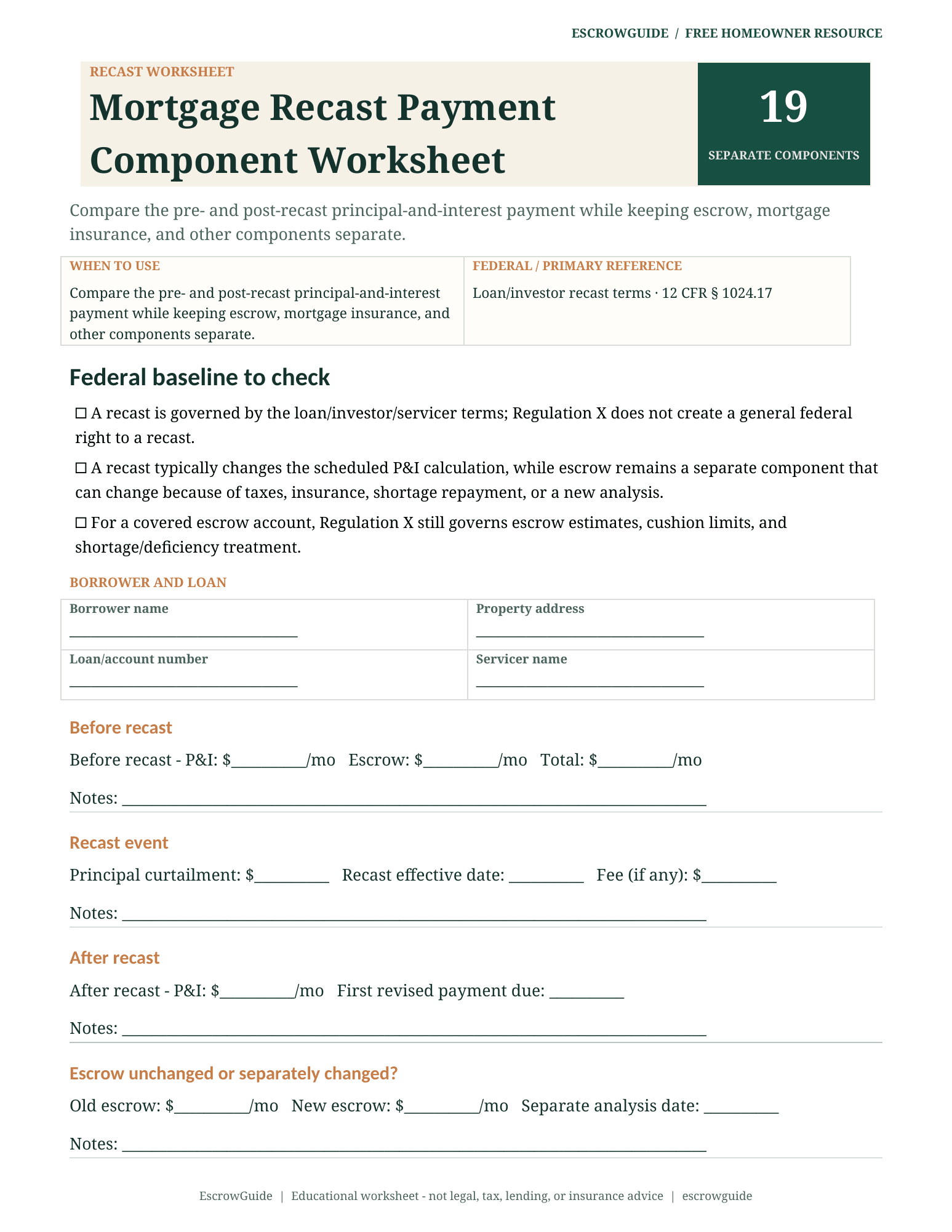
- Compare the principal-and-interest line on the old and new statements.
- Compare the annual property-tax amount used in the projection with the tax authority's current bill.
- Compare the projected insurance premium with the declarations page or renewal notice.
- Locate any shortage, deficiency, surplus, or cushion line on the annual escrow statement.
- Check for mortgage-insurance changes, fees, or a servicing transfer if the numbers still do not reconcile.
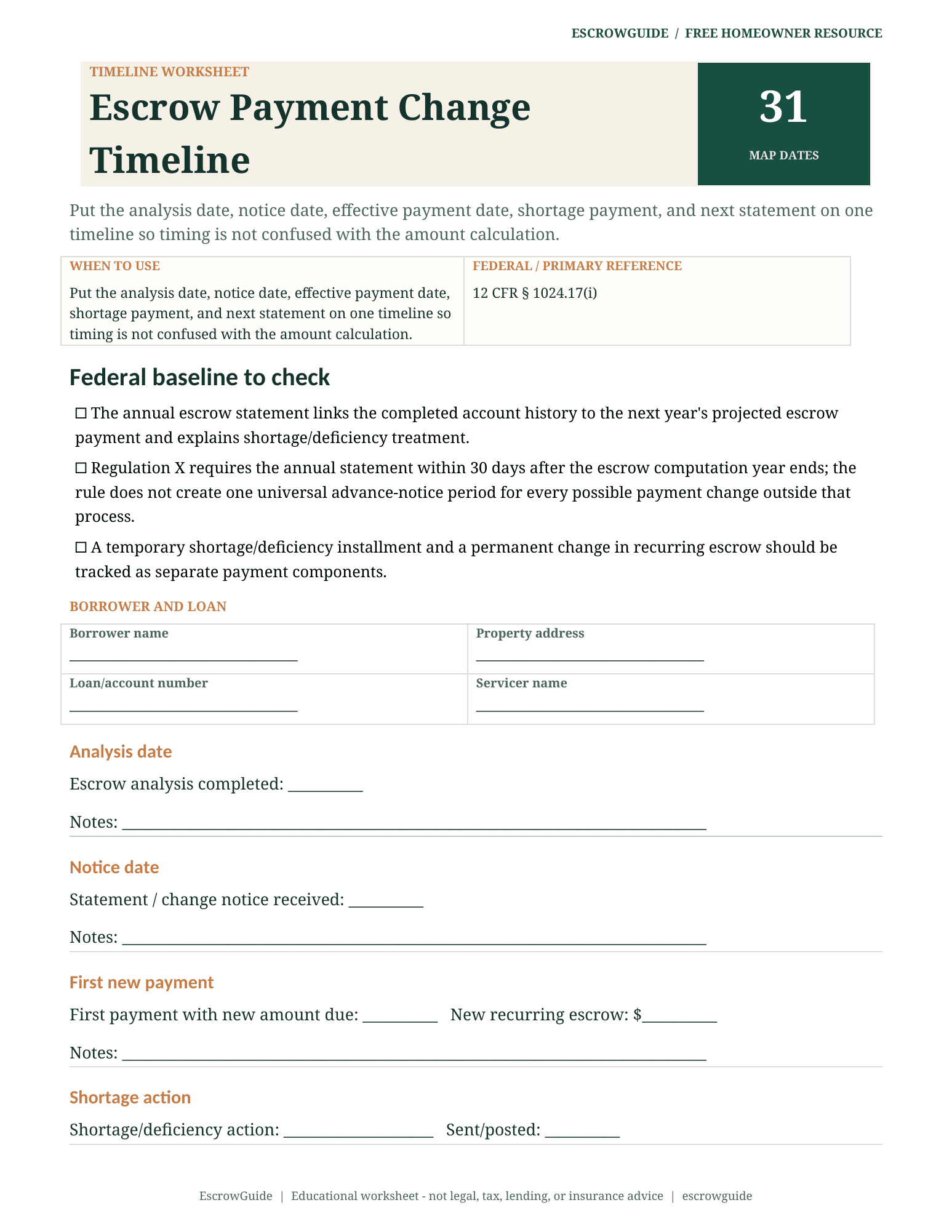
Dates matter as much as dollars. A transaction posted a few days before or after the analysis date can explain why a borrower and servicer appear to be starting from different balances. For this issue, also rule out assuming a fixed-rate loan guarantees a fixed total payment.
Finish with a timeline check
Distinguish the amount that is expected to persist from any amount designed to catch up a past imbalance. Recurring tax, insurance or mortgage-insurance costs belong in the first bucket. Shortage or deficiency treatment belongs in the second. Labeling those buckets makes the likely duration of a payment change easier to understand. A page-specific cross-check is to locate any shortage, deficiency, surplus, or cushion line on the annual escrow statement.
For educational estimates, label assumptions explicitly. If a simple annual amount divided by 12 is being used only as a cross-check, it should not be presented as the formal aggregate-accounting result. That distinction keeps a useful estimate from becoming false evidence of servicing error. For this issue, also rule out paying a shortage and expecting taxes or insurance to revert to old amounts.
For a rule-based claim, preserve the exact official page or section used in the analysis. That makes future review easier if agency guidance, investor instructions or servicing procedures change and prevents a later summary from being mistaken for the authority that applied at the time. A page-specific cross-check is to check for mortgage-insurance changes, fees, or a servicing transfer if the numbers still do not reconcile.
Common false signals
- Assuming a fixed-rate loan guarantees a fixed total payment.
- Paying a shortage and expecting taxes or insurance to revert to old amounts.
- Comparing only the monthly total instead of tracing each component.
- Treating an estimate from a calculator as proof that the servicer made an error.
Avoid treating a calculator disagreement as the error itself. Simplified estimates do not capture every running-balance timing rule, while an identified wrong bill or posting is a concrete fact the servicer can investigate. A page-specific cross-check is to compare the principal-and-interest line on the old and new statements.
If the ledger still does not tie
Before using a formal error process, make sure the allegation is operational: wrong amount, wrong date, missing transfer, duplicate disbursement, or unavailable calculation. That gives the servicer something testable to investigate. A page-specific cross-check is to compare the annual property-tax amount used in the projection with the tax authority's current bill.
The site can explain the mechanism and source framework, but it cannot determine the legal consequence for an individual loan. Keep required-payment decisions outside a general article unless the controlling loan-specific source is clear. For this issue, also rule out comparing only the monthly total instead of tracing each component.
Close the loop on the following statement
A resolved phone call is not the end of the audit until the transaction history reflects the resolution. Look for the promised credit, reversal, transfer entry or revised projection, then keep the statement that proves it posted. That closes the evidence loop without relying on memory. A page-specific cross-check is to compare the projected insurance premium with the declarations page or renewal notice.
For tax and insurance disputes, distinguish the billing address from the property and policy identifiers. A payment sent to the correct company can still be misapplied, so matching parcel number, policy number and covered period can matter as much as matching the dollar amount. For this issue, also rule out treating an estimate from a calculator as proof that the servicer made an error.