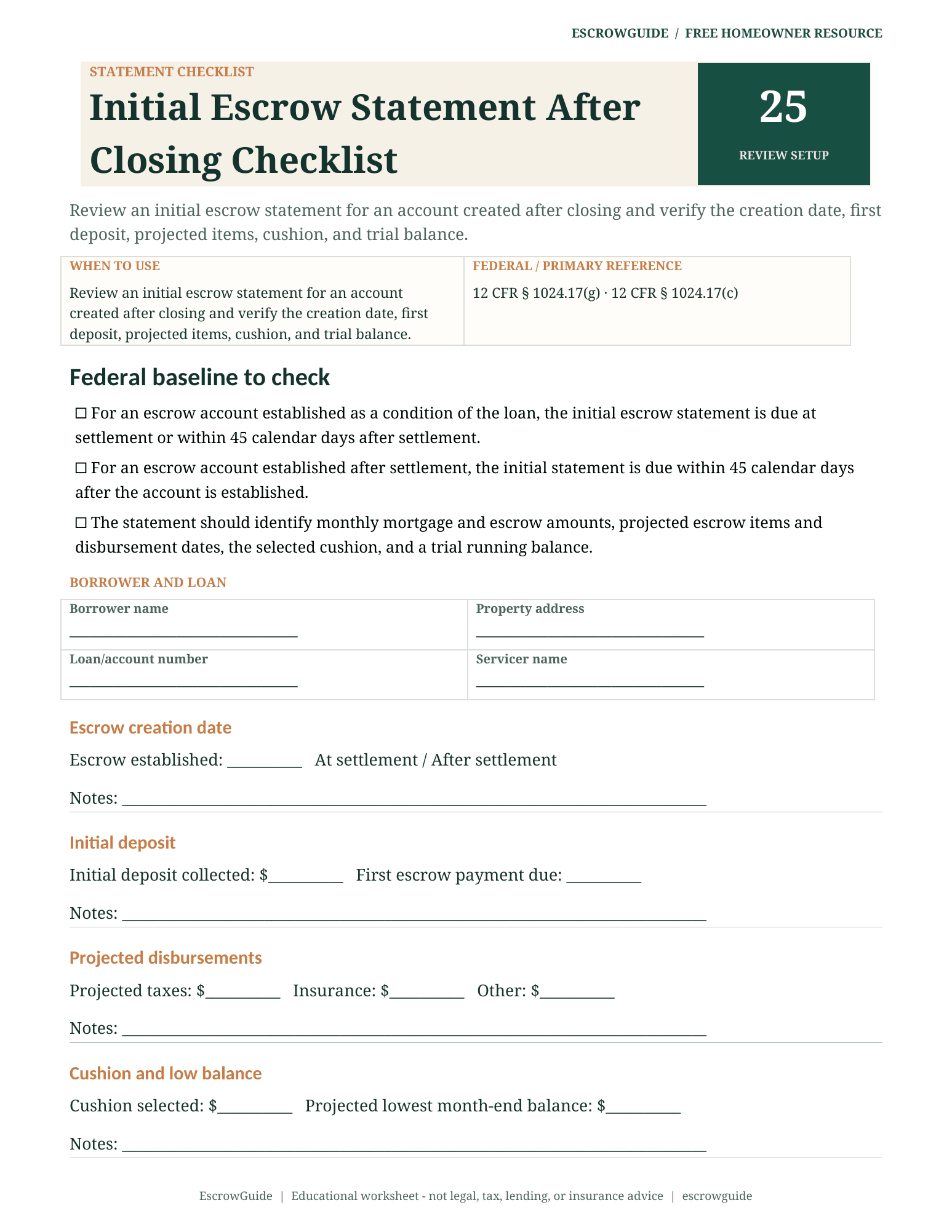
When an escrow account is established after settlement and was not a condition of the loan, 12 CFR § 1024.17(g)(2) requires the servicer to submit an initial escrow account statement within 45 calendar days of the date the account was established. The servicer must also run an escrow analysis before establishing the account. Whether the servicer was allowed to create escrow when the mortgage documents were silent is a separate question controlled by other federal or state law.
The first date to pin down is the account-establishment date. A customer-service note saying “escrow starts next month” is not as useful as the system notice, statement, or transaction history that identifies when the servicer actually established the account. That date drives the 45-calendar-day disclosure test for a post-settlement account.
Document the exact escrow-establishment date
The initial deposit and the ongoing monthly deposit answer different questions. At creation, Regulation X allows an amount sufficient to cover property charges attributable to the period since they were last paid, plus a permitted cushion. The monthly collection for the life of the account is based on anticipated annual disbursements and the applicable cushion. Mixing those two layers can make the first payment look inexplicably high.
Long-tail question: initial escrow statement within 45 days after account established after closing. The initial statement should be more than a new payment notice. It should itemize estimated taxes, insurance premiums and other expected charges, show anticipated disbursement dates, identify the chosen cushion, and include a trial running balance. Those fields are what let a borrower reproduce the setup instead of merely accepting an all-in payment.
The rule that controls save the notice or authority cited for creating escrow
Regulation X separates an escrow account created as a condition of the loan from one created later. Section 1024.17(c)(2) requires an escrow analysis before establishment. Section 1024.17(g)(2) sets the 45-calendar-day statement deadline for an account established after settlement and not required as a condition of the loan. Section 1024.17(c)(8) adds an important boundary: if the mortgage documents do not specifically establish escrow, Regulation X itself does not answer whether the servicer may create the account; other federal or state law may control.
A later-created escrow account can coincide with a tax bill, insurance renewal, delinquency cure, investor requirement, or another servicing event. The existence of one of those events does not automatically prove that creation was authorized. The account documents and applicable law should be checked separately from the federal limits on how the account is funded after it exists.
Worked example: Compare the initial deposit with unpaid property charges
A borrower closes without a tax-and-insurance escrow. Eighteen months later the servicer establishes escrow after a permitted servicing event. The account-establishment date is June 10, not the date of the first larger payment. The 45-day clock is measured from June 10. The initial statement should show the monthly mortgage payment, the portion going to escrow, expected taxes and insurance with anticipated disbursement dates, the selected cushion and a trial running balance. The borrower should separately retain the notice or document explaining why escrow was established.
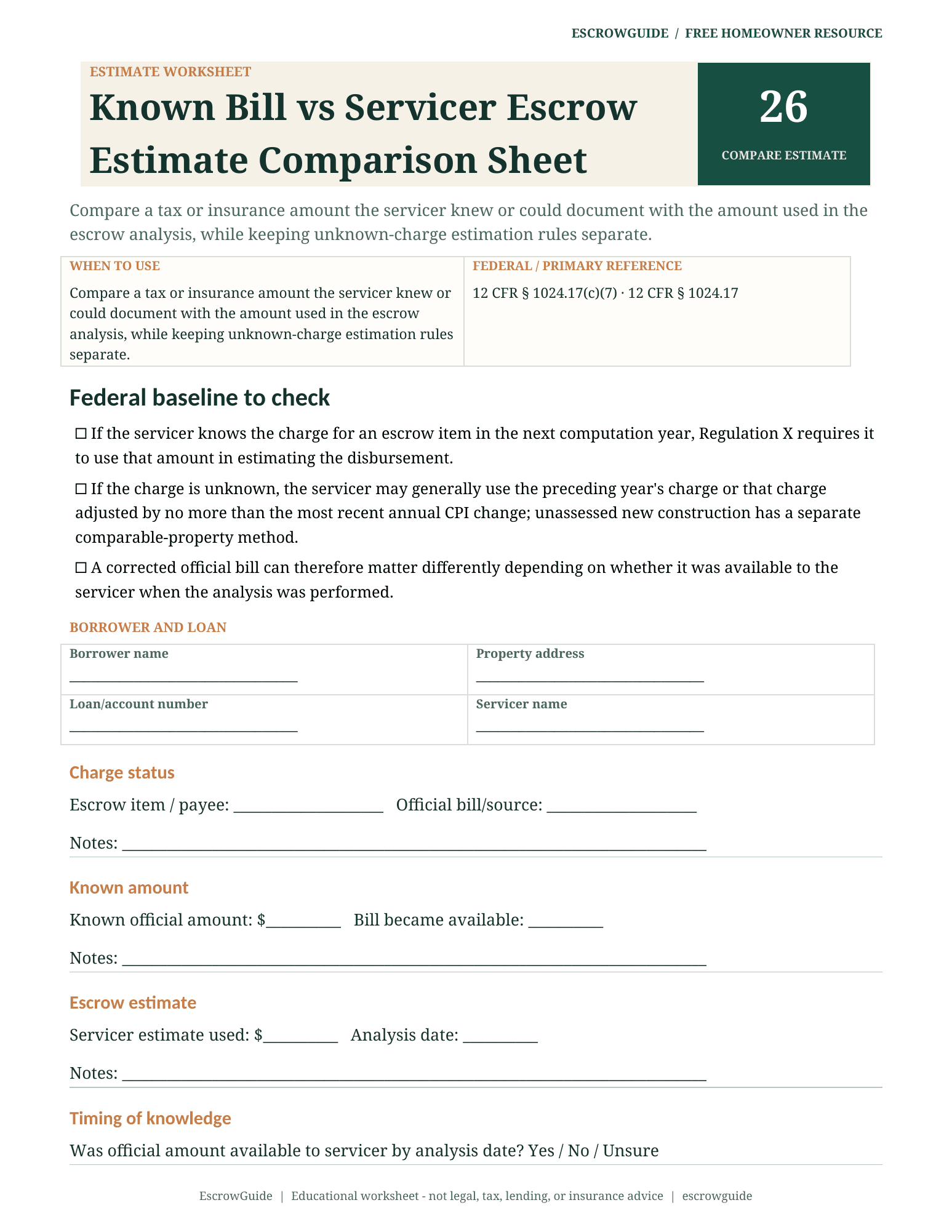
If the first statement uses an old tax figure or expired insurance premium, the issue is not the 45-day deadline alone. The borrower should compare the servicer projection with the current tax bill and declarations page, then identify exactly which input is stale. That creates a narrow, answerable servicing question.
Account audit from Document the exact escrow-establishment date to Request the trial running balance if the setup cannot be reproduced
Document the exact escrow-establishment date
The first date to pin down is the account-establishment date. A customer-service note saying “escrow starts next month” is not as useful as the system notice, statement, or transaction history that identifies when the servicer actually established the account. That date drives the 45-calendar-day disclosure test for a post-settlement account. Evidence target: Document the exact escrow-establishment date. Next comparison: Save the notice or authority cited for creating escrow. Error to avoid: using the first increased payment date as the establishment date.
Save the notice or authority cited for creating escrow
The initial deposit and the ongoing monthly deposit answer different questions. At creation, Regulation X allows an amount sufficient to cover property charges attributable to the period since they were last paid, plus a permitted cushion. The monthly collection for the life of the account is based on anticipated annual disbursements and the applicable cushion. Mixing those two layers can make the first payment look inexplicably high. Evidence target: Save the notice or authority cited for creating escrow. Next comparison: Compare the initial deposit with unpaid property charges. Error to avoid: assuming Regulation X itself authorizes escrow whenever loan documents are silent.
Compare the initial deposit with unpaid property charges
The initial statement should be more than a new payment notice. It should itemize estimated taxes, insurance premiums and other expected charges, show anticipated disbursement dates, identify the chosen cushion, and include a trial running balance. Those fields are what let a borrower reproduce the setup instead of merely accepting an all-in payment. Evidence target: Compare the initial deposit with unpaid property charges. Next comparison: Verify the selected cushion against the mortgage documents. Error to avoid: treating an initial funding deposit as a recurring monthly amount.
Verify the selected cushion against the mortgage documents
A later-created escrow account can coincide with a tax bill, insurance renewal, delinquency cure, investor requirement, or another servicing event. The existence of one of those events does not automatically prove that creation was authorized. The account documents and applicable law should be checked separately from the federal limits on how the account is funded after it exists. Evidence target: Verify the selected cushion against the mortgage documents. Next comparison: Match each projected tax and insurance item to a current bill. Error to avoid: using last year’s insurance or tax amount when the servicer had a newer known charge.
Match each projected tax and insurance item to a current bill
If the first statement uses an old tax figure or expired insurance premium, the issue is not the 45-day deadline alone. The borrower should compare the servicer projection with the current tax bill and declarations page, then identify exactly which input is stale. That creates a narrow, answerable servicing question. Evidence target: Match each projected tax and insurance item to a current bill. Next comparison: Confirm the first monthly escrow deposit and effective payment. Error to avoid: counting a tax or insurance bill that the borrower already paid directly.
Confirm the first monthly escrow deposit and effective payment
The safest reconciliation covers the period from the last tax or insurance payment before escrow was established through the first projected disbursement after establishment. This prevents a prepaid bill, seller credit, or direct borrower payment from being counted again inside the new escrow funding requirement. Evidence target: Confirm the first monthly escrow deposit and effective payment. Next comparison: Trace the first actual escrow disbursement. Error to avoid: using the first increased payment date as the establishment date.
Trace the first actual escrow disbursement
The first date to pin down is the account-establishment date. A customer-service note saying “escrow starts next month” is not as useful as the system notice, statement, or transaction history that identifies when the servicer actually established the account. That date drives the 45-calendar-day disclosure test for a post-settlement account. Evidence target: Trace the first actual escrow disbursement. Next comparison: Request the trial running balance if the setup cannot be reproduced. Error to avoid: assuming Regulation X itself authorizes escrow whenever loan documents are silent.
Request the trial running balance if the setup cannot be reproduced
The initial deposit and the ongoing monthly deposit answer different questions. At creation, Regulation X allows an amount sufficient to cover property charges attributable to the period since they were last paid, plus a permitted cushion. The monthly collection for the life of the account is based on anticipated annual disbursements and the applicable cushion. Mixing those two layers can make the first payment look inexplicably high. Evidence target: Request the trial running balance if the setup cannot be reproduced. Next comparison: Document the exact escrow-establishment date. Error to avoid: treating an initial funding deposit as a recurring monthly amount.
Evidence table for “initial escrow statement within 45 days after account established after closing”
| Step | What to verify | Failure mode |
|---|---|---|
| 1 | Document the exact escrow-establishment date | using the first increased payment date as the establishment date |
| 2 | Save the notice or authority cited for creating escrow | assuming Regulation X itself authorizes escrow whenever loan documents are silent |
| 3 | Compare the initial deposit with unpaid property charges | treating an initial funding deposit as a recurring monthly amount |
| 4 | Verify the selected cushion against the mortgage documents | using last year’s insurance or tax amount when the servicer had a newer known charge |
| 5 | Match each projected tax and insurance item to a current bill | counting a tax or insurance bill that the borrower already paid directly |
| 6 | Confirm the first monthly escrow deposit and effective payment | using the first increased payment date as the establishment date |
| 7 | Trace the first actual escrow disbursement | assuming Regulation X itself authorizes escrow whenever loan documents are silent |
| 8 | Request the trial running balance if the setup cannot be reproduced | treating an initial funding deposit as a recurring monthly amount |
What can change the answer
The safest reconciliation covers the period from the last tax or insurance payment before escrow was established through the first projected disbursement after establishment. This prevents a prepaid bill, seller credit, or direct borrower payment from being counted again inside the new escrow funding requirement.
- using the first increased payment date as the establishment date
- assuming Regulation X itself authorizes escrow whenever loan documents are silent
- treating an initial funding deposit as a recurring monthly amount
- using last year’s insurance or tax amount when the servicer had a newer known charge
- counting a tax or insurance bill that the borrower already paid directly
Primary authority for this servicing question
- CFPB Regulation X — § 1024.17 ↗
initial escrow statement within 45 days after account established after closing — use CFPB Regulation X — § 1024.17 to verify the federal or investor rule described above; use the borrower’s own statements, bills and transaction history for loan-level facts.
- CFPB Mortgage Servicing FAQs ↗
initial escrow statement within 45 days after account established after closing — use CFPB Mortgage Servicing FAQs to verify the federal or investor rule described above; use the borrower’s own statements, bills and transaction history for loan-level facts.
Scope: this guide explains mortgage-servicing mechanics for initial escrow statement within 45 days after account established after closing. It does not provide personalized legal, tax, insurance-coverage or loan-choice advice. Where local law, mortgage documents or investor rules matter, verify those authorities separately.