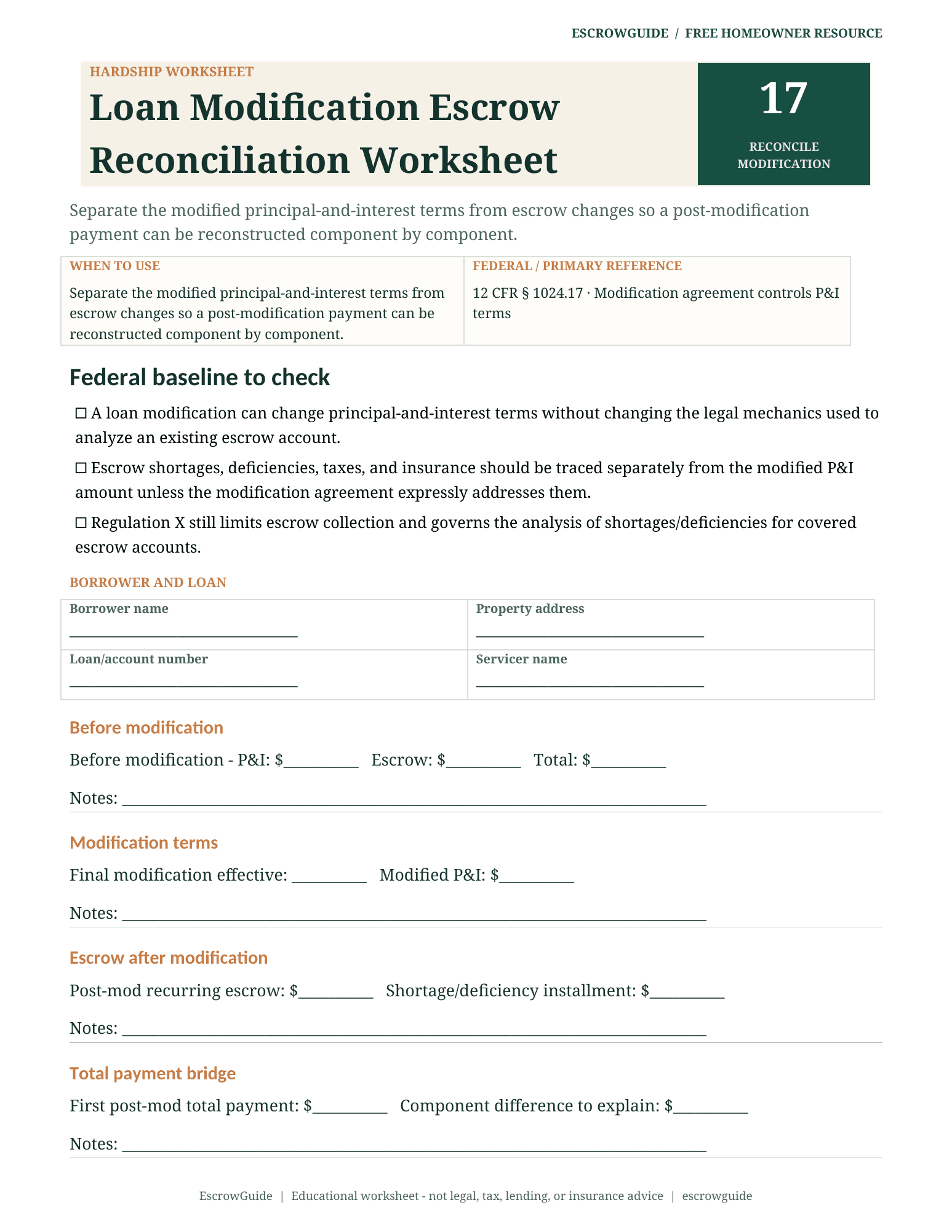
A permanent loan modification and an escrow analysis solve different problems. The modification may change principal, interest rate, maturity or other loan terms. Escrow still reflects projected property taxes, homeowners insurance and other permitted escrow items. When the first permanent payment differs from a trial payment or an earlier estimate, rebuild the total from those separate components before assuming one calculation replaced the other.
Hardship relief can change the payment schedule without stopping every tax or insurance disbursement, so workout accounting and escrow accounting have to be reconciled separately. Keeping the records separate also makes a later dispute much easier to describe precisely.
Identify the ledger event
The cleanest audit starts from the permanent agreement, not from a phone quote. Write the modified principal-and-interest amount on one line, the new ongoing escrow amount on the next, and any temporary escrow catch-up on a third. If the sum still does not match the statement, the remaining difference is small enough to investigate directly.
The federal baseline
CFPB guidance describes a mortgage modification as a change to the loan's terms and warns borrowers to understand how the new terms affect both monthly and total amounts owed. Regulation X separately requires the servicer to analyze covered escrow accounts. A lower principal-and-interest obligation therefore does not guarantee that the total payment falls if escrow rises at the same time.
The rulebook does not replace the account evidence. It tells you what should happen; dated statements and outside records show what did happen. A mismatch matters only after those two layers are compared on the same facts. A calculator can test magnitude, but the statement and primary records remain the evidence for the actual loan. A page-specific cross-check is to locate the permanent modification agreement and identify the stated principal-and-interest payment, if shown separately.
Example with dates and dollars
Suppose a trial modification payment was quoted at $2,050 while the servicer was still using $500 of monthly escrow. The final modified principal-and-interest amount becomes $1,520, but the next escrow analysis uses $660 because taxes and insurance changed and also adds $120 per month for a $1,440 shortage. The first fully adjusted payment is $2,300: $1,520 P&I + $660 ongoing escrow + $120 temporary shortage repayment. The $250 difference from the trial amount is not explained by the modification rate alone.
The point of the scenario is traceability. Each number has a source and a role; repeating that mapping with the actual account prevents a temporary catch-up amount from being confused with a permanent recurring cost. A page-specific cross-check is to obtain the most recent escrow analysis and find the new periodic escrow deposit.
Cross-check three records
A clean audit file usually has three layers: servicer statement, escrow transaction history and the third-party bill or policy. For transfer or workout cases, add the document that defines the handoff or payment arrangement. A page-specific cross-check is to check whether a shortage or deficiency repayment began on the same effective date as the modified payment.
- Locate the permanent modification agreement and identify the stated principal-and-interest payment, if shown separately.
- Obtain the most recent escrow analysis and find the new periodic escrow deposit.
- Check whether a shortage or deficiency repayment began on the same effective date as the modified payment.
- Compare the tax and insurance projections with current third-party bills.
- Keep trial-plan statements because they can show whether an earlier payment used a temporary escrow figure.
If a check fails, stop and define the failure before moving on. A duplicated payment, missing credit and wrong projection are different problems and should not be bundled into one allegation. For this issue, also rule out assuming the trial payment must equal the final all-in payment forever.
Check the direction of the evidence
Distinguish the amount that is expected to persist from any amount designed to catch up a past imbalance. Recurring tax, insurance or mortgage-insurance costs belong in the first bucket. Shortage or deficiency treatment belongs in the second. Labeling those buckets makes the likely duration of a payment change easier to understand. A page-specific cross-check is to compare the tax and insurance projections with current third-party bills.
For educational estimates, label assumptions explicitly. If a simple annual amount divided by 12 is being used only as a cross-check, it should not be presented as the formal aggregate-accounting result. That distinction keeps a useful estimate from becoming false evidence of servicing error. For this issue, also rule out attributing a tax or insurance increase to the modified interest rate.
If the account contains several simultaneous changes, avoid solving them with one explanation. Tax, insurance, mortgage insurance, P&I and shortage treatment can move independently. Assign each change its own source and effective date, then recombine them only after each component has been verified. A page-specific cross-check is to keep trial-plan statements because they can show whether an earlier payment used a temporary escrow figure.
What not to infer
- Assuming the trial payment must equal the final all-in payment forever.
- Attributing a tax or insurance increase to the modified interest rate.
- Comparing only two total-payment figures without separating principal and interest from escrow.
- Treating an investor-specific workout rule as a universal servicing rule.
A second common error is jumping across several years of statements. Reconcile one change at a time; otherwise a valid tax increase can mask an unrelated transfer or posting issue. A page-specific cross-check is to locate the permanent modification agreement and identify the stated principal-and-interest payment, if shown separately.
A cleaner way to contact the servicer
Formal servicing rights are not a substitute for the initial math. Use them when a specific unresolved discrepancy remains, and send the notice through the channel the servicer designates for that purpose. A page-specific cross-check is to obtain the most recent escrow analysis and find the new periodic escrow deposit.
Servicing research is different from personalized advice. Use the evidence to ask a precise question, while treating payment, legal and tax decisions as fact-specific matters beyond this general explanation. For this issue, also rule out comparing only two total-payment figures without separating principal and interest from escrow.
Keep a record for the next escrow cycle
Save any corrected analysis as a new version instead of replacing the original. Differences between the two documents can show exactly which input or balance changed and can be important if a later statement appears to revert to the earlier, incorrect figure. A page-specific cross-check is to check whether a shortage or deficiency repayment began on the same effective date as the modified payment.
When contacting a tax authority, insurer or prior servicer, ask for a record that includes the property or loan reference, amount, effective date and payment status. Those fields are more useful for reconciliation than a generic confirmation that the account is 'fine.' For this issue, also rule out treating an investor-specific workout rule as a universal servicing rule.