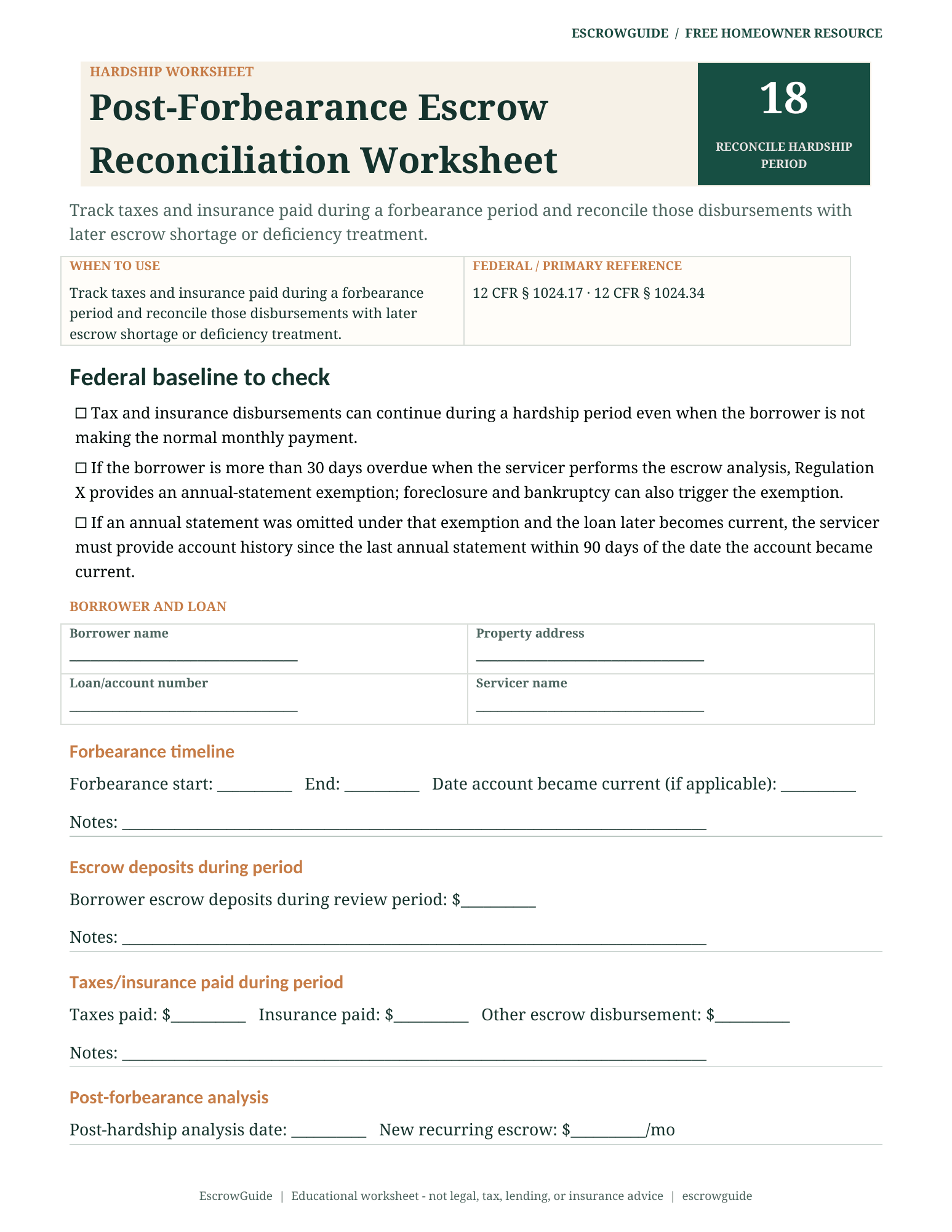
Forbearance can pause or reduce the payment you send without pausing the underlying tax and insurance bills. When a servicer continues paying those bills from escrow, the escrow ledger can finish the forbearance period below its target. A later analysis can therefore add two different amounts to the payment: a catch-up amount for the prior gap and a higher ongoing deposit if the next tax or insurance bills are larger.
Hardship relief can change the payment schedule without stopping every tax or insurance disbursement, so workout accounting and escrow accounting have to be reconciled separately. The useful result is an evidence trail, not merely a second estimate of the monthly total.
Find the first number that changed
A useful reconciliation has three columns: money collected into escrow, money paid out for escrow items, and workout amounts that belong elsewhere on the mortgage account. Keeping those columns separate prevents a common mistake—using the total amount deferred during hardship as a proxy for the escrow gap. The two numbers can be very different.
What Regulation X contributes
CFPB homeowner guidance says that when taxes and insurance are paid through escrow, the servicer should continue making those payments during forbearance. Regulation X separately governs escrow analyses, shortages and deficiencies. The combination matters: a borrower can owe less or nothing during an approved forbearance period while the escrow account still experiences real disbursements.
Regulation X can tell a servicer how to analyze or administer escrow without determining the underlying tax or insurance charge. Keep the rule question and the outside-bill question separate so a correct calculation does not validate a wrong input. If the servicer uses a designated address for written notices, ordinary customer-service chat may not substitute for that process. A page-specific cross-check is to download the escrow transaction history covering the entire forbearance period, not only the first statement after payments resume.
Test the explanation with a scenario
Assume six months of forbearance, with $560 of monthly escrow ordinarily embedded in the payment. During those six months the servicer pays a $2,100 insurance premium and $1,620 in tax installments, or $3,720 total. If little or no escrow money was collected during the same period, the ledger can be several thousand dollars below the path assumed before forbearance. If a later analysis identifies a $2,400 shortage and the new ongoing escrow is $590, a 12-month shortage treatment would add $200 temporarily, making the escrow-related portion $790 for that period.
Do not copy the sample outcome onto another loan. Copy only the process: identify the inputs, show the calculation, and compare the reconstructed result with the servicer's figure. A page-specific cross-check is to mark every tax and insurance disbursement and compare each one with the underlying bill or policy invoice.
Verify the source documents
Use records that are independent where possible. A servicer's own statement can be checked against a tax collector, insurer or prior servicer record, which reduces the risk of treating one repeated internal number as confirmation. A page-specific cross-check is to separate amounts that were deferred under the workout from amounts that represent escrow disbursements already made.
- Download the escrow transaction history covering the entire forbearance period, not only the first statement after payments resume.
- Mark every tax and insurance disbursement and compare each one with the underlying bill or policy invoice.
- Separate amounts that were deferred under the workout from amounts that represent escrow disbursements already made.
- Compare the new ongoing escrow deposit with the current annual tax and insurance figures.
- If the loan is current again, look for the post-delinquency escrow history required by the annual-statement rule.
Turn the checklist into a short timeline. The order of collection, disbursement, analysis and notice dates often explains a balance that looks wrong when only month-end totals are compared. For this issue, also rule out treating a forbearance as if taxes and insurance stopped accruing.
Resolve the remaining ambiguity
Distinguish the amount that is expected to persist from any amount designed to catch up a past imbalance. Recurring tax, insurance or mortgage-insurance costs belong in the first bucket. Shortage or deficiency treatment belongs in the second. Labeling those buckets makes the likely duration of a payment change easier to understand. A page-specific cross-check is to compare the new ongoing escrow deposit with the current annual tax and insurance figures.
Preserve the original document set even after the problem appears resolved. Escrow changes can affect later analyses, and a future shortage or transfer question is easier to diagnose when the prior correction, refund or recalculation can be traced to its source. For this issue, also rule out adding the entire mortgage payment that was not made during forbearance and calling it an escrow shortage.
The final account note should be concise enough to reuse later: what changed, which record explained it, whether a correction was needed, and what the next statement should show. That summary reduces repeated research when the following annual analysis arrives. A page-specific cross-check is to if the loan is current again, look for the post-delinquency escrow history required by the annual-statement rule.
Avoid these shortcuts
- Treating a forbearance as if taxes and insurance stopped accruing.
- Adding the entire mortgage payment that was not made during forbearance and calling it an escrow shortage.
- Confusing a loss-mitigation repayment arrangement with the servicer's separate escrow analysis.
- Assuming a post-forbearance payment increase proves the modification or forbearance terms were applied incorrectly.
Watch for compounded explanations. Several legitimate changes can occur together, so the total may look dramatic even though no single component is unusually large. Test components before testing the emotion of the total. A page-specific cross-check is to download the escrow transaction history covering the entire forbearance period, not only the first statement after payments resume.
Next step when the math is still off
If a concrete difference survives ordinary customer service, state the dates and amounts in writing. Ask what record supports the servicer's figure and, for covered servicing issues, consider the Regulation X error-resolution or information-request process using the servicer's designated instructions. A page-specific cross-check is to mark every tax and insurance disbursement and compare each one with the underlying bill or policy invoice.
Account documentation can establish whether a servicing number is supported without answering every legal or financial question that may follow. Those later questions can depend on facts not visible in an escrow statement. For this issue, also rule out confusing a loss-mitigation repayment arrangement with the servicer's separate escrow analysis.
What the follow-up statement should show
After any servicer explanation, write down what should visibly change and by when. That might be a refund, an opening-balance correction, removal of an insurance charge, a revised projected disbursement or a later monthly-payment adjustment. A promised outcome that never reaches the statement is a new, separately documentable fact. A page-specific cross-check is to separate amounts that were deferred under the workout from amounts that represent escrow disbursements already made.
If the issue involves more than one servicer or insurer, name each institution in the timeline. Transfers and policy rewrites can create overlapping dates, and an unnamed 'they paid it' note is difficult to reconcile months later when the account is reviewed again. For this issue, also rule out assuming a post-forbearance payment increase proves the modification or forbearance terms were applied incorrectly.