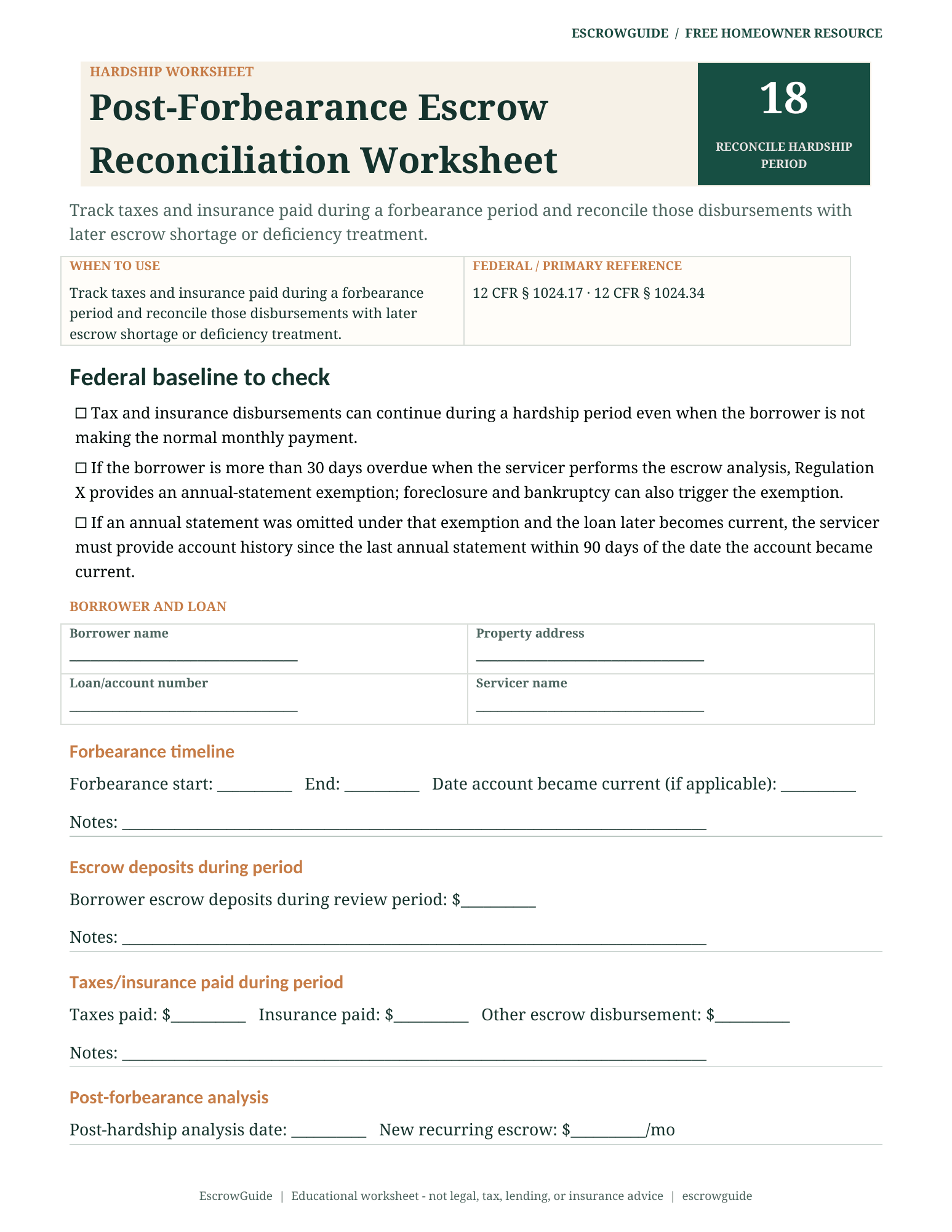
After a delinquent mortgage is reinstated, the escrow account may need to be reconstructed from months of collections, advances and tax or insurance disbursements. Regulation X gives servicers an annual-statement exception while a borrower is more than 30 days overdue and provides a specific post-delinquency history requirement once the loan becomes current again. That history is the best starting point for checking the opening balance of the reinstated account.
Hardship relief can change the payment schedule without stopping every tax or insurance disbursement, so workout accounting and escrow accounting have to be reconciled separately. A component-level view also prevents a correct outside bill from hiding an unrelated posting problem.
The payment question to isolate first
Reinstatement is a useful boundary date because it separates a messy historical period from the account going forward. Reconcile the historical ledger first. Then test the next projected escrow amount against current bills. Doing both at once can hide whether the problem is an old posting error or a legitimate future-cost change.
The rule boundary
Under 12 CFR § 1024.17(i)(2), a servicer is not required to send the normal annual escrow statement when the borrower is more than 30 days overdue, the loan is in foreclosure, or the borrower is in bankruptcy. If the loan later is reinstated or otherwise becomes current, the rule requires an escrow account history covering the period since the last annual statement within 90 days of the date the account became current.
The rulebook does not replace the account evidence. It tells you what should happen; dated statements and outside records show what did happen. A mismatch matters only after those two layers are compared on the same facts. Use adjacent statements first; comparing years that contain several intervening changes can merge unrelated causes. A page-specific cross-check is to record the exact date the servicer treated the mortgage as current again.
Run the numbers
A borrower becomes current on April 15 after eight delinquent months. During that period the servicer paid $3,600 in taxes and $1,800 in insurance but collected only $2,700 into escrow through partial or reinstatement-related payments. Before considering cushion or timing, the raw cash-flow difference is $2,700. The post-reinstatement history should let the borrower trace those entries rather than trying to infer the deficit from the new monthly payment alone.
A worked case is valuable because it forces every dollar into a category. Once the same categories are filled with real statement values, a vague payment complaint becomes a specific difference with a date and amount. A page-specific cross-check is to obtain the escrow history beginning with the last annual statement before delinquency.
Build the document trail
Prepare the file before contacting the servicer. Start with the current and prior analysis, recent statements and the tax or insurance evidence. A dated source beside each disputed amount is more useful than a thick folder of unrelated paperwork. A page-specific cross-check is to match each disbursement to a tax bill, insurance invoice or other authorized escrow item.
- Record the exact date the servicer treated the mortgage as current again.
- Obtain the escrow history beginning with the last annual statement before delinquency.
- Match each disbursement to a tax bill, insurance invoice or other authorized escrow item.
- Match each escrow deposit to the payment history and reinstatement transaction.
- If the history does not arrive within the applicable period or entries do not reconcile, document the specific missing or incorrect transaction.
Record both the finding and its source. A conclusion such as 'premium increased' is stronger when it sits beside the renewal amount, effective date and matching escrow disbursement. For this issue, also rule out expecting a normal annual statement during every month of a serious delinquency.
Before treating the result as an error
Look for effective dates, not just notice dates. Insurance renewals, tax assessments, transfers and workout changes can be communicated on one day but affect the ledger on another. Matching the correct effective date to the correct statement period avoids false discrepancies caused by timing alone. A page-specific cross-check is to match each escrow deposit to the payment history and reinstatement transaction.
For educational estimates, label assumptions explicitly. If a simple annual amount divided by 12 is being used only as a cross-check, it should not be presented as the formal aggregate-accounting result. That distinction keeps a useful estimate from becoming false evidence of servicing error. For this issue, also rule out using the reinstatement quote as a substitute for the escrow transaction history.
For a rule-based claim, preserve the exact official page or section used in the analysis. That makes future review easier if agency guidance, investor instructions or servicing procedures change and prevents a later summary from being mistaken for the authority that applied at the time. A page-specific cross-check is to if the history does not arrive within the applicable period or entries do not reconcile, document the specific missing or incorrect transaction.
What would count as a real mismatch
- Expecting a normal annual statement during every month of a serious delinquency.
- Using the reinstatement quote as a substitute for the escrow transaction history.
- Assuming every servicer advance is a fee rather than checking what bill was paid.
- Starting a dispute without identifying the transaction date or amount that is wrong.
Also avoid comparing the new payment with a much older payment while skipping intervening events. Adjacent periods make it easier to isolate a single cause and to identify a genuine statement entry that conflicts with a known bill or ledger. A page-specific cross-check is to record the exact date the servicer treated the mortgage as current again.
Questions worth putting in writing
Escalate facts, not frustration. A written request should identify the loan, the transaction or projection at issue, the competing source record and the information or correction being sought. Keep copies and delivery evidence. A page-specific cross-check is to obtain the escrow history beginning with the last annual statement before delinquency.
The site can explain the mechanism and source framework, but it cannot determine the legal consequence for an individual loan. Keep required-payment decisions outside a general article unless the controlling loan-specific source is clear. For this issue, also rule out assuming every servicer advance is a fee rather than checking what bill was paid.
One final transaction-history check
A resolved phone call is not the end of the audit until the transaction history reflects the resolution. Look for the promised credit, reversal, transfer entry or revised projection, then keep the statement that proves it posted. That closes the evidence loop without relying on memory. A page-specific cross-check is to match each disbursement to a tax bill, insurance invoice or other authorized escrow item.
Where the governing source is investor-specific, save the version or effective date of the published guidance. Program rules can change, and preserving the source that applied when the servicing action occurred is more reliable than relying on a later summary of the policy. For this issue, also rule out starting a dispute without identifying the transaction date or amount that is wrong.