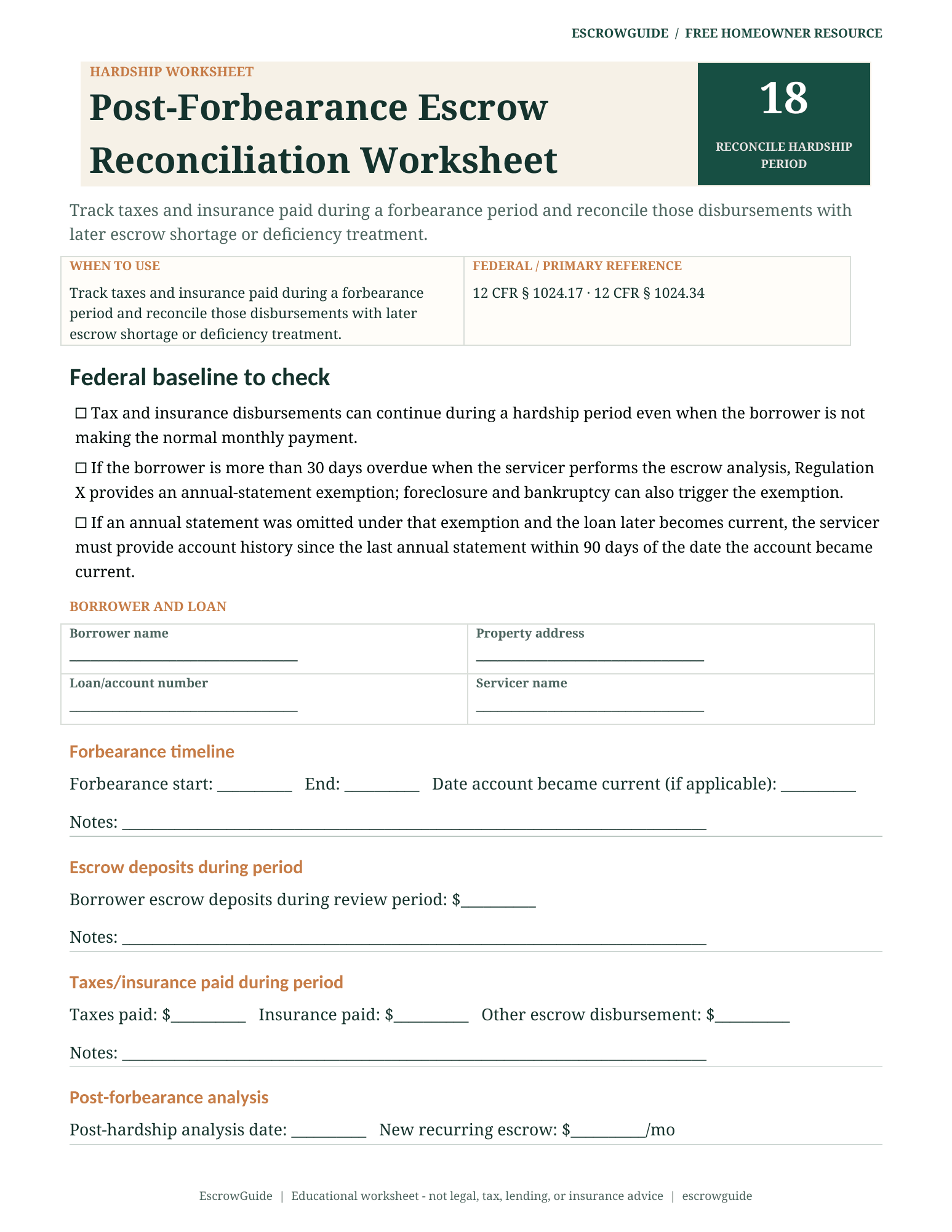
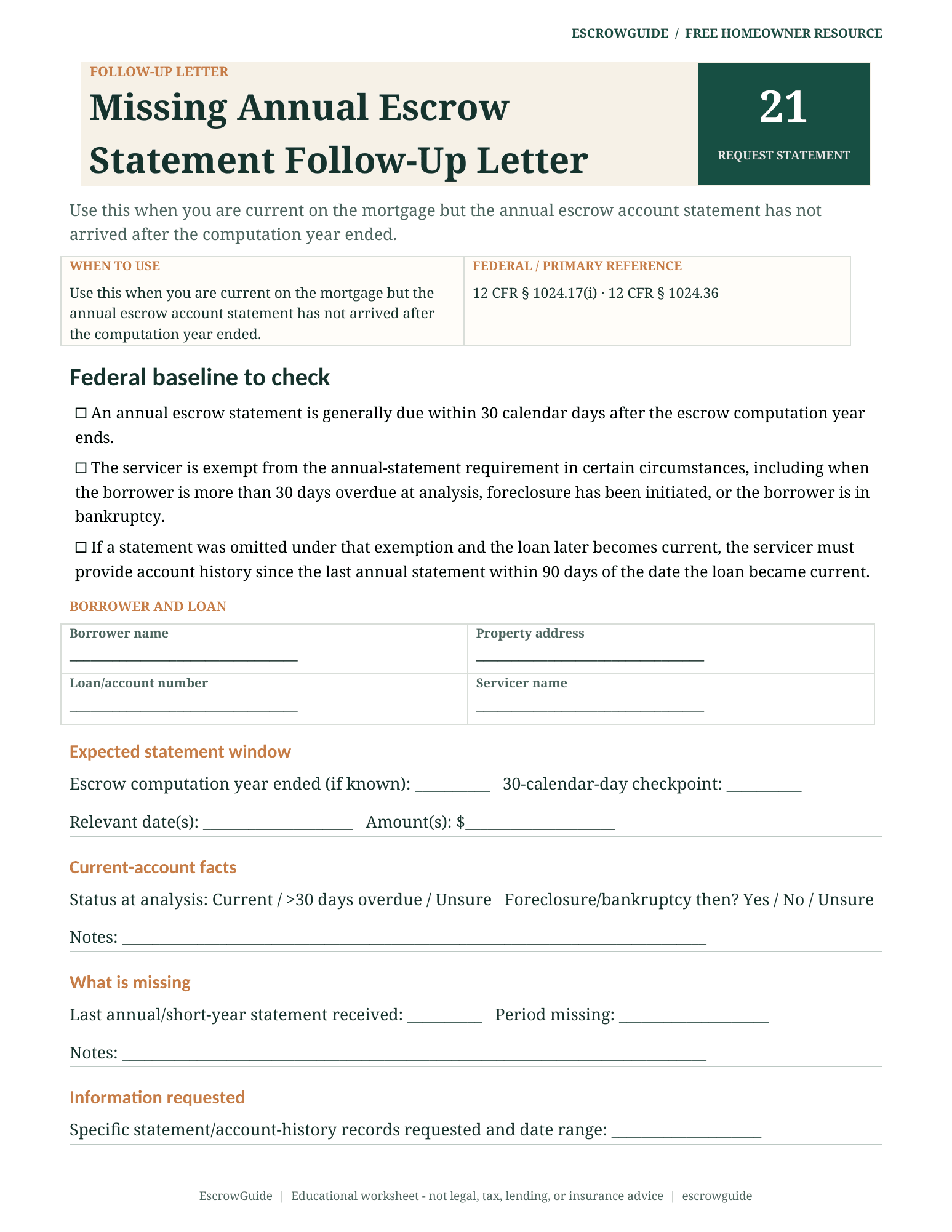
The absence of a normal annual escrow statement during a serious delinquency can be permitted by Regulation X. The annual-statement exception applies while the borrower is more than 30 days overdue and also in specified foreclosure or bankruptcy circumstances. The exception does not erase the escrow ledger or authorize inaccurate tax and insurance posting; it changes the timing of the annual statement.
An annual escrow statement combines history and forecast: past deposits and disbursements explain the current position, while projected bills explain the next periodic deposit. This turns a surprising payment into a set of smaller questions that can each be verified.
Reconstruct the timeline before judging the total
This distinction matters because the remedy depends on the problem. If the only issue is the missing annual statement during a qualifying delinquency, the exception may explain it. If the ledger contains a duplicate insurance payment or a tax penalty, that is a different servicing issue and should be documented on its own facts.
Rule first, statement second
Regulation X § 1024.17(i)(2) says the servicer need not provide the annual escrow account statement if the borrower is more than 30 days overdue, the loan is in foreclosure, or the borrower is in bankruptcy. When the borrower later becomes current, the servicer must provide an escrow history covering the period since the last annual statement within 90 days. Other servicing obligations can continue during the same period.
Scope is part of the diagnosis. A cited federal provision may control timing or escrow treatment while another source controls whether the charge itself is due, how large it is, or whether a loan-specific option exists. Investor-specific guidance should be labeled as such rather than presented as a universal borrower right. A page-specific cross-check is to confirm how many days overdue the mortgage was on the normal annual-analysis date.
Put actual numbers beside the rule
A borrower's normal annual analysis date is February 1, but the mortgage is 75 days delinquent then. No annual statement arrives in February. The borrower cures the delinquency on May 10. The relevant compliance question is no longer simply 'Where was the February statement?' It becomes whether the required post-current escrow history arrives within the rule's 90-day window and whether that history accurately records the intervening tax and insurance activity.
Treat the sample as a unit test for the explanation. The real account passes only when its own bills, ledger entries and statement components produce the total the servicer is collecting. A page-specific cross-check is to keep the last annual escrow statement received before the delinquency.
Audit the account
Collect the smallest set of records that can prove or disprove the explanation: the relevant escrow analysis, nearby mortgage statements and the outside document tied to the change. Add transfer, payoff, hardship or correction records only when the timeline requires them. A page-specific cross-check is to track tax and insurance bills even when the annual statement is not being sent.
- Confirm how many days overdue the mortgage was on the normal annual-analysis date.
- Keep the last annual escrow statement received before the delinquency.
- Track tax and insurance bills even when the annual statement is not being sent.
- After the mortgage becomes current, calendar the 90-day period for the account history described in § 1024.17(i)(2).
- Review that history for missing deposits, duplicate disbursements or unexplained advances.
Each checked item should end with a citation to a statement page, bill or transaction. If one step has no source record, that unsupported step becomes the next research target. For this issue, also rule out assuming no annual statement means the servicer no longer has to maintain the escrow account.
One more reconciliation before you decide
Test causation in chronological order. First identify the outside event or account entry, then the servicer's response, then the monthly-payment effect. Reversing that order—starting from the payment and guessing backward—makes unrelated events look connected and encourages conclusions the records may not support. A page-specific cross-check is to after the mortgage becomes current, calendar the 90-day period for the account history described in § 1024.17(i)(2).
Preserve the original document set even after the problem appears resolved. Escrow changes can affect later analyses, and a future shortage or transfer question is easier to diagnose when the prior correction, refund or recalculation can be traced to its source. For this issue, also rule out assuming the exception automatically excuses a late tax or insurance payment.
When the evidence points outside the servicer, follow it. A tax assessment question belongs with the taxing authority, a policy-premium question with the insurer, and an investor-specific eligibility question with the applicable program material. The servicer can explain how it used those inputs without necessarily controlling them. A page-specific cross-check is to review that history for missing deposits, duplicate disbursements or unexplained advances.
Mistakes that distort the diagnosis
- Assuming no annual statement means the servicer no longer has to maintain the escrow account.
- Assuming the exception automatically excuses a late tax or insurance payment.
- Counting from the old annual-analysis date instead of the date the account became current when checking the post-current history.
- Treating a bankruptcy or foreclosure fact pattern as identical without reviewing the applicable servicing context.
Do not let a surprising outcome substitute for evidence. A servicing error is easier to support when one dated entry is duplicated, missing, sent to the wrong payee or inconsistent with an official bill. A page-specific cross-check is to confirm how many days overdue the mortgage was on the normal annual-analysis date.
When a written servicing request makes sense
Before using a formal error process, make sure the allegation is operational: wrong amount, wrong date, missing transfer, duplicate disbursement, or unavailable calculation. That gives the servicer something testable to investigate. A page-specific cross-check is to keep the last annual escrow statement received before the delinquency.
Servicing research is different from personalized advice. Use the evidence to ask a precise question, while treating payment, legal and tax decisions as fact-specific matters beyond this general explanation. For this issue, also rule out counting from the old annual-analysis date instead of the date the account became current when checking the post-current history.
What to save after the issue is explained
For a payment change with both temporary and recurring layers, calendar when the temporary layer is expected to end. The payment after that date should still reflect whatever ongoing escrow, insurance or other recurring amounts remain. This makes the later statement a useful confirmation of the original analysis. A page-specific cross-check is to track tax and insurance bills even when the annual statement is not being sent.
Where the governing source is investor-specific, save the version or effective date of the published guidance. Program rules can change, and preserving the source that applied when the servicing action occurred is more reliable than relying on a later summary of the policy. For this issue, also rule out treating a bankruptcy or foreclosure fact pattern as identical without reviewing the applicable servicing context.