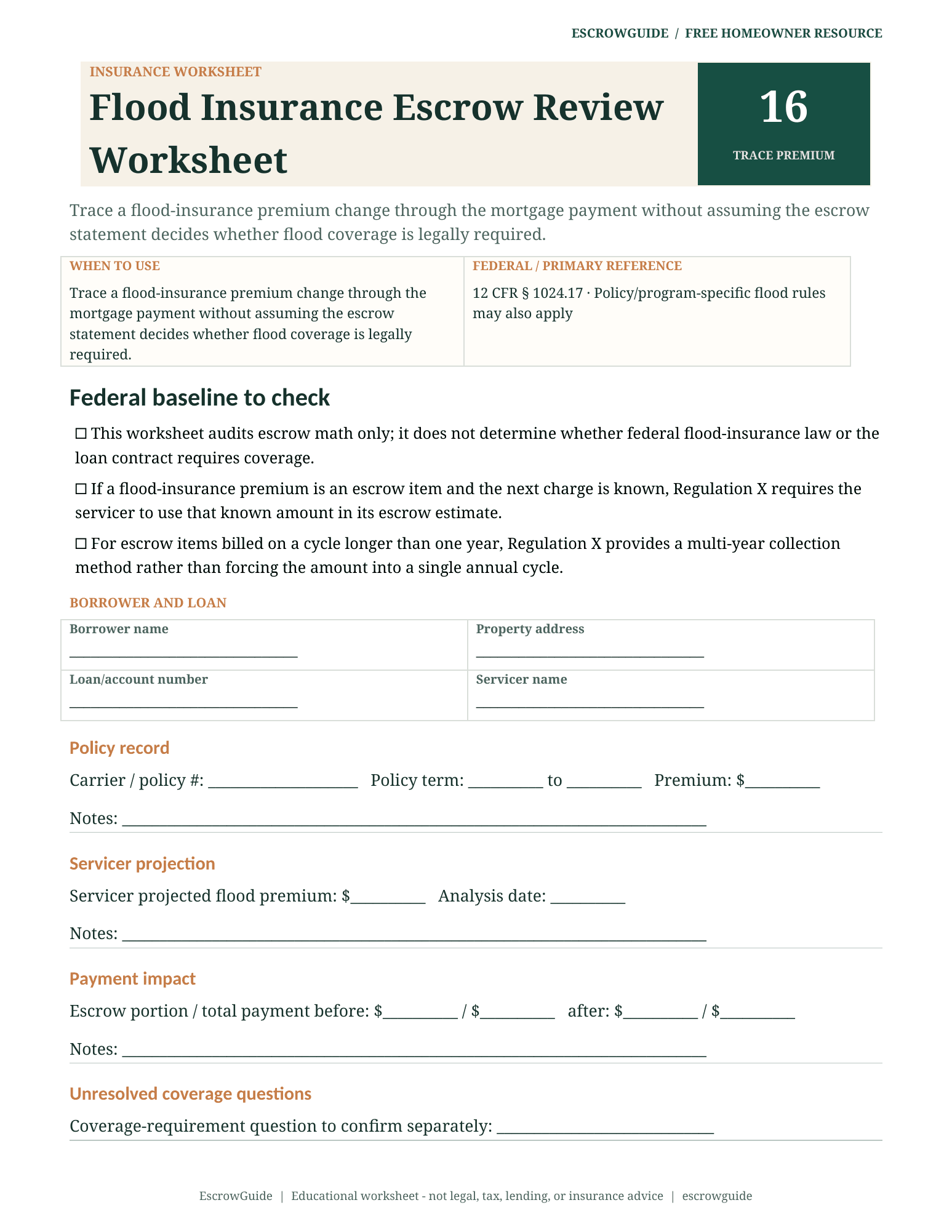
Flood insurance can appear as a separate escrowed charge on loans for which flood coverage is required or otherwise escrowed. A premium change affects the mortgage payment through the escrow component, not through the note interest rate. The useful comparison is therefore old flood premium versus new flood premium, followed by a check for any shortage created when the servicer paid more than it previously projected.
Insurance is an outside bill administered through the escrow account, so the policy record and the servicing ledger have to agree before the payment change is explained. Once the first mismatch is located, the rest of the analysis becomes a reconciliation rather than a guess.
The payment question to isolate first
Keep the scope narrow: EscrowGuide can explain how a flood premium reaches the monthly payment, but the legal or program-specific coverage requirement can depend on facts outside the escrow statement. Separating those questions produces a cleaner audit and avoids overreading Regulation X.
The rule boundary
Regulation X treats certain insurance premiums and other charges as escrow items and requires the annual escrow analysis to use known or properly estimated disbursements. Flood-insurance requirements can also arise under separate federal flood-insurance law and loan-program rules, so the reason coverage is required should be verified separately from the arithmetic used to collect the premium through escrow.
Scope is part of the diagnosis. A cited federal provision may control timing or escrow treatment while another source controls whether the charge itself is due, how large it is, or whether a loan-specific option exists. If the servicer uses a designated address for written notices, ordinary customer-service chat may not substitute for that process. A page-specific cross-check is to identify the flood policy separately from the standard homeowners policy; the two premiums should not be blended when you audit the statement.
Run the numbers
Suppose flood coverage rises from $960 to $1,560 a year. The annual difference is $600, or $50 per month on a simple annualized basis. If the servicer paid the $1,560 renewal while the prior escrow schedule had accumulated only $960 for that bill, the same $600 timing gap can contribute to a shortage. A statement could therefore show both a roughly $50 higher ongoing deposit and a temporary catch-up amount.
The point of the scenario is traceability. Each number has a source and a role; repeating that mapping with the actual account prevents a temporary catch-up amount from being confused with a permanent recurring cost. A page-specific cross-check is to compare policy number, coverage dates and annual premium with the escrow disbursement.
Build the document trail
Build a compact evidence packet that a second reader could follow without explanation. Include the statement that introduced the change, the prior comparison point, and the official record that should support the changed amount. A page-specific cross-check is to confirm whether the property or loan still requires the coverage and direct that question to the appropriate insurer, servicer or flood-determination process.
- Identify the flood policy separately from the standard homeowners policy; the two premiums should not be blended when you audit the statement.
- Compare policy number, coverage dates and annual premium with the escrow disbursement.
- Confirm whether the property or loan still requires the coverage and direct that question to the appropriate insurer, servicer or flood-determination process.
- Check whether a premium refund or policy rewrite was credited to escrow.
- Trace the next analysis to the currently known annual premium.
Write the supporting date and amount beside every completed check. That chronology can show whether an apparent balance gap is actually a bill paid near an analysis, transfer or reinstatement cutoff. For this issue, also rule out assuming standard homeowners insurance includes flood coverage.
Before treating the result as an error
Keep the outside cost and the servicing treatment in separate columns. A tax increase may be valid while its projected amount is entered incorrectly, or a correct premium may be paid twice. Separating cause from administration allows both possibilities to be tested without assuming one proves the other. A page-specific cross-check is to check whether a premium refund or policy rewrite was credited to escrow.
Preserve the original document set even after the problem appears resolved. Escrow changes can affect later analyses, and a future shortage or transfer question is easier to diagnose when the prior correction, refund or recalculation can be traced to its source. For this issue, also rule out treating the annual flood premium increase as if it changed principal and interest.
For a rule-based claim, preserve the exact official page or section used in the analysis. That makes future review easier if agency guidance, investor instructions or servicing procedures change and prevents a later summary from being mistaken for the authority that applied at the time. A page-specific cross-check is to trace the next analysis to the currently known annual premium.
What would count as a real mismatch
- Assuming standard homeowners insurance includes flood coverage.
- Treating the annual flood premium increase as if it changed principal and interest.
- Counting the same premium once under homeowners insurance and again under flood insurance.
- Using a general escrow explanation to decide whether flood coverage is legally required for a specific property.
A second common error is jumping across several years of statements. Reconcile one change at a time; otherwise a valid tax increase can mask an unrelated transfer or posting issue. A page-specific cross-check is to identify the flood policy separately from the standard homeowners policy; the two premiums should not be blended when you audit the statement.
Questions worth putting in writing
If a concrete difference survives ordinary customer service, state the dates and amounts in writing. Ask what record supports the servicer's figure and, for covered servicing issues, consider the Regulation X error-resolution or information-request process using the servicer's designated instructions. A page-specific cross-check is to compare policy number, coverage dates and annual premium with the escrow disbursement.
This reconciliation framework is educational. Mortgage terms, investor rules and account status may change the operational next step, so the article stops at explaining and documenting the servicing issue. For this issue, also rule out counting the same premium once under homeowners insurance and again under flood insurance.
One final transaction-history check
On the next statement, verify both the ledger and the payment. A correction can post as a credit before the required monthly amount is recalculated, while a valid new tax or insurance projection may remain in place after a temporary shortage layer disappears. Checking both avoids mistaking a partial fix for a complete one. A page-specific cross-check is to confirm whether the property or loan still requires the coverage and direct that question to the appropriate insurer, servicer or flood-determination process.
Treat a revised payment notice and an escrow transaction history as complementary records. The notice explains what the servicer plans to collect; the history shows what money actually moved. Both are needed when the question concerns whether a projection and an account balance tell the same story. For this issue, also rule out using a general escrow explanation to decide whether flood coverage is legally required for a specific property.