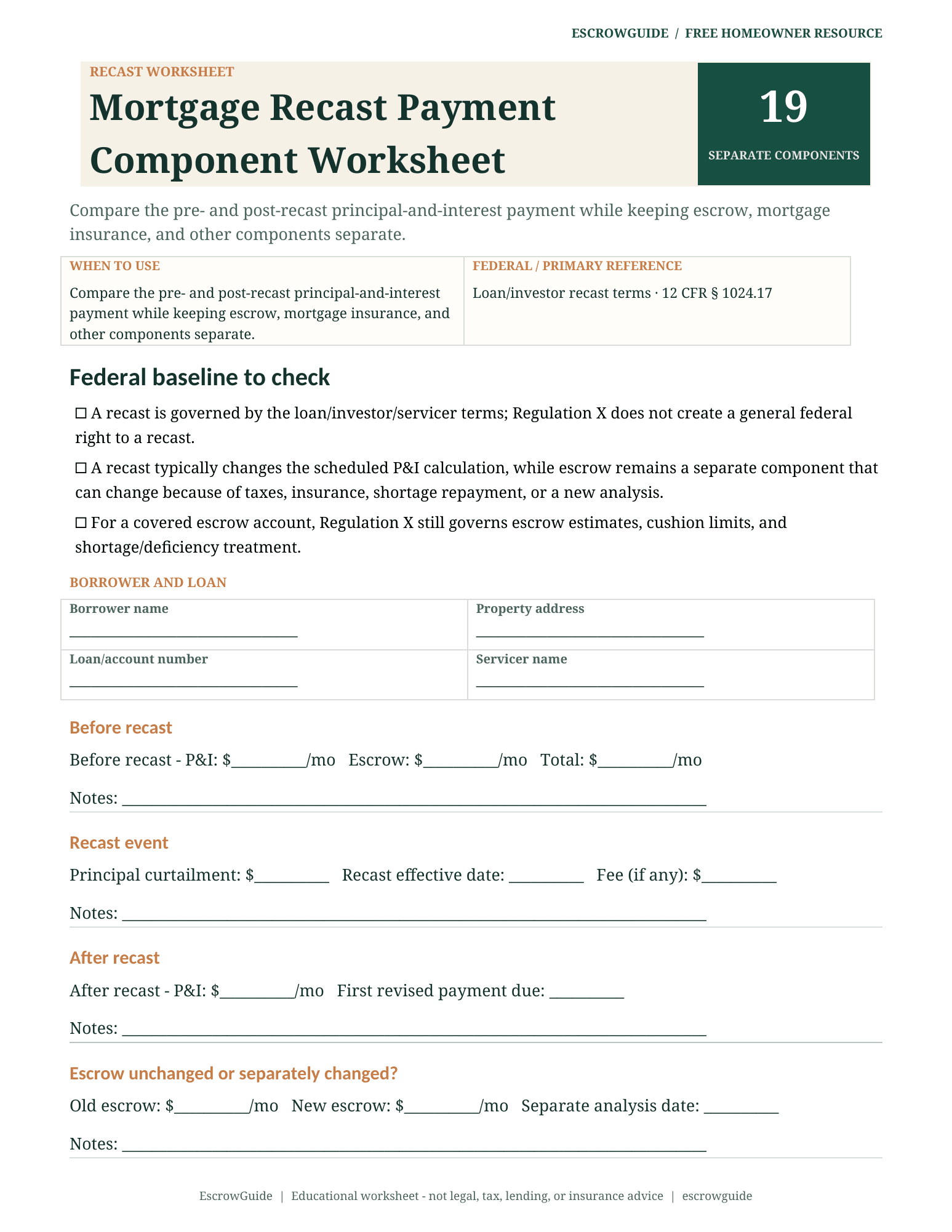
A mortgage recast, when permitted, generally recalculates scheduled principal and interest after a substantial principal reduction while keeping the existing loan rather than replacing it. Escrow is a separate collection for taxes, insurance and other items. That means the recast can lower P&I while the escrow amount stays flat—or even rises at the same time for unrelated reasons.
A recast changes scheduled principal and interest only when the loan or investor permits it; escrow remains a separate servicing calculation tied to outside bills. This turns a surprising payment into a set of smaller questions that can each be verified.
Start with the component that moved
Recast articles often become misleading when they report only the new total payment. For servicing analysis, the better record is two numbers: the verified P&I reduction created by the recast and any independent escrow change effective in the same billing cycle. That separation makes the explanation portable across servicers without pretending all recast policies are identical.
What the regulation controls — and what it does not
Freddie Mac's publicly available servicing guide gives one concrete investor example: its § 8103.3 permits a servicer, under stated conditions, to agree to recalculate monthly principal and interest after a principal curtailment without extending the maturity and while keeping the note rate unchanged. That is an investor-specific rule, not a universal right to recast. Regulation X separately governs the covered escrow account.
A regulation and a mortgage statement answer different questions. The rule defines servicing duties; the statement shows what the servicer actually posted or projected. The tax authority, insurer or investor record may still control the underlying input. The strongest follow-up names the disputed transaction instead of asserting that the entire escrow account is incorrect. A page-specific cross-check is to obtain the recast or re-amortization confirmation and identify the new scheduled P&I amount.
Worked case
A payment before recast is $2,850: $2,180 P&I plus $670 escrow. After an approved recast, P&I falls to $1,930, a $250 reduction. At the same time, the annual escrow analysis raises ongoing escrow to $735 because taxes increased. The new total is $2,665. The borrower saves $185 per month overall, not $250, because a $65 escrow increase partially offsets the P&I reduction.
The example is a reconciliation method, not a forecast. Substituting the reader's dated figures should either reproduce the statement or isolate a smaller residual that can be investigated directly. A page-specific cross-check is to verify that the note rate and maturity treatment match the applicable loan or investor terms.
Create a before-and-after record
Prepare the file before contacting the servicer. Start with the current and prior analysis, recent statements and the tax or insurance evidence. A dated source beside each disputed amount is more useful than a thick folder of unrelated paperwork. A page-specific cross-check is to compare the escrow deposit on the statement immediately before and after the recast.
- Obtain the recast or re-amortization confirmation and identify the new scheduled P&I amount.
- Verify that the note rate and maturity treatment match the applicable loan or investor terms.
- Compare the escrow deposit on the statement immediately before and after the recast.
- If escrow changed, trace that change to a separate analysis, tax bill, insurance bill or correction.
- Use the total-payment difference only after the component-level differences are understood.
Turn the checklist into a short timeline. The order of collection, disbursement, analysis and notice dates often explains a balance that looks wrong when only month-end totals are compared. For this issue, also rule out assuming every mortgage can be recast on request.
Make the conclusion reproducible
Separate the answer into a historical question and a forward-looking question. The historical side asks whether prior collections and disbursements produced the displayed balance; the forward side asks whether the next projected bills justify the new periodic amount. A page can reconcile on one side and still contain a problem on the other. A page-specific cross-check is to if escrow changed, trace that change to a separate analysis, tax bill, insurance bill or correction.
Keep investor or servicer examples in their lane. A published procedure can illustrate how one program handles an issue without proving that every mortgage must be handled identically. The universal part of the explanation should come from the rule that actually has universal scope. For this issue, also rule out treating a recast as a refinance.
For a rule-based claim, preserve the exact official page or section used in the analysis. That makes future review easier if agency guidance, investor instructions or servicing procedures change and prevents a later summary from being mistaken for the authority that applied at the time. A page-specific cross-check is to use the total-payment difference only after the component-level differences are understood.
Red flags versus normal changes
- Assuming every mortgage can be recast on request.
- Treating a recast as a refinance.
- Attributing an escrow increase to the principal curtailment without evidence.
- Quoting an investor guide as if it controlled every lender, servicer or loan program.
A second common error is jumping across several years of statements. Reconcile one change at a time; otherwise a valid tax increase can mask an unrelated transfer or posting issue. A page-specific cross-check is to obtain the recast or re-amortization confirmation and identify the new scheduled P&I amount.
Escalation with specific facts
A servicing request is most useful after the audit has reduced the problem to one or two disputed entries. Follow any designated address requirement and preserve the complete submission and proof that it was delivered. A page-specific cross-check is to verify that the note rate and maturity treatment match the applicable loan or investor terms.
Do not infer that sending a request changes the amount contractually due. The purpose here is to document and investigate servicing, not to give individualized legal or payment advice. For this issue, also rule out attributing an escrow increase to the principal curtailment without evidence.
Verify the next visible account change
Save any corrected analysis as a new version instead of replacing the original. Differences between the two documents can show exactly which input or balance changed and can be important if a later statement appears to revert to the earlier, incorrect figure. A page-specific cross-check is to compare the escrow deposit on the statement immediately before and after the recast.
If the issue involves more than one servicer or insurer, name each institution in the timeline. Transfers and policy rewrites can create overlapping dates, and an unnamed 'they paid it' note is difficult to reconcile months later when the account is reviewed again. For this issue, also rule out quoting an investor guide as if it controlled every lender, servicer or loan program.