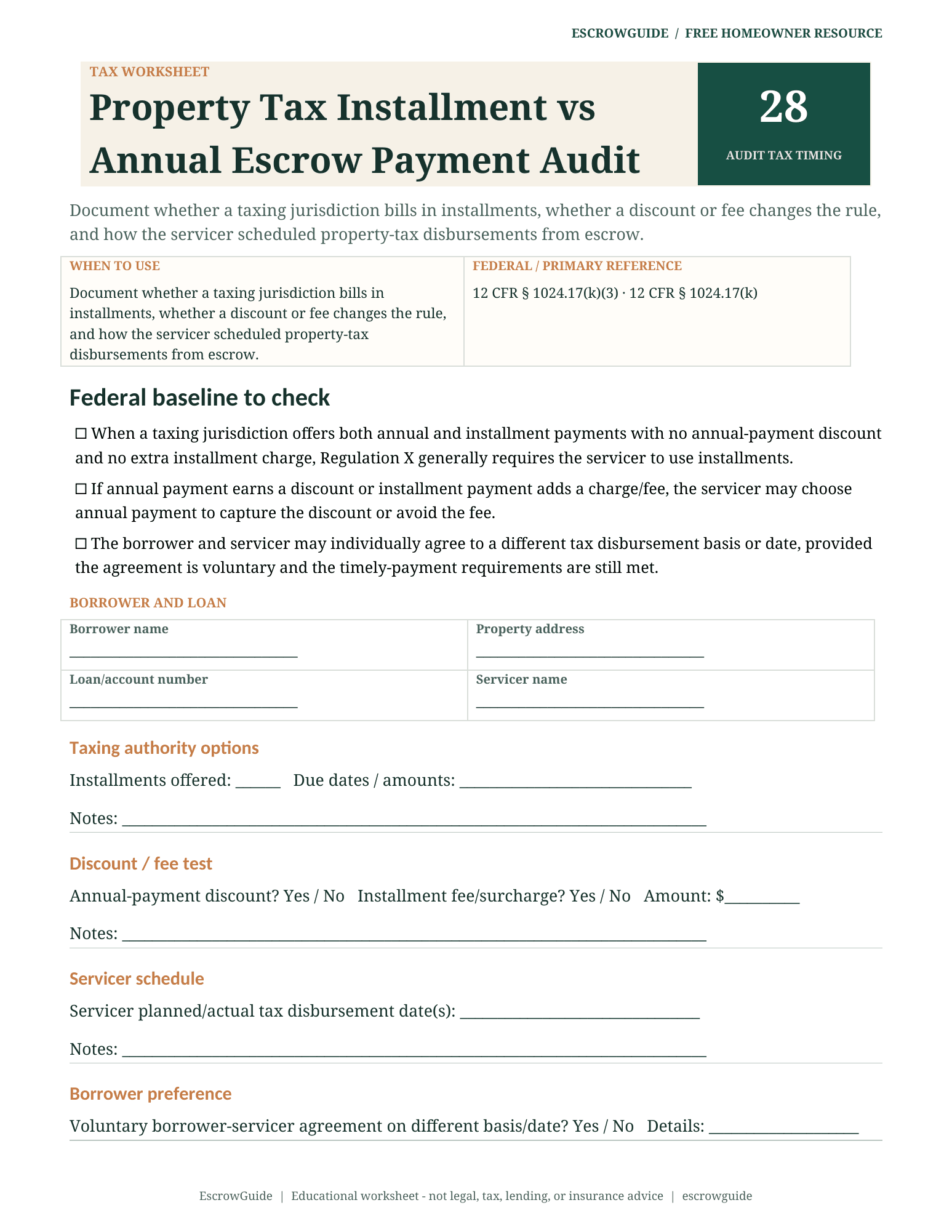
If the taxing jurisdiction offers both annual and installment payment and there is no annual-payment discount and no extra fee for installments, § 1024.17(k)(3) says the servicer must pay on an installment basis. If annual payment earns a discount or installments carry an added fee, the servicer may choose annual payment. A borrower and servicer may also voluntarily agree case-by-case to a different basis or payment date if the timely-payment rules are still met.
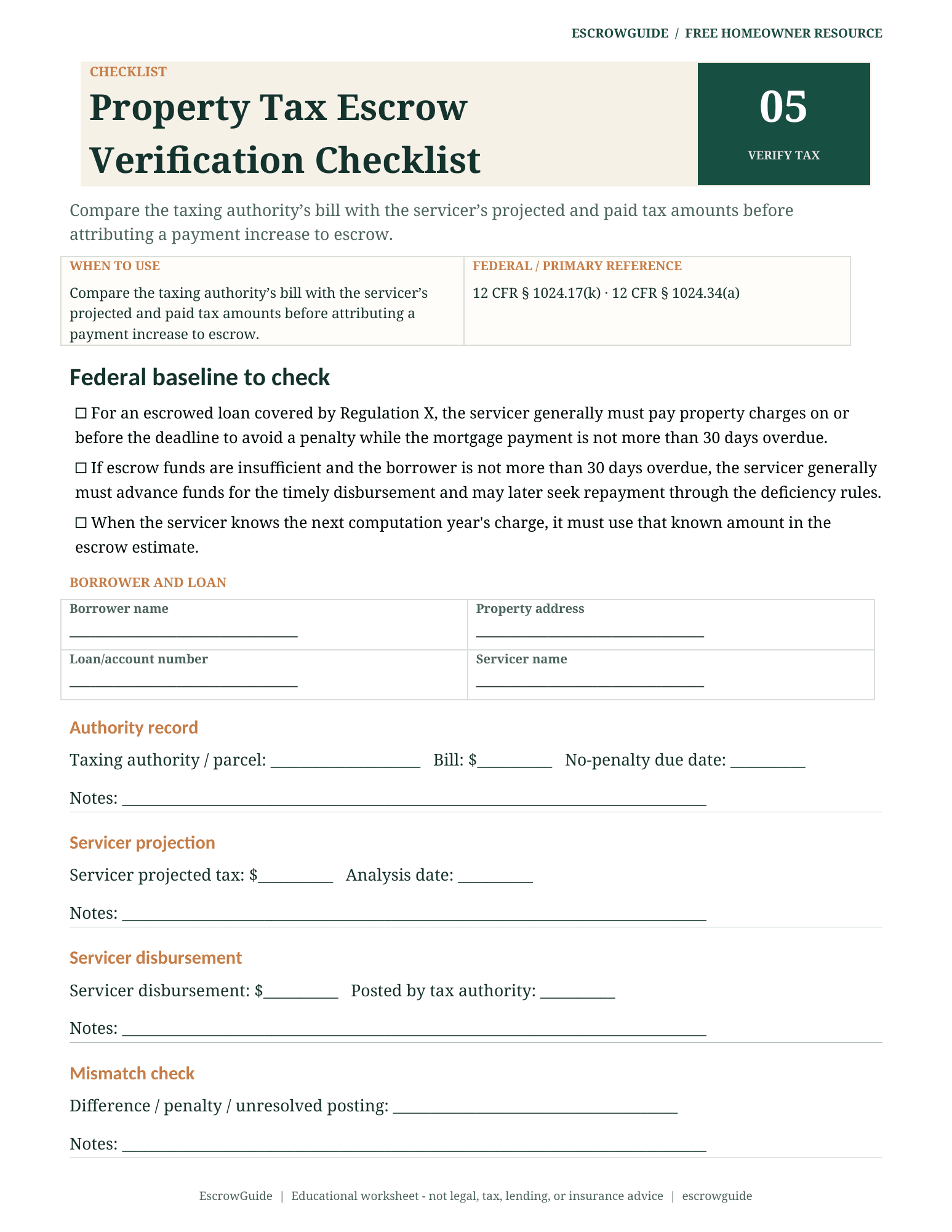
The first evidence should come from the tax authority, not from a generic escrow FAQ. Confirm whether the jurisdiction truly offers a choice, whether installments add a fee, and whether annual or early payment produces a discount. Those facts determine which branch of the federal rule applies.
Verify the taxing authority offers annual and installment options
Annual versus installment payment changes the timing of the trial running balance even when the total tax is identical. A January lump-sum disbursement can produce a lower early-year balance than two later installments, which may affect the monthly deposit needed to keep the account at its permitted target.
Long-tail question: should mortgage escrow pay property taxes annually or in installments. The borrower preference is relevant but not absolute. CFPB says it encourages servicers to follow a known borrower preference, but § 1024.17(k)(3) itself does not require that preference. The separate case-by-case agreement provision is the clearer route for a different basis or date.
The rule that controls check for an annual-payment or early-payment discount
Section 1024.17(k)(3) is narrower than a general preference for monthly budgeting. It addresses the servicer’s disbursement basis when the tax authority itself offers a choice. The rule favors installments when they cost the same as annual payment, while allowing annual payment to capture a discount or avoid an installment fee. Section 1024.17(k)(4) permits a different individualized arrangement only when the borrower voluntarily agrees and timely payment requirements remain satisfied.
A voluntary agreement under paragraph (k)(4) must actually be voluntary. Loan approval or a term of the loan may not be conditioned on agreeing to a different tax-disbursement basis or date. The agreement also cannot authorize a late payment that violates the timely-payment requirements.
Worked example: Check for any added installment charge or fee
A county offers two equal installments with no surcharge, and paying the full tax bill in January provides no discount. The servicer’s default should be the installment basis under § 1024.17(k)(3). In a different county, a 2% discount applies only if the full annual bill is paid early. The servicer may choose the annual payment to capture that discount. In either scenario, the escrow analysis should project disbursement dates that match the chosen basis.
If the tax authority changes its schedule from annual to semiannual or quarterly billing, the escrow analysis needs the new disbursement calendar. A shortage caused solely by timing can look like a tax-rate increase unless the borrower compares both annual totals and due dates.
Account audit from Verify the taxing authority offers annual and installment options to Rebuild the trial balance using the correct disbursement dates
Verify the taxing authority offers annual and installment options
The first evidence should come from the tax authority, not from a generic escrow FAQ. Confirm whether the jurisdiction truly offers a choice, whether installments add a fee, and whether annual or early payment produces a discount. Those facts determine which branch of the federal rule applies. Evidence target: Verify the taxing authority offers annual and installment options. Next comparison: Check for an annual-payment or early-payment discount. Error to avoid: assuming installments are always mandatory.
Check for an annual-payment or early-payment discount
Annual versus installment payment changes the timing of the trial running balance even when the total tax is identical. A January lump-sum disbursement can produce a lower early-year balance than two later installments, which may affect the monthly deposit needed to keep the account at its permitted target. Evidence target: Check for an annual-payment or early-payment discount. Next comparison: Check for any added installment charge or fee. Error to avoid: assuming a borrower preference automatically controls.
Check for any added installment charge or fee
The borrower preference is relevant but not absolute. CFPB says it encourages servicers to follow a known borrower preference, but § 1024.17(k)(3) itself does not require that preference. The separate case-by-case agreement provision is the clearer route for a different basis or date. Evidence target: Check for any added installment charge or fee. Next comparison: Identify the servicer’s projected disbursement basis. Error to avoid: ignoring an annual-payment discount or installment fee.
Identify the servicer’s projected disbursement basis
A voluntary agreement under paragraph (k)(4) must actually be voluntary. Loan approval or a term of the loan may not be conditioned on agreeing to a different tax-disbursement basis or date. The agreement also cannot authorize a late payment that violates the timely-payment requirements. Evidence target: Identify the servicer’s projected disbursement basis. Next comparison: Compare projected dates with the actual tax calendar. Error to avoid: comparing only total annual tax and missing the timing effect.
Compare projected dates with the actual tax calendar
If the tax authority changes its schedule from annual to semiannual or quarterly billing, the escrow analysis needs the new disbursement calendar. A shortage caused solely by timing can look like a tax-rate increase unless the borrower compares both annual totals and due dates. Evidence target: Compare projected dates with the actual tax calendar. Next comparison: Look for a borrower-servicer voluntary agreement. Error to avoid: agreeing to a different date without checking the penalty deadline.
Look for a borrower-servicer voluntary agreement
For disputes, state the narrow mismatch: for example, “the county offered two no-fee installments, but the analysis projects one annual disbursement on a date the county does not require.” That is more useful than saying the escrow payment is simply too high. Evidence target: Look for a borrower-servicer voluntary agreement. Next comparison: Confirm the payment timing avoids penalties. Error to avoid: assuming installments are always mandatory.
Confirm the payment timing avoids penalties
The first evidence should come from the tax authority, not from a generic escrow FAQ. Confirm whether the jurisdiction truly offers a choice, whether installments add a fee, and whether annual or early payment produces a discount. Those facts determine which branch of the federal rule applies. Evidence target: Confirm the payment timing avoids penalties. Next comparison: Rebuild the trial balance using the correct disbursement dates. Error to avoid: assuming a borrower preference automatically controls.
Rebuild the trial balance using the correct disbursement dates
Annual versus installment payment changes the timing of the trial running balance even when the total tax is identical. A January lump-sum disbursement can produce a lower early-year balance than two later installments, which may affect the monthly deposit needed to keep the account at its permitted target. Evidence target: Rebuild the trial balance using the correct disbursement dates. Next comparison: Verify the taxing authority offers annual and installment options. Error to avoid: ignoring an annual-payment discount or installment fee.
Evidence table for “should mortgage escrow pay property taxes annually or in installments”
| Step | What to verify | Failure mode |
|---|---|---|
| 1 | Verify the taxing authority offers annual and installment options | assuming installments are always mandatory |
| 2 | Check for an annual-payment or early-payment discount | assuming a borrower preference automatically controls |
| 3 | Check for any added installment charge or fee | ignoring an annual-payment discount or installment fee |
| 4 | Identify the servicer’s projected disbursement basis | comparing only total annual tax and missing the timing effect |
| 5 | Compare projected dates with the actual tax calendar | agreeing to a different date without checking the penalty deadline |
| 6 | Look for a borrower-servicer voluntary agreement | assuming installments are always mandatory |
| 7 | Confirm the payment timing avoids penalties | assuming a borrower preference automatically controls |
| 8 | Rebuild the trial balance using the correct disbursement dates | ignoring an annual-payment discount or installment fee |
What can change the answer
For disputes, state the narrow mismatch: for example, “the county offered two no-fee installments, but the analysis projects one annual disbursement on a date the county does not require.” That is more useful than saying the escrow payment is simply too high.
- assuming installments are always mandatory
- assuming a borrower preference automatically controls
- ignoring an annual-payment discount or installment fee
- comparing only total annual tax and missing the timing effect
- agreeing to a different date without checking the penalty deadline
Primary authority for this servicing question
- CFPB Regulation X — § 1024.17(k)(3)-(4) ↗
should mortgage escrow pay property taxes annually or in installments — use CFPB Regulation X — § 1024.17(k)(3)-(4) to verify the federal or investor rule described above; use the borrower’s own statements, bills and transaction history for loan-level facts.
- eCFR — 12 CFR § 1024.17(k) ↗
should mortgage escrow pay property taxes annually or in installments — use eCFR — 12 CFR § 1024.17(k) to verify the federal or investor rule described above; use the borrower’s own statements, bills and transaction history for loan-level facts.
Scope: this guide explains mortgage-servicing mechanics for should mortgage escrow pay property taxes annually or in installments. It does not provide personalized legal, tax, insurance-coverage or loan-choice advice. Where local law, mortgage documents or investor rules matter, verify those authorities separately.