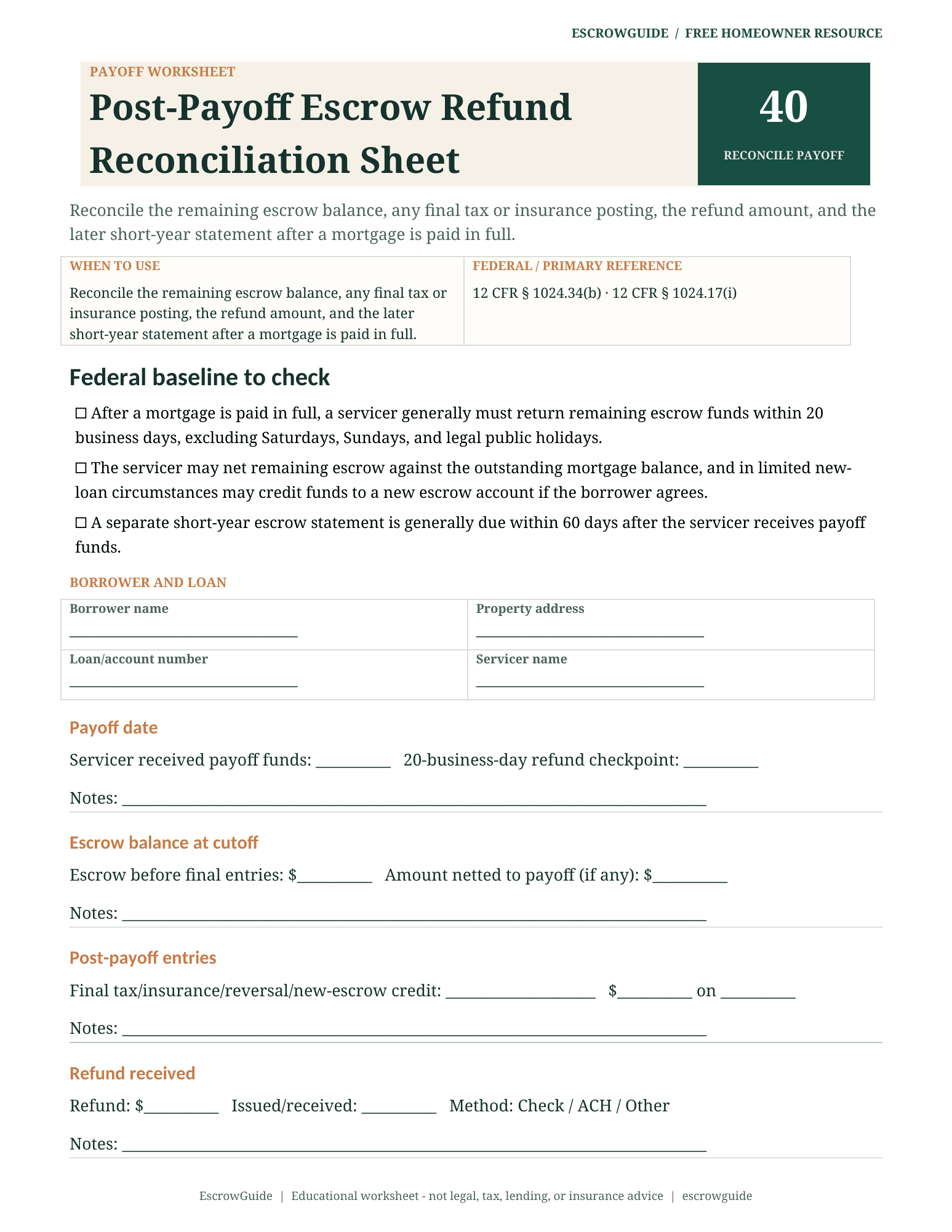
After payoff, two different escrow events can happen: the servicer generally must return remaining escrow funds within the payoff-refund timeline, and Regulation X also requires a short-year statement after payoff. The refund and the statement are related but they are not the same deadline.
The payoff date matters because the final escrow ledger can still contain disbursements or reversals around the payoff cutoff. For short year escrow statement after mortgage payoff, start with “Confirm when the servicer received payoff funds..”
Confirm when the servicer received payoff funds.: starting record
A payoff escrow refund is not the same as the $50 annual-analysis surplus rule. Evidence anchor: Record the escrow balance immediately before payoff.
The short-year statement can arrive after the refund because its deadline is longer. Timing anchor: List post-payoff escrow disbursements or reversals.
Rule boundary for short year escrow statement after mortgage payoff
12 CFR § 1024.17(i)(4)(iii) requires a short-year statement within 60 days after the servicer receives payoff funds. Separately, § 1024.34(b) generally requires remaining escrow funds within 20 days, excluding weekends and legal public holidays, after the mortgage is paid in full.
If funds are netted at payoff, compare the payoff statement with the escrow ledger before calling the refund short. Account test: Confirm when the servicer received payoff funds. Then: Record the escrow balance immediately before payoff. The payment total alone cannot answer short year escrow statement after mortgage payoff; those two records must agree first.
Worked account example: List post-payoff escrow disbursements or reversals.
Illustrative payoff: the loan is paid in full on April 3 with $1,860 in escrow. A final insurance adjustment of $210 posts on April 7, leaving $1,650. A $1,650 refund and a later short-year statement can both be correct; the statement should explain the account history that produced the refund amount.
short year escrow statement after mortgage payoff: substitute borrower-specific figures for “Confirm when the servicer received payoff funds..” Next test “List post-payoff escrow disbursements or reversals..” Finish at “Use a written information request if the final ledger is missing..” Refinance transactions can look like payoff refunds but the new loan may involve a separate new escrow account. The figures show sequence only; they are not a forecast.
Six evidence tests for short year escrow statement after mortgage payoff
Confirm when the servicer received payoff funds.
Date-and-amount test: Confirm when the servicer received payoff funds.. A payoff escrow refund is not the same as the $50 annual-analysis surplus rule. For short year escrow statement after mortgage payoff, capture this evidence: Confirm when the servicer received payoff funds. Risk to flag: Using the annual surplus rule for payoff. Next cross-check: Record the escrow balance immediately before payoff.. If funds are netted at payoff, compare the payoff statement with the escrow ledger before calling the refund short.
Record the escrow balance immediately before payoff.
Reconciliation item: Record the escrow balance immediately before payoff.. The short-year statement can arrive after the refund because its deadline is longer. For short year escrow statement after mortgage payoff, capture this evidence: Record the escrow balance immediately before payoff. Risk to flag: Counting a post-payoff disbursement twice. Next cross-check: List post-payoff escrow disbursements or reversals.. Refinance transactions can look like payoff refunds but the new loan may involve a separate new escrow account.
List post-payoff escrow disbursements or reversals.
Source comparison: List post-payoff escrow disbursements or reversals.. If funds are netted at payoff, compare the payoff statement with the escrow ledger before calling the refund short. For short year escrow statement after mortgage payoff, capture this evidence: List post-payoff escrow disbursements or reversals. Risk to flag: Expecting the refund and short-year statement on the same day. Next cross-check: Match the refund amount to the final balance.. The cleanest audit starts with the exact payoff receipt date, not the date the closing occurred or the old monthly due date.
Match the refund amount to the final balance.
Final bridge: Match the refund amount to the final balance.. Refinance transactions can look like payoff refunds but the new loan may involve a separate new escrow account. For short year escrow statement after mortgage payoff, capture this evidence: Match the refund amount to the final balance. Risk to flag: Confusing a new refinance escrow deposit with the old loan’s refund. Next cross-check: Watch for the short-year statement within its separate timeline.. The payoff date matters because the final escrow ledger can still contain disbursements or reversals around the payoff cutoff.
Watch for the short-year statement within its separate timeline.
Date-and-amount test: Watch for the short-year statement within its separate timeline.. The cleanest audit starts with the exact payoff receipt date, not the date the closing occurred or the old monthly due date. For short year escrow statement after mortgage payoff, capture this evidence: Watch for the short-year statement within its separate timeline. Risk to flag: Using the annual surplus rule for payoff. Next cross-check: Use a written information request if the final ledger is missing.. A payoff escrow refund is not the same as the $50 annual-analysis surplus rule.
Use a written information request if the final ledger is missing.
Reconciliation item: Use a written information request if the final ledger is missing.. The payoff date matters because the final escrow ledger can still contain disbursements or reversals around the payoff cutoff. For short year escrow statement after mortgage payoff, capture this evidence: Use a written information request if the final ledger is missing. Risk to flag: Counting a post-payoff disbursement twice. Next cross-check: Confirm when the servicer received payoff funds.. The short-year statement can arrive after the refund because its deadline is longer.
| Step | short year escrow statement after mortgage payoff evidence | Expected finding | Risk |
|---|---|---|---|
| 1 | Confirm when the servicer received payoff funds. | The payoff date matters because the final escrow ledger can still contain disbursements or reversals around the payoff cutoff. | Using the annual surplus rule for payoff |
| 2 | Record the escrow balance immediately before payoff. | A payoff escrow refund is not the same as the $50 annual-analysis surplus rule. | Counting a post-payoff disbursement twice |
| 3 | List post-payoff escrow disbursements or reversals. | The short-year statement can arrive after the refund because its deadline is longer. | Expecting the refund and short-year statement on the same day |
| 4 | Match the refund amount to the final balance. | If funds are netted at payoff, compare the payoff statement with the escrow ledger before calling the refund short. | Confusing a new refinance escrow deposit with the old loan’s refund |
| 5 | Watch for the short-year statement within its separate timeline. | Refinance transactions can look like payoff refunds but the new loan may involve a separate new escrow account. | Using the annual surplus rule for payoff |
| 6 | Use a written information request if the final ledger is missing. | The cleanest audit starts with the exact payoff receipt date, not the date the closing occurred or the old monthly due date. | Counting a post-payoff disbursement twice |
Watch for the short-year statement within its separate timeline.: interpretation
Refinance transactions can look like payoff refunds but the new loan may involve a separate new escrow account. Reconcile: Match the refund amount to the final balance.
The cleanest audit starts with the exact payoff receipt date, not the date the closing occurred or the old monthly due date. Final evidence: Use a written information request if the final ledger is missing.
Confirm when the servicer received payoff funds. → Use a written information request if the final ledger is missing.: reconstruction
Bridge 1: Confirm when the servicer received payoff funds.
The short-year statement can arrive after the refund because its deadline is longer. Start record: Confirm when the servicer received payoff funds.. Next record: Record the escrow balance immediately before payoff.. short year escrow statement after mortgage payoff issue at this bridge: Counting a post-payoff disbursement twice. Account implication: The cleanest audit starts with the exact payoff receipt date, not the date the closing occurred or the old monthly due date.
Bridge 2: Record the escrow balance immediately before payoff.
If funds are netted at payoff, compare the payoff statement with the escrow ledger before calling the refund short. Start record: Record the escrow balance immediately before payoff.. Next record: List post-payoff escrow disbursements or reversals.. short year escrow statement after mortgage payoff issue at this bridge: Expecting the refund and short-year statement on the same day. Account implication: The payoff date matters because the final escrow ledger can still contain disbursements or reversals around the payoff cutoff.
Bridge 3: List post-payoff escrow disbursements or reversals.
Refinance transactions can look like payoff refunds but the new loan may involve a separate new escrow account. Start record: List post-payoff escrow disbursements or reversals.. Next record: Match the refund amount to the final balance.. short year escrow statement after mortgage payoff issue at this bridge: Confusing a new refinance escrow deposit with the old loan’s refund. Account implication: A payoff escrow refund is not the same as the $50 annual-analysis surplus rule.
Bridge 4: Match the refund amount to the final balance.
The cleanest audit starts with the exact payoff receipt date, not the date the closing occurred or the old monthly due date. Start record: Match the refund amount to the final balance.. Next record: Watch for the short-year statement within its separate timeline.. short year escrow statement after mortgage payoff issue at this bridge: Using the annual surplus rule for payoff. Account implication: The short-year statement can arrive after the refund because its deadline is longer.
Bridge 5: Watch for the short-year statement within its separate timeline.
The payoff date matters because the final escrow ledger can still contain disbursements or reversals around the payoff cutoff. Start record: Watch for the short-year statement within its separate timeline.. Next record: Use a written information request if the final ledger is missing.. short year escrow statement after mortgage payoff issue at this bridge: Counting a post-payoff disbursement twice. Account implication: If funds are netted at payoff, compare the payoff statement with the escrow ledger before calling the refund short.
Bridge 6: Use a written information request if the final ledger is missing.
A payoff escrow refund is not the same as the $50 annual-analysis surplus rule. Start record: Use a written information request if the final ledger is missing.. Next record: Confirm when the servicer received payoff funds.. short year escrow statement after mortgage payoff issue at this bridge: Expecting the refund and short-year statement on the same day. Account implication: Refinance transactions can look like payoff refunds but the new loan may involve a separate new escrow account.
short year escrow statement after mortgage payoff: final reconciliation checklist
- Confirm when the servicer received payoff funds. — The short-year statement can arrive after the refund because its deadline is longer.
- Record the escrow balance immediately before payoff. — If funds are netted at payoff, compare the payoff statement with the escrow ledger before calling the refund short.
- List post-payoff escrow disbursements or reversals. — Refinance transactions can look like payoff refunds but the new loan may involve a separate new escrow account.
- Match the refund amount to the final balance. — The cleanest audit starts with the exact payoff receipt date, not the date the closing occurred or the old monthly due date.
- Watch for the short-year statement within its separate timeline. — The payoff date matters because the final escrow ledger can still contain disbursements or reversals around the payoff cutoff.
- Use a written information request if the final ledger is missing. — A payoff escrow refund is not the same as the $50 annual-analysis surplus rule.
Primary sources for short year escrow statement after mortgage payoff
- CFPB Regulation X — 12 CFR § 1024.17 (Escrow Accounts) ↗
short year escrow statement after mortgage payoff — rule focus: escrow analysis, statements, cushion limits, shortage/surplus treatment, and disbursement mechanics. Borrower-file cross-check: Confirm when the servicer received payoff funds..
- CFPB Regulation X — 12 CFR § 1024.34 (Timely Escrow Payments and Balances) ↗
short year escrow statement after mortgage payoff — rule focus: timely escrow disbursements and payoff escrow balances. Borrower-file cross-check: Record the escrow balance immediately before payoff..
- CFPB Mortgage Servicing FAQs ↗
short year escrow statement after mortgage payoff — rule focus: CFPB escrow and mortgage-servicing explanations. Borrower-file cross-check: List post-payoff escrow disbursements or reversals..
Scope for short year escrow statement after mortgage payoff: mortgage-servicing mechanics. First verify “Confirm when the servicer received payoff funds..” Last verify “Use a written information request if the final ledger is missing..” Example dollars are illustrative. Tax law, insurance coverage, bankruptcy, probate, and investor eligibility can require separate authority.