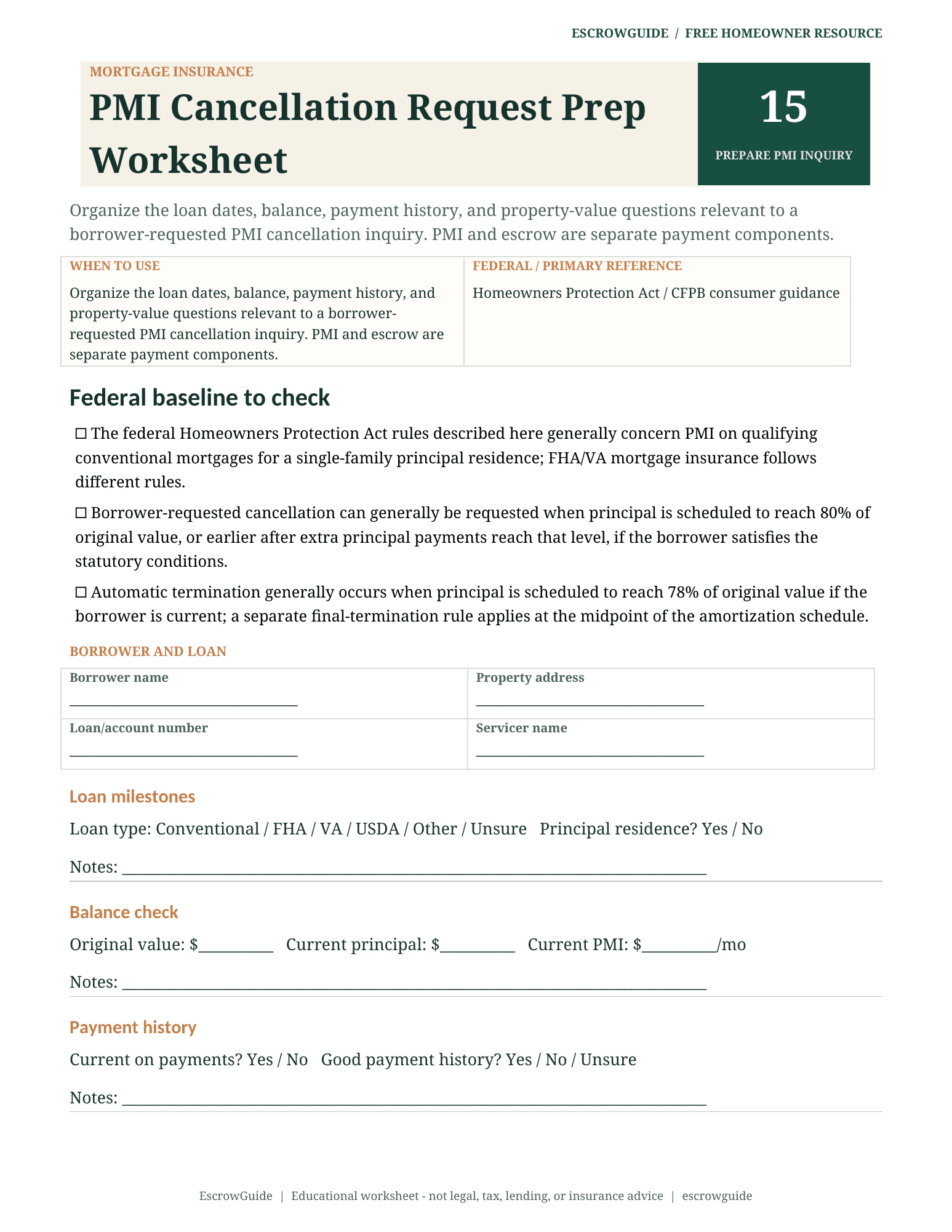
Private mortgage insurance and escrow can both appear inside one monthly mortgage payment, but they are not the same account. When PMI is cancelled, the PMI charge can disappear while the escrow deposit for property taxes and homeowners insurance stays exactly where it was. The total payment should be checked by components rather than by looking for a change in the escrow balance.
Mortgage insurance is a distinct payment component from tax-and-insurance escrow, even when both appear in the same all-in monthly amount. The useful result is an evidence trail, not merely a second estimate of the monthly total.
Read the account in the right order
A one-page before-and-after table is usually enough: P&I, PMI, escrow, other fees, total. That table also makes simultaneous changes visible. If PMI falls by $145 but escrow rises by $60, the net payment decline is $85—not $145—and neither number by itself indicates an error.
Where federal servicing rules fit
CFPB guidance on the Homeowners Protection Act explains the general framework for borrower-requested PMI cancellation around 80% of the home's original value and automatic termination around the scheduled 78% point when applicable conditions are met. Separate CFPB payment guidance explains that a total mortgage payment can include principal and interest, mortgage insurance and escrow. Removing one component does not mechanically recalculate the others.
Federal servicing rules are the baseline, not the source of every dollar on the statement. Taxes, premiums and program-specific terms can originate elsewhere, so each input needs the authority that actually controls it. The strongest follow-up names the disputed transaction instead of asserting that the entire escrow account is incorrect. A page-specific cross-check is to locate PMI as its own line item on statements before cancellation.
A concrete scenario
Before PMI cancellation, a monthly statement shows $1,720 principal and interest, $145 PMI and $610 escrow, for a $2,475 total. If PMI is removed and no other component changes, the new total is $2,330. The escrow deposit remains $610 and the escrow balance should not drop by $145. If an escrow analysis later raises taxes by $40 per month, the total can become $2,370 even though PMI is gone.
Treat the sample as a unit test for the explanation. The real account passes only when its own bills, ledger entries and statement components produce the total the servicer is collecting. A page-specific cross-check is to confirm the effective date of cancellation or automatic termination under the applicable loan terms and law.
Reconcile the evidence
Use records that are independent where possible. A servicer's own statement can be checked against a tax collector, insurer or prior servicer record, which reduces the risk of treating one repeated internal number as confirmation. A page-specific cross-check is to compare the first statement after cancellation with the prior statement line by line.
- Locate PMI as its own line item on statements before cancellation.
- Confirm the effective date of cancellation or automatic termination under the applicable loan terms and law.
- Compare the first statement after cancellation with the prior statement line by line.
- Do not expect the escrow balance to receive prior PMI charges unless your statement specifically treated them as an escrow item.
- If the total payment does not fall by the expected amount, check for a simultaneous escrow, fee or principal-and-interest change.
Turn the checklist into a short timeline. The order of collection, disbursement, analysis and notice dates often explains a balance that looks wrong when only month-end totals are compared. For this issue, also rule out calling every insurance charge in the mortgage payment 'escrow insurance'.
Finish with a timeline check
Distinguish the amount that is expected to persist from any amount designed to catch up a past imbalance. Recurring tax, insurance or mortgage-insurance costs belong in the first bucket. Shortage or deficiency treatment belongs in the second. Labeling those buckets makes the likely duration of a payment change easier to understand. A page-specific cross-check is to do not expect the escrow balance to receive prior PMI charges unless your statement specifically treated them as an escrow item.
If several explanations remain possible, list them rather than choosing the most alarming one. A projection update, posting lag, transfer cutoff and true outside-cost increase can produce similar symptoms. The next document request should be aimed at eliminating possibilities one at a time. For this issue, also rule out expecting PMI cancellation to lower property taxes or homeowners premiums.
A good worksheet also records what the article cannot determine from the statement alone. Loan-program eligibility, local tax liability, insurance coverage disputes and individualized legal consequences may require a different source. Marking that boundary keeps the escrow audit focused on facts the servicing records can actually prove. A page-specific cross-check is to if the total payment does not fall by the expected amount, check for a simultaneous escrow, fee or principal-and-interest change.
Common false signals
- Calling every insurance charge in the mortgage payment 'escrow insurance'.
- Expecting PMI cancellation to lower property taxes or homeowners premiums.
- Applying conventional-loan PMI cancellation rules to FHA or VA mortgage insurance without checking the program.
- Assuming a smaller total payment means the escrow analysis changed.
The strongest red flags are transactional: an amount cannot be tied to a source, a transfer loses a balance, a disbursement appears twice, or an outside bill and the servicer's projection disagree on the same date. A page-specific cross-check is to locate PMI as its own line item on statements before cancellation.
If the ledger still does not tie
If the call center cannot reconcile the account, convert the timeline into a written question. Regulation X has procedures for certain servicing errors and information requests, but the submission should still be anchored to concrete account facts. A page-specific cross-check is to confirm the effective date of cancellation or automatic termination under the applicable loan terms and law.
Keep payment obligations and the dispute track separate unless the servicer or a qualified adviser provides loan-specific direction. Educational reconciliation is not a suspension of the mortgage contract. For this issue, also rule out applying conventional-loan PMI cancellation rules to FHA or VA mortgage insurance without checking the program.
Close the loop on the following statement
After any servicer explanation, write down what should visibly change and by when. That might be a refund, an opening-balance correction, removal of an insurance charge, a revised projected disbursement or a later monthly-payment adjustment. A promised outcome that never reaches the statement is a new, separately documentable fact. A page-specific cross-check is to compare the first statement after cancellation with the prior statement line by line.
If the issue involves more than one servicer or insurer, name each institution in the timeline. Transfers and policy rewrites can create overlapping dates, and an unnamed 'they paid it' note is difficult to reconcile months later when the account is reviewed again. For this issue, also rule out assuming a smaller total payment means the escrow analysis changed.